DI tank resin life is not a dependable calendar interval. For XERO’s current 0.5- and 1.0-cubic-foot tanks, however, the published capacity table can become a useful stock-planning estimate: divide the tank’s approximate gallon budget by the gallons you actually send through the DI vessel each month.
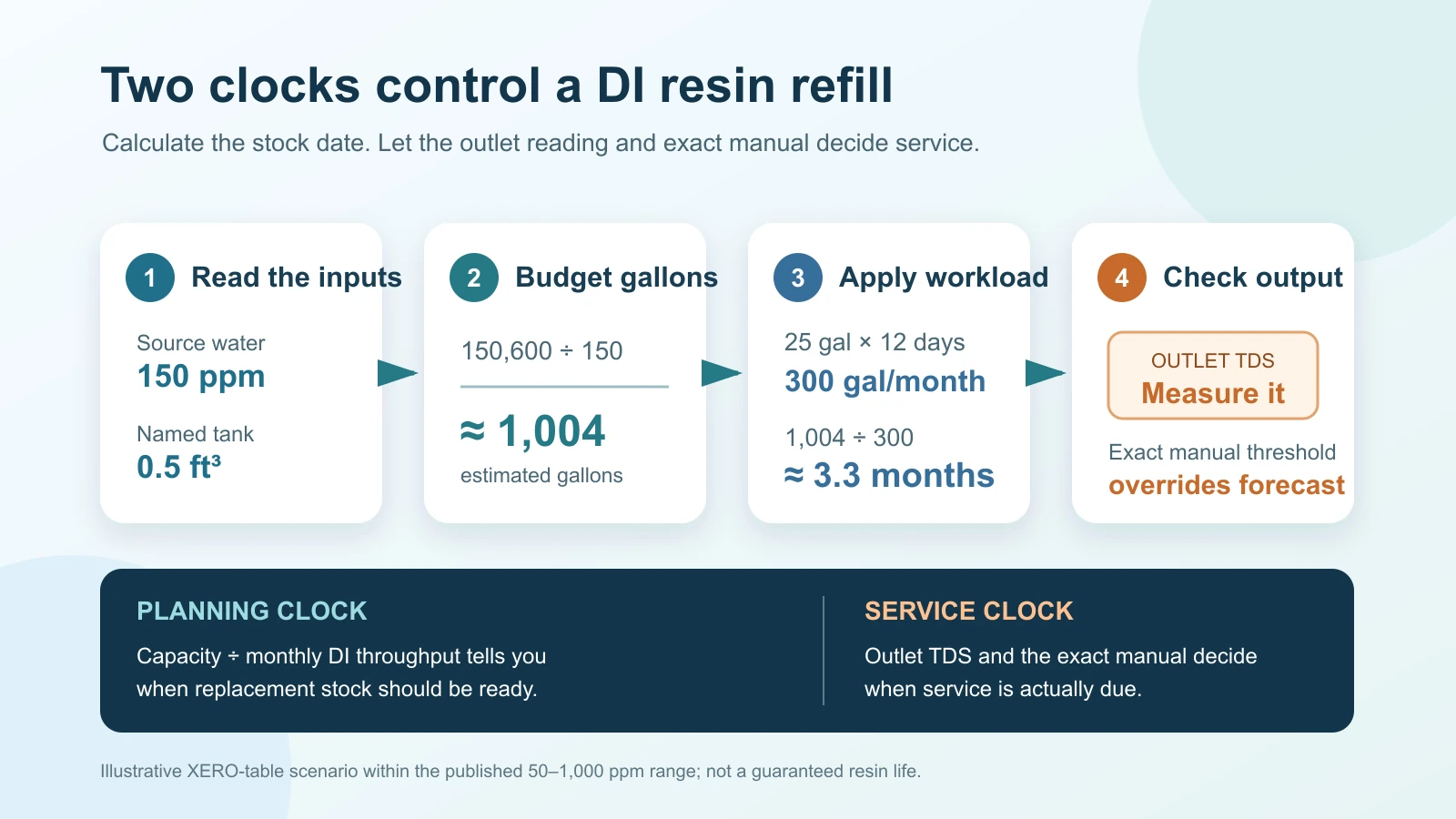
The short answer: for source water between 50 and 1,000 ppm, the XERO table is reproduced by about 150,600 ÷ source TDS for its 0.5-ft³ tank and 301,200 ÷ source TDS for its 1.0-ft³ tank. Then calculate estimated gallons ÷ monthly DI throughput. Use that interval to stock the correct refill—not to declare the resin spent. The outlet reading and the exact equipment instructions decide actual service.
Give the tank a gallon budget
XERO’s published DI tank table falls sharply as incoming TDS rises. At 100 ppm, it lists about 1,506 gallons for the 0.5-ft³ tank and 3,012 gallons for the 1.0-ft³ tank. At 300 ppm, those estimates fall to 502 and 1,004 gallons. These are approximate capacities for the named tanks, not a universal yield for every mixed-bed resin vessel.
| Source TDS | 0.5 ft³ tank | 1.0 ft³ tank |
|---|---|---|
| 50 ppm | 3,012 gal | 6,024 gal |
| 100 ppm | 1,506 gal | 3,012 gal |
| 200 ppm | 753 gal | 1,506 gal |
| 300 ppm | 502 gal | 1,004 gal |
| 500 ppm | 301 gal | 602 gal |
| 1,000 ppm | 151 gal | 302 gal |
Copy the following six fields into the same job or purchasing record. The last row is deliberately separate from the calculation: it prevents an estimate from becoming an unsupported replacement rule.
| Field | What to enter | What it controls |
|---|---|---|
| Tank and resin volume | Exact model and 0.5 or 1.0 ft³ for this XERO relationship | Selects the correct capacity line and refill quantity |
| Source-water TDS | Current reading in ppm, 50–1,000 for this relationship | Sets the estimated gallon budget |
| Estimated gallon budget | 150,600 ÷ TDS or 301,200 ÷ TDS | Creates the planning capacity, not a guaranteed yield |
| Monthly DI throughput | Gallons through DI per day × DI workdays | Connects capacity to the real work month |
| Planning interval | Estimated gallons ÷ monthly DI throughput | Sets the refill-stock date |
| Actual service point | Outlet-TDS instruction from the exact manual | Overrides the forecast and decides service |
XERO states that its 0.5-ft³ vessel takes 0.5 ft³ of resin and its 1.0-ft³ vessel takes 1.0 ft³. For another tank, cartridge or resin specification, stop here and use its own capacity and refill instructions. Do not scale this formula into an undocumented size.
Put the work month under the number
Suppose a 0.5-ft³ tank receives 150-ppm source water. The bounded relationship gives about 1,004 gallons. If 25 gallons pass through the DI tank on each of 12 workdays, monthly DI throughput is 300 gallons. The planning interval is therefore about 3.3 months.
| Source TDS | Estimated capacity | Planning interval |
|---|---|---|
| 100 ppm | 1,506 gal | about 5.0 months |
| 150 ppm | about 1,004 gal | about 3.3 months |
| 200 ppm | 753 gal | about 2.5 months |
That is a stock date, not a promise. A different supply reading, more workdays or higher gallons per day requires a fresh calculation. Record water that actually passes through the DI vessel; do not substitute a property’s total water use or an RO system’s reject-water volume.
If DI is polishing water after RO, the relevant input is the water entering the DI stage. Do not assume the standalone-tank formula transfers to a cartridge or another resin quantity. Use the capacity statement for the exact downstream component.
Use the outlet reading as the service clock
The planning interval cannot confirm water quality. Measure at the DI outlet under the procedure in the exact instructions and keep the fresh-resin baseline with the refill record.
XERO’s current product guidance says its tank resin should be replaced when output TDS consistently creeps over 10 ppm. Unger’s HydroPower Ultra manual likewise says 0 ppm is best and directs replacement of its named resin packs at 10 ppm or higher. Those matching numbers are useful examples, not a license to impose 10 ppm on every system. The current manual for the equipment in front of you remains the authority.
If the output reaches that named service point earlier than the calculation, service the system earlier. If the estimate arrives while output remains within the exact instruction, the calculation has done its job by putting replacement stock on hand; it has not proved the resin is exhausted.
Turn a short interval into a system decision
A consistently short estimate changes the purchase question. Use the DI or RO/DI system selector to compare the source-water load and workload before committing to repeated refills. XERO currently uses 100 ppm as the point where its guidance begins a multistage comparison, but workload can make a lower-TDS DI tank expensive to service and does not make that vendor threshold universal.
If DI still fits, order only the resin volume and type specified for the exact tank, keep the vessel in its instructed operating orientation and start a new record with source TDS, fresh output TDS, refill date and cumulative gallons. Then reconnect the filtration choice to the complete water-fed pole system guide so flow, hose, brush-end delivery, transport and maintenance are not decided from the resin number alone.