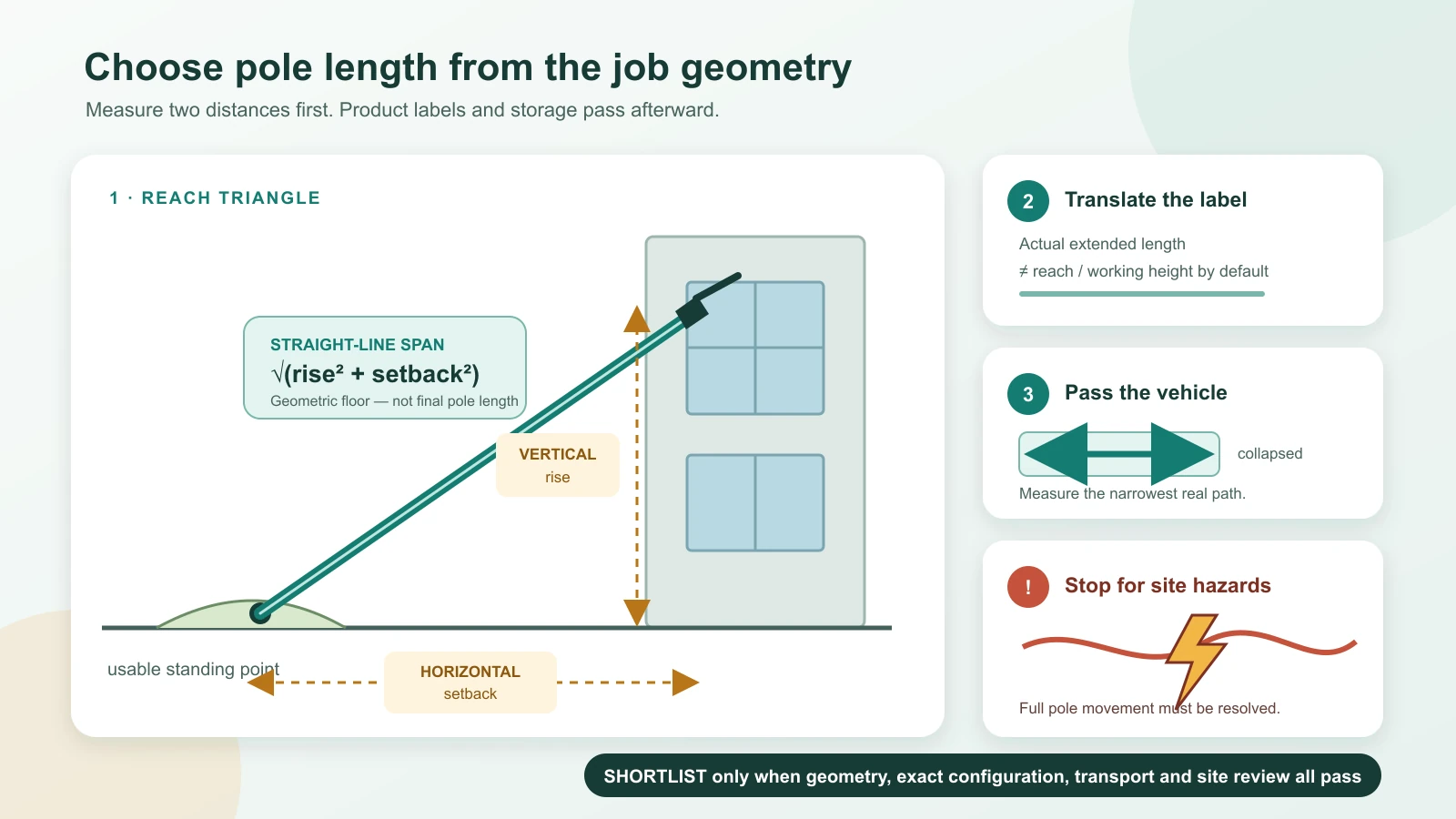
Before comparing a 30-, 40- or 50-foot water-fed pole, put two job measurements on paper: the vertical rise from the planned lower-pole position to the highest brush contact point, and the horizontal setback from that position to the glass. Those numbers expose candidates that look long enough only because the catalog has added an assumed operator reach.
The two measurements produce a straight-line span. That span is a geometric floor, not the pole length to buy. The complete working assembly still needs enough documented length for the brush angle, permitted section arrangement and real operating position. If the manufacturer publishes only “reach” or “working height” and does not define the actual extended pole length, the candidate stays unresolved.
Draw the reach triangle from the place you can actually stand
Mark the lower-pole position on usable ground, not directly below the window by default. A porch roof, planted bed, canopy or restricted walkway can push the position away from the wall. Measure vertical rise and setback from that same point so the two legs describe one right triangle.
Geometric floor: straight-line span = √(vertical rise² + horizontal setback²). This calculation describes the direct distance between two measured points. It does not include brush-head geometry, pole flex, hand position, technique or a manufacturer-required operating allowance.
| Vertical rise | Horizontal setback | Straight-line span | What remains unresolved |
|---|---|---|---|
| 20 ft | 5 ft | 20.6 ft | Actual pole length, brush angle and approved configuration |
| 24 ft | 8 ft | 25.3 ft | The same fields; the larger setback is already reflected in the span |
| 30 ft | 10 ft | 31.6 ft | Whether a documented working assembly covers the geometry with control |
Do not add a universal percentage or a fixed number of feet to the result. Such a rule would pretend that every brush, angle adapter, section layout and operator position behaves alike. Take the measured geometry to the exact model documents. If those documents do not close the gap between straight-line span and usable working configuration, hold the model rather than inventing the allowance.
Translate the product label before comparing poles
Product names, actual pole length and advertised reach can be three different numbers. XERO states on its water-fed pole range page that its advertised length is actual pole length, while some other brands add operator height. That statement explains XERO’s own convention; it does not normalize another manufacturer’s range.
Current model pages show why the field names matter. Tucker lists its High Modulus 50 with a 46-foot full extended height, a 50-foot reach and a 7-foot collapsed length. XERO’s 30-foot Micro Basic lists a 53.5-inch collapsed length and removable section configurations. The XERO M9 lists 21 feet extended and 53 inches collapsed. A similar transport number therefore does not imply a similar working span.
Unger’s nLITE brochure uses “feet shown = working height” in its range diagram while separately publishing extended and collapsed pole lengths in the product table. For example, the listed carbon master pole extends to 28 feet and collapses to 5.5 feet; its compatible extension is listed at 10.5 feet extended and 6 feet collapsed. Keep those fields attached to the exact named components and permitted combination.
| Field | Record exactly | Reject or hold when |
|---|---|---|
| Advertised label | Model name and the number shown in the listing | The label is treated as a physical measurement without a definition |
| Actual extended length | Physical length for the exact permitted section configuration | Only reach, floors or stories are published |
| Reach or working height | Manufacturer wording and any operator-height assumption | The convention is missing or borrowed from another brand |
| Collapsed length | Longest stored piece or complete assembly, as applicable | The measured vehicle path is shorter |
| Permitted configuration | Sections, extension order, brush and angle adapter | The required layout is not documented |
Give the collapsed pole a second test in the vehicle
A pole can pass the reach calculation and fail every workday in transport. Measure the narrowest door, hatch, rack opening or storage turn through which the longest piece must pass. Then measure the usable straight bay where it will be secured. The empty diagonal across a vehicle is not a transport plan if the pole cannot enter, turn or be restrained without damaging clamps, hose or brush.
Decide whether the working assembly travels complete or is broken down. If sections are removable, verify the permitted arrangement for the exact model and record the longest stored component after disassembly. If the brush or gooseneck stays attached, include it in the stored dimension. A modular pole earns a transport advantage only when the manufacturer permits the configuration and the operator will actually use that routine.
Use two separate pass/fail lines: reach fit for the documented working configuration, and transport fit for the measured vehicle path. Do not average them. A candidate that fails either line leaves the shortlist even if its model name is attractive.
Reject reach that creates a site problem
Longer is not a workaround for an uncontrolled standing area or overhead hazard. An OSHA accident record describes a worker lowering a water-fed pole while washing third-story windows and contacting overhead electrical lines. The event is a narrow but important warning: the movement path of the complete pole matters, including adjustment and lowering, not only the position of the brush on the glass.
Stop the sizing exercise when the intended standing zone or full pole movement can encounter overhead electrical lines, unstable ground, uncontrolled traffic or another site condition outside the operator’s documented method and competence. This guide does not establish electrical clearances or approve an access method. Route the site through the applicable employer plan, equipment instructions and qualified safety authority before choosing length.
A stop is not a recommendation to stand farther away and buy a longer pole. Changing the lower-pole position changes the triangle, the control problem and possibly the hazard path. Re-measure only after the standing zone and access method have been legitimately resolved.
Write one complete pole-length specification
Finish with one record that a supplier or manufacturer can answer without translating your assumptions:
Highest brush contact point: [vertical rise] above the planned lower-pole position. Horizontal setback to the glass: [setback]. Straight-line span: [calculated floor]. Candidate must publish actual extended length for the exact [sections/extensions], define any working-height claim, use [brush/gooseneck configuration], and collapse or separate into a longest stored piece no greater than [measured transport limit]. Site stop review: [passed / unresolved].
| Evidence pattern | Disposition | Reason |
|---|---|---|
| Geometry is covered; actual length and configuration are documented; transport fits; site review passes | Shortlist | The length case is closed without borrowing an advertised assumption |
| Listing gives reach or working height but no actual-length definition | Hold | The number cannot be compared with the measured span |
| Reach fits but the collapsed pole or longest piece does not fit the vehicle path | Reject or compare a documented modular alternative | Transport is a controlling operating constraint |
| Overhead, ground or traffic condition remains uncontrolled | Stop | Buying more length does not close the site-method problem |
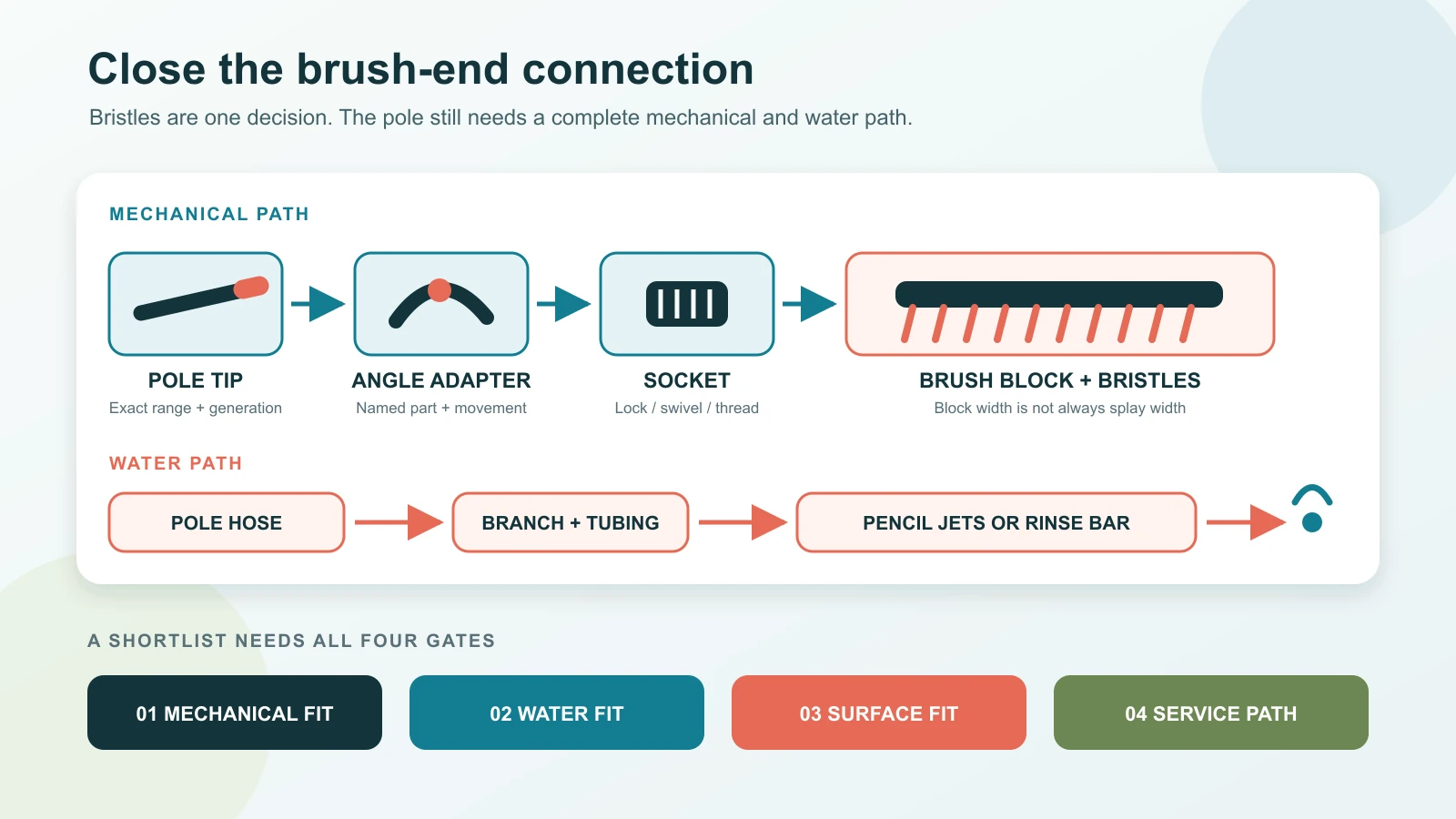
This record closes only the length decision. Material, stiffness, clamps, hose and brush compatibility still belong in the broader water-fed pole selection guide. Carry the measured span, exact label definition and transport limit into that comparison so a later product choice cannot quietly replace them with a bigger catalog number.