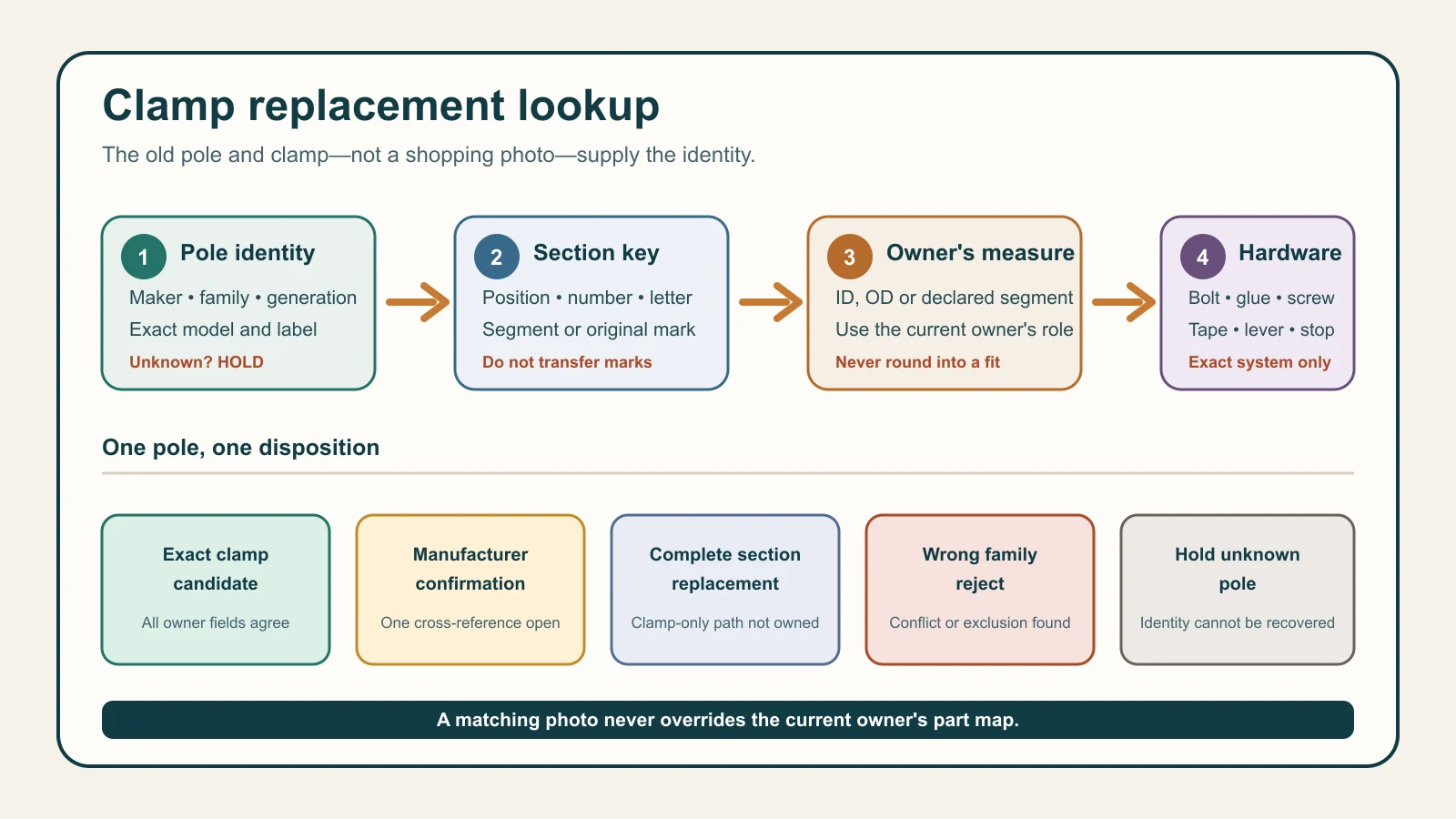
The old clamp is a better lookup tool than the new-part photo. Before loosening, cutting or gluing anything, preserve the pole label, product family and generation, the affected section, the original number or letter, and the current owner’s fastening method.
The quick answer is deliberately narrow: buy a clamp only when one current owner maps that exact pole and section to that exact part. A shared number, color, profile or approximate tube diameter is not enough. If the label or section identity is missing, ask the manufacturer before altering the pole. If the tube or section is damaged, the replacement object may be the complete section rather than the clamp.
This page begins after the whole-pole decision. Use the water-fed pole guide when reach, material and brush are still open, and use the traditional extension-pole connection record when the problem is the tool tip. Here, the pole is already selected and one clamp needs a defensible purchase path.
The old clamp is the lookup key
Photograph the installed clamp from both sides and the complete pole label before removing parts. Preserve any mark on the clamp, the affected section’s position and any current model code. The aim is not to document a repair sequence. It is to keep the evidence that an exact current part owner can recognize.
The current XERO V3 replacement-clamp cart tells buyers to use the number printed on the damaged clamp. That makes the old mark valuable, but only inside the V3 family. The same numeral on a different pole is not the same part.
| Receipt field | Evidence to retain | Why it changes the order |
|---|---|---|
| Pole identity | Manufacturer, family, generation, exact model and a full label photo | Determines which part map and instruction can control the purchase |
| Affected section | Section position in the maker’s sequence, section mark and total section count | The same clamp family normally changes size as tubes nest |
| Original clamp key | Number, letter, segment label, molded code and photographs from both sides | May lead to one exact part, but only after the pole family is frozen |
| Owner-defined measure | Published diameter role, actual value, units and measurement location | Prevents ID, OD, nominal tube size and finished clamp size from being merged |
| Fastening and condition | Bolt, glue, screw, tape, lever and stop components; tube, seat and stop-tape condition | Separates an exact clamp candidate from a complete-section or support route |
| Current owner | Exact product page or catalog, observed date and current instruction | Keeps an old forum answer or look-alike cart from becoming compatibility proof |
Do this even when the seller’s selector looks obvious. The selector is the last step in the identity chain, not the first. A missing mark remains unknown until the pole maker or current part owner supplies another cross-reference.
Five systems can reuse the same visual language
Current replacement owners show why color, profile and even a printed number are weak outside their own family. These examples are not a ranking. They are five incompatible lookup languages that happen to describe parts with a similar job.
| Current owner lane | Identity the owner publishes | What the buyer must not infer |
|---|---|---|
| XERO V3 complete clamp | Numbers #1 through #12; bolt-on complete-clamp cart; number on the damaged clamp; declared inner-diameter choices; lever included | That the number identifies an earlier XERO, OVA8 or another brand |
| Earlier XERO Pro glue-on clamp | Letters AA, B, C, D, E and F; glue-on replacement identity | That a numbered V3 part is the newer equivalent for the selected old pole |
| OVA8 Pro replacement clamp | Numbers #1 through #8; bolt-on/no-glue language; explicit exclusion for XERO Trad 2.0 | That matching numbers, shape or approximate tube size override the exclusion |
| Ettore REA-C-H product #1908 | Small for two-section, large for three-section and extra-large for four-section poles | That section count alone closes an unnamed or historic REA-C-H model |
| Unger nLITE and SmartLock catalog | SmartLock parts 23134-23139 mapped to segments 1-6 and 22, 25, 28, 31, 34 and 37 mm; nLITE set 23145 and named service parts | That an Unger segment or diameter is a universal replacement-clamp size |
A #2 XERO V3, a #2 OVA8 and an Unger segment 2 are not interchangeable propositions. The useful comparison row is not “clamp #2.” It is “manufacturer + family/generation + model + affected section + original mark + owner-defined diameter + exact current part + fastening.” Remove any term and the row can point to another object.
Explicit exclusions deserve more weight than resemblance. OVA8’s current seller says its replacement clamps do not fit XERO Trad 2.0. A matching number, close color or convincing photograph cannot reopen that cart.
A diameter is useful only inside its owner’s map
“The tube measures about one inch” sounds precise but may answer the wrong question. One cart may publish clamp inner diameter. A manufacturer may map a part to a named pole segment. A service instruction may care about tube outside diameter, adhesive thickness or the clamp’s exact axial position. Those values are not interchangeable merely because each is measured in millimeters or inches.
Use a diameter only after the exact current owner says what is measured, where it is measured and which part map consumes the number. If a product page lists two diameter choices, retain its labels and selected value. Do not round a measurement to the nearest attractive cart, subtract wall thickness to manufacture an unlisted inner diameter, or assume a nominal carbon-tube size is the finished clamp size.
Measure the physical pole to answer an owner-defined question, not to invent an independent fit rule. Record the instrument, units and location so the maker can correct the field if its convention is different. If the current part owner cannot explain the diameter role for the selected model, the result is manufacturer confirmation required—not a best guess.
This is also why a section link matters more than a logo. The carbon-fiber pole comparison owns material and complete-section service economics; it does not grant permission to fit a clamp. If the maker can identify the complete section but not a separate clamp, a documented section can be the lower-uncertainty replacement object.
Sometimes the section—not the clamp—is the replacement
A broken lever on an intact, fully identified, owner-supported clamp is a different purchase problem from a split tube, crushed fibers, distorted clamp seat, missing stop tape or an unknown older pole. A new clamp cannot establish the condition of the structural section beneath it.
| Observed record | Defensible object | Reason |
|---|---|---|
| Exact pole, generation and section; original clamp mark; intact tube and seat; current separate part and instruction | Exact clamp candidate | The current owner closes both identity and a clamp-only service path |
| Pole and section are known, but the current part map or diameter role is incomplete | Manufacturer confirmation | One written cross-reference can close or reject the cart without alteration |
| The maker owns a complete section but not a separate clamp, or the clamp seat/stop component is damaged | Complete section | A clamp-only purchase would leave the section-side condition or service contract open |
| Cart belongs to another family/generation or carries an explicit exclusion | Wrong-family rejection | No visual or nominal match can override the owner conflict |
| Pole label, family, generation or affected section cannot be recovered | Unknown-pole hold | There is no stable owner map against which to evaluate the part |
Split tube, crushed or delaminated composite, a distorted section, missing structural stop components or an unreadable identity belong with the pole maker or qualified service owner. Do not escalate to stronger adhesive, a tighter bolt or a larger clamp from article advice. The replacement question has changed.
Reach and collapsed length remain whole-pole questions. If replacing a complete section changes the build, return to the working-reach and transport plan before assuming the rebuilt pole preserves its intended configuration.
Send support a question it can actually answer
Do not send only a close-up of a black clamp. Include the full pole label, current family and generation, exact model, total section count, affected section counted in the maker’s direction, original clamp mark, the owner-defined measurement with units and location, photographs of the clamp and tube, the current candidate part page, and whether the tube, stop tape or seat is damaged.
I have [manufacturer / family / generation / model]. The affected clamp is on [owner-defined section], marked [number / letter / segment]. The current owner-defined measurement is [value, unit and location]. The existing fastening is [bolt / glue / screw / tape], and the tube and stop components are [condition]. Does current part [identifier and URL] fit this exact pole and section? If not, which current clamp or complete section replaces it, and which current instruction applies?
That wording gives the owner enough identity to reject a wrong generation, ask for one missing field or name a complete-section route. Preserve the reply with the selected cart. A general “it should fit most poles” answer does not close the purchase record.
Give the pole one disposition
Do not leave the research as a folder of five possible clamps. The first unresolved or failed identity gate determines one outcome for the pole.
| Outcome | Evidence required | Next action |
|---|---|---|
| Exact clamp candidate | One family/generation/model, affected section, original mark, owner-defined diameter where required, fastening, current part source, intact section-side condition and current instruction | Preserve one exact line item for owner review before ordering |
| Manufacturer confirmation required | Pole is identifiable, but one current cross-reference, revision, diameter role or service instruction is missing | Send the complete evidence request and hold the cart |
| Complete section replacement | Maker owns a section but not a clamp-only path, or the section-side seat, stop component or tube condition prevents a clamp conclusion | Price and verify the exact complete section under the pole owner’s current configuration |
| Wrong-family reject | Identifier language, generation, fastening or explicit exclusion conflicts with the selected cart | Remove the part from consideration; do not adapt it by appearance |
| Hold unknown pole | Manufacturer, family, generation or affected section cannot be recovered | Do not alter the section; recover identity or replace the documented complete pole route |
The useful procurement line is short enough for another person to audit: [maker] [family/generation] [model] / [affected section and original mark] / [owner-defined diameter] / [exact current clamp or section] / [fastening and included parts] / [source and observation date] / [one disposition]. If the cart cannot support that line, it is not ready for payment.