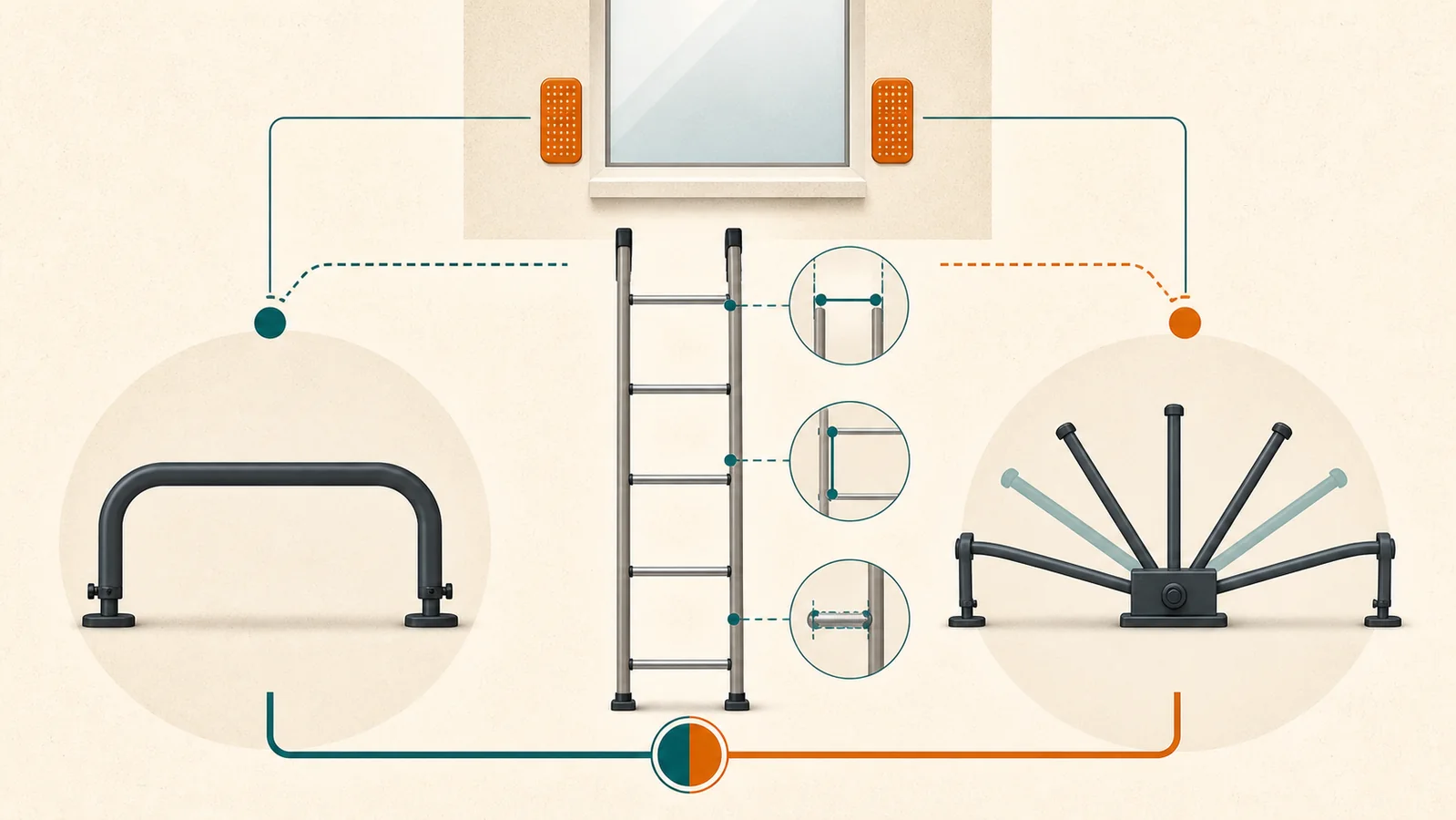
Three silver sections and a claimed 18 or 21 feet do not make a stack ladder set. A buyable set has one named manufacturer and family, a real base, compatible center sections, the correct top, the owner’s joining rule, a readable rating and a route that can actually accept the complete configuration.
Run the broader ladder type and loaded-job decision first. The job has to permit a ladder, the ladder type and load have to be appropriate, and a responsible site owner has to control access. If a ground-based high-window method completes the entire task, section shopping should stop there. Compact storage is not a reason to introduce a climb that the job does not require.
If a sectional ladder still belongs in the comparison, work in this order: prove why the route rewards sections, inventory every piece as one exact system, calculate the assembled configuration by the owner’s rule, and then close the top, feet, load, electrical exposure and operating owner. A missing answer is a hold, not an invitation to borrow a fact from a similar-looking ladder.
First decide whether the route rewards sections
The honest buying case for a stack ladder is not “more height.” It is a route where several short, owner-approved sections can move through the vehicle, doorway, elevator or interior passage that the suitable extension ladder cannot, while the available top design has an authorized bearing point at the work area.
Metallic Ladder describes its current window-cleaning range as special-purpose aluminum sectional ladders. The manufacturer also emphasizes small-vehicle and jobsite movement. That establishes a product concept; it does not prove that any particular stairwell, room, exterior approach or crew can use it.
Before comparing kits, write down the longest individual piece, the narrowest opening on the route, the turns that piece must make, and where the base and top would bear. Then compare the result with the equipment the business already owns.
| Route evidence | What it can establish | What it cannot establish |
|---|---|---|
| Every named section can pass through the vehicle, doors and turns without improvisation | The sectional format solves a real transport constraint | That the assembled ladder is authorized or correctly rated |
| The existing extension ladder fits the route and reaches the authorized bearing point | A separate sectional purchase may add no route value | That the extension ladder is suitable without its own label, load and site review |
| A ground-based pole system completes the glass, frame and rinse task | Keep the work on stable ground | That every high-window job can be reached from the ground |
| The route or bearing point is unknown, obstructed or exposed to uncontrolled traffic | The cart is premature | That a narrow top or accessory can manufacture a site plan |
Current professional discussions repeatedly contrast compact indoor transport with the smaller height increments and simplicity of an extension ladder. That is useful evidence that route fit is a real purchase question. It is not product authority. Your measured route and the current manufacturer’s documents have to answer it.
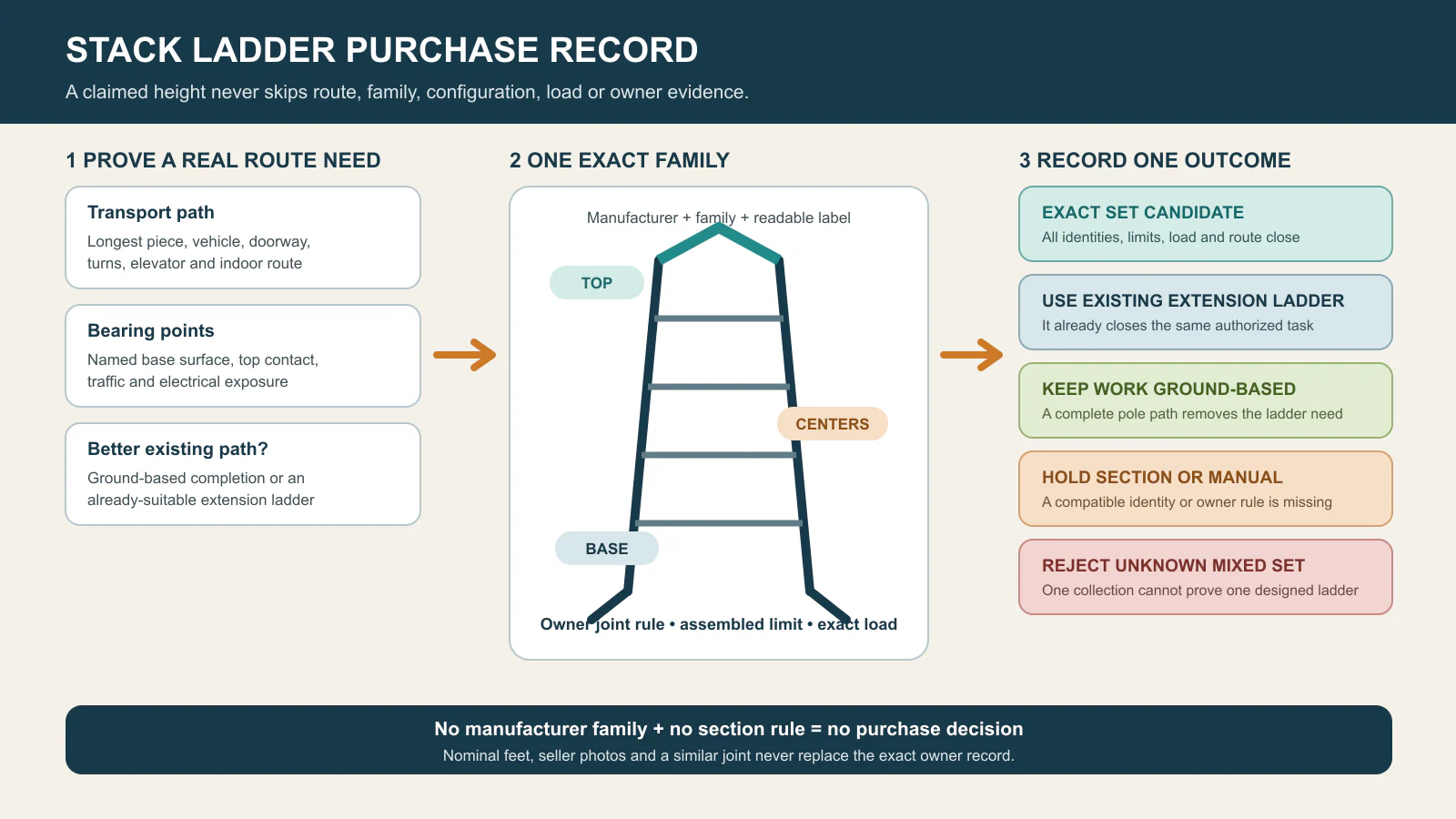
Inventory the set from the ground up
A sectional ladder is intentionally made from different component roles. That is exactly why a marketplace photograph or a seller’s section count is not enough.
Metallic’s current family page lists a 6-foot base; 4- or 6-foot center sections; and 6-foot open or V-groove, 7-foot open, and 8-foot open tops. It also lists rubber pads or swivel shoes for the base. Those facts apply to that current family. They do not prove that an unmarked top, an older center or a section from another manufacturer belongs in the same stack.
Build the purchase record from the floor upward:
| Component | Evidence to retain before purchase | Why it changes the decision |
|---|---|---|
| Base | Manufacturer, family, section identifier, label, feet or shoes and condition | Only the documented base owns the support geometry; a center is not a visual substitute |
| Every center | Manufacturer and family match, length, joint end, required locking hardware and condition | One incompatible center breaks the complete set even if the nominal lengths look useful |
| Top | Exact open or V-groove model, intended support role, contact condition and section identity | The top has to match both the family and the real bearing point |
| Joint or lock | Current owner instruction, overlap or engagement rule, all required pins or locks and inspection condition | It controls compatibility and may change assembled length |
| Complete label and load record | Exact duty rating or maximum intended load plus employee, tools, materials and other loads | A family description or accessory rating cannot supply a missing ladder rating |
Treat a used set as unidentified until each component survives this inventory. A verbal claim that “they all came together” is not a manufacturer cross-reference. Paint, wear and a shared tube size do not prove that joints, pin locations, alloy, rating or revision match.
This is also where missing hardware changes the object. A set sold without the exact current joint or locking components is not merely incomplete in the cart; it may lack the evidence needed to call the pieces one designed ladder at all.
Calculate the configuration the way its owner does
Nominal section length is catalog data, not assembled reach.
Metallic currently states that its window-cleaning sections are stackable up to 21 feet of vertical height. Keep that wording intact. “Vertical height” is not the worker’s standing level, maximum window height or safe working reach, and it does not transfer to a different family.
The joint method can change the arithmetic. One current Squeegees.net sectional variant says to subtract one foot at each joint when calculating extended length, requires locking pins and states that top and center sections are not bases. Those are valuable decision facts for that exact variant. They are not permission to apply the same overlap or hardware rule to an unidentified US kit.
For the selected cart, obtain the current manufacturer’s own equation or configuration table. Record the ordered base, centers and top; the exact overlap or engagement at every joint; every required lock or pin; the owner’s maximum section count and assembled or vertical limit; and the complete-set label and rating. Only then calculate a documented configuration. Do not add a person’s height, arm reach or a seller’s “working height” to manufacture a more attractive number.
OSHA’s construction ladder rule reinforces the identity boundary: ladders may not be tied or fastened together to create longer sections unless they are specifically designed for that use. The same rule keeps the maximum intended load and manufacturer rating attached to the exact ladder. This page does not determine whether that construction standard governs a particular job, but it does show why improvised joining and borrowed ratings are invalid purchase inputs.
Total load is not just body weight. The job record must account for the employee and the tools, equipment and materials that will be applied to the ladder. If the exact label or complete load is missing, the configuration remains a hold even when the section arithmetic is neat.
Let the bearing points choose the top and feet
A V-groove top and an open top are not cosmetic alternatives. Metallic describes the V-groove option for using window corners where a straight approach cannot work. That makes the planned contact point part of the order.
Record what the top is intended to bear against, whether the exact owner permits that role, and whether both rails can bear as required. OSHA 1926.1053 says the top of a non-self-supporting ladder normally needs both rails supported equally unless it has a single-support attachment. A V-groove option is a product choice inside that boundary, not a blanket exception for any corner, mullion, frame or surface.
The base deserves the same precision. A catalog may offer rubber pads, swivel shoes or a compatible leveler. The site still has to supply stable support and control displacement or traffic under the applicable plan. If the existing shoes are damaged, the decision returns to the model-specific replacement-foot path; a near-match foot does not rescue a cart.
Material can stop the purchase as well. Metallic describes this family as aluminum. OSHA’s construction rule requires nonconductive side rails where the employee or ladder could contact exposed energized electrical equipment. The responsible worksite owner—not the cart—must close the energy state and exposure plan. If aluminum is excluded, compare an exact option through the fiberglass-versus-aluminum decision after holding type, rating, length and route constant.
Finally, inspect the actual sections and labels. Structural defects, missing components or damaged joints do not become acceptable because the pieces are inexpensive or difficult to replace. A purchase decision should preserve who inspects the set, who owns current instructions and training, and how any rejected section stays out of service.
Give the whole set one buying outcome
Do not end with “stack ladders are compact” or “extension ladders are easier.” End with one disposition that someone else can audit before the order is placed.
| Outcome | Required evidence | What happens next |
|---|---|---|
| Exact set candidate | Authorized ladder route; one manufacturer and family; documented base, centers, top and joints; current limit; exact rating and load; accepted contact, electrical and transport records; responsible owner | Preserve the complete line items and obtain final owner approval before any purchase |
| Use the existing extension ladder | The current extension ladder already closes the same authorized route, load and support task with no material access disadvantage | Do not buy a sectional set for novelty or storage alone |
| Keep the work ground-based | A pole or other authorized ground method completes the full task | Keep ladder sections out of the job plan |
| Hold for section or manual | The family is plausible, but an identifier, joint rule, label, current manual, hardware item or exact configuration limit is missing | Ask the manufacturer or authorized distributor for the exact missing record |
| Reject unknown mixed set | Any section belongs to an unknown or different family, the required base or top role is wrong, the rating cannot be proved, or the route or electrical condition fails | Do not treat the pieces as a ladder system |
A complete procurement line should be specific enough to expose a bad cart: manufacturer and family; exact base; each center in order; exact top; every required pin or lock; base feet; documented assembled limit; exact rating; current instructions; and the named route and owner record.
That line belongs inside the business’s broader professional window-cleaning tool stack, beside the ground-reach and extension-ladder alternatives it was compared against. If the seller cannot supply enough identity to write the line, the decision is already complete: the cart is not an exact set candidate.