Unger HydroPower Ultra names a product family, not one order line. Unger’s current US operating instructions identify UHP01 and UHP3C. Its global instructions identify DIUH1, DIUH2 and DIUH3. A listing that says only “HydroPower Ultra” has not yet told you which model table or service instructions belong to the unit.
For a US purchase, begin with the label on the actual tank or seller line. UHP01 is the small one-green-pack unit in the US manual. UHP3C is the larger cart configuration with one green pack at the top and two red packs below it. If the label starts with DIUH, keep it with the global documentation; do not translate DIUH1 into UHP01 merely because both are compact versions.
The model match is only the first decision. The exact cart must still state whether it contains a filter alone or a starter kit, and the intended water source, pressure, temperature, hose route and DI workload must fit before checkout.
Start with the code stamped on the unit
The two current official manuals share an 8-bar pressure ceiling and similar pack logic, but they do not share model names or identical dimensional records. Preserve the document region and its units on the same row.
| Document owner | Model | Form and resin packs | Published mass and size | Operating fields |
|---|---|---|---|---|
| Unger US manual | UHP01 | Small tank; one green pack | 21 lb including resin; 14.75 x 13.75 x 12 in L x W x H; 11 x 12 in base | 116 psi max; 41–86°F water |
| Unger US manual | UHP3C | Large tank with cart; one green pack at top, two red packs below | 71 lb including resin; 27.5 x 21 x 42.5 in L x W x H; 11 x 12 in base | 116 psi max; 41–86°F water |
| Unger global manual | DIUH1 | Filter S; one green pack | 10 kg including resin; 35 cm high; 28 x 30 cm base | 8 bar max; 5–30°C water |
| Unger global manual | DIUH2 | Filter L; one green pack at top, two red packs below | 22 kg including resin; 76.5 cm high; 28 x 30 cm base | 8 bar max; 5–30°C water |
| Unger global manual | DIUH3 | Filter LC with cart; one green pack at top, two red packs below | 31 kg including resin; 107 cm high; 28 x 30 cm base | 8 bar max; 5–30°C water |
The US figures come from the current Unger US HydroPower Ultra operating instructions. The DIUH rows come from the current global operating instructions. They are separate owner records, not a conversion chart.
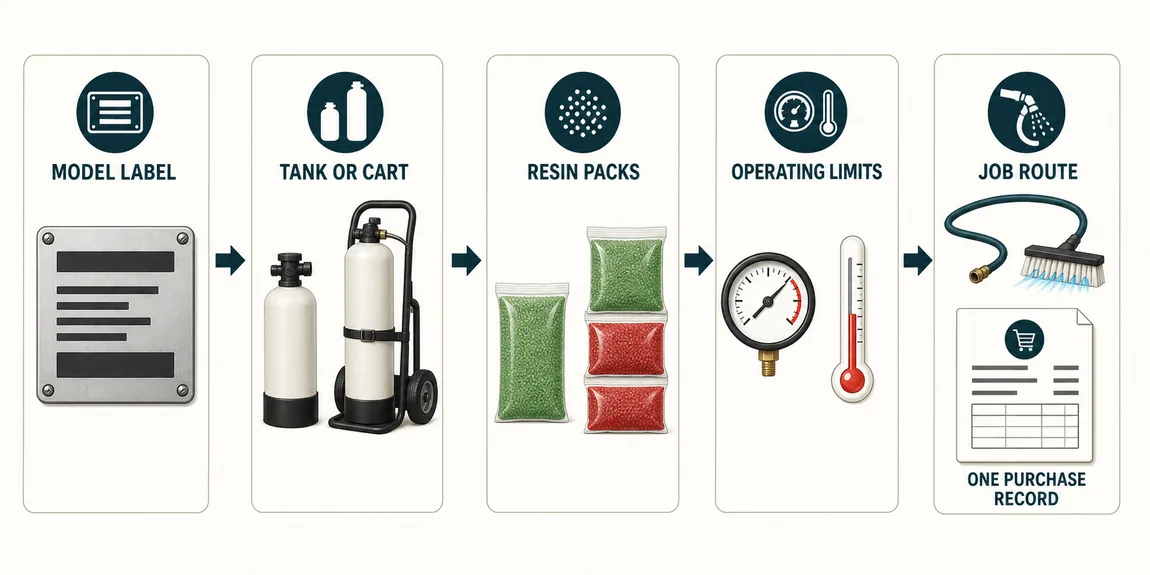
This matters most with a used tank, an imported listing or a page assembled from several catalogs. Ask for a readable model label and compare its physical form with the matching manual row. A cart beneath a short tank does not create a UHP3C or DIUH3, and a metric DIUH table does not supply missing specifications for a US UHP listing.
One green pack and green-red-red are different service records
The model-specific replacement instructions are more useful than a generic “one pack” or “three pack” button. For UHP01, the US manual specifies one green Ultra Resin Pack and explicitly says not to use a red pack in that unit. UHP3C uses all three vessel positions: green occupies the upper slot, while a red pack goes into each lower slot. The global manual applies that same color order to DIUH1 versus DIUH2/DIUH3, but the model codes remain global.
| Candidate record | Pack evidence that must travel with it | Hold when |
|---|---|---|
| UHP01 | One green pack for the named small tank | The offer shows only “single,” no model or no pack identity |
| UHP3C | Green top + red middle + red bottom | A three-pack quantity does not state the color stack or tank |
| DIUH1 | One green pack under the global manual | A US listing is being filled from the global code by resemblance |
| DIUH2 or DIUH3 | Green top + two red packs below under the global manual | Cart status, exact code or pack positions are missing |
The current Window Cleaning Resource system page identifies its one-stage offer as manufacturer part UHP01. Its separate resin page offers single and three-pack choices. Those pages establish what that seller is presenting; the quantity control does not override the model manual or prove that a three-pack selection contains the UHP3C green-red-red stack. Save the system model and the replacement pack description together.
Do not predict resin life from tank size or a seller chart. Feed-water TDS, gallons used and the manual’s meter rule all matter. In the US instructions, the first-use reading should be 0 and resin replacement is due when the meter reaches 10 ppm or higher. That is an operating rule for the named system, not a promise about hours of use or the finished glass.
A cart picture does not tell you what the cart contains
The US manual assigns the cart to UHP3C; the global manual assigns it to DIUH3. That answers which filter version owns the wheeled frame inside each document. It does not answer what a merchant bundled around the filter.
Unger’s global product overview makes the distinction visible: DIUH3 is the Filter LC with cart, while kit codes add named poles, brush, hose, adapter and flow-control components. A retailer may construct other bundles. Record each included item from the selected cart line instead of assuming that a pole or hose shown in a gallery travels with a filter.
For the tank itself, preserve the meter, inlet and outlet connections, valve, cap/pressure-release parts, cart clamp and wheels that the selected owner says are included. For a kit, add every pole section, brush, hose, fitting and control by its own part identity. If a component is merely pictured, its status is unknown.
Transport is also a different fact from catalog mass. The US manual’s 21- and 71-pound figures include resin; the global manual publishes 10, 22 and 31 kg including resin. Neither number is the loaded vehicle weight after retained water, hose, fittings and other kit contents are added. Measure the complete traveling configuration and assign vehicle restraint and payload decisions to the responsible owner.
The faucet can reject a correctly labeled tank
A correct label and pack stack can still produce the wrong purchase for a particular route. Apply the matching manual to the source and setup rather than treating its technical table as general advertising.
| Route field | Current manual boundary | Purchase effect |
|---|---|---|
| Water source | The manuals call for tap/drinking water | Hold a different source until the responsible water/system owner approves it |
| Inlet pressure | Maximum 116 psi / 8 bar | Reject a source above the ceiling; do not let a downstream fitting raise it |
| Low-pressure behavior | Below 44 psi / 3 bar, reduced flow becomes noticeable | Measure the intended assembled route instead of promising brush output |
| Incoming water temperature | US technical table: 41–86°F; global table: 5–30°C | Use the row belonging to the actual model and protect the system from frost |
| Position and hose pull | Upright, stable placement; adequate pole-hose slack | Change the placement or route if tugging can tip the tank |
| Water-quality monitoring | Read the installed TDS meter and follow the matching service instruction | A display reading does not prove cleaning outcome, route capacity or resin life |
Pressure needs both a ceiling and a delivery check. The manual’s 116-psi value is not a target. Its separate warning that flow reduction becomes noticeable below 44 psi does not create a universal minimum for every pole, jet, hose length or elevation. Confirm actual delivery in the intended complete water-fed pole system, with the tank upright and enough hose slack that normal movement does not pull on the cap.
HydroPower Ultra does not choose DI economics
HydroPower Ultra is a DI product family. That does not mean DI-only is automatically the economical treatment path for every source and workload. The current specialist UHP01 page positions the one-stage unit for softer-water use and says it is not recommended for hard water. Keep that statement attached to the seller; do not convert its production estimate into expected gallons for another source or route.
Measure feed-water TDS and estimate demand before comparing consumable burden. The public DI or RO/DI system selector owns that class decision; the broader water-fed pole system guide carries filtration into flow, reach, hose, transport and maintenance. Use those results before choosing between UHP01, UHP3C or another treatment system.
A larger DI tank can reduce the frequency of opening the vessel while still consuming resin at an unattractive rate. A compact tank can be easier to place while failing the required output or service rhythm. This model comparison does not rank those tradeoffs without the source-water and workload record.
Put one resolvable line in the cart
Before checkout, save this line from the selected offer and the matching manual:
seller + date / country or document region / exact model label / filter-only or kit / tank or cart / pack count + colors + positions / included meter + connections + cart parts / published mass + dimensions / water source + feed TDS / pressure + water temperature / stable placement + hose route / current manual / exact replacement pack description
UHP01 candidate. The US label, small tank, one green pack, exact contents and route all agree.
UHP3C candidate. The US label, cart, green-red-red stack, exact contents, transport record and route all agree.
Global-model review. A DIUH1, DIUH2 or DIUH3 label is genuine, but its global manual, supply path and US suitability must remain explicit.
Compare RO/DI or another system. Source-water burden, workload, delivery, transport or service needs reject the DI-only candidate.
Hold identity, pack or route. A family title, unlabeled tank, quantity-only resin selector, uncertain kit, conflicting operating field or unstable hose path still controls the purchase.