Keep the window scraper out of the cart for one minute. The first specification is not a four-inch or six-inch blade. It is the cleaning instruction for the exact glass surface in front of you.
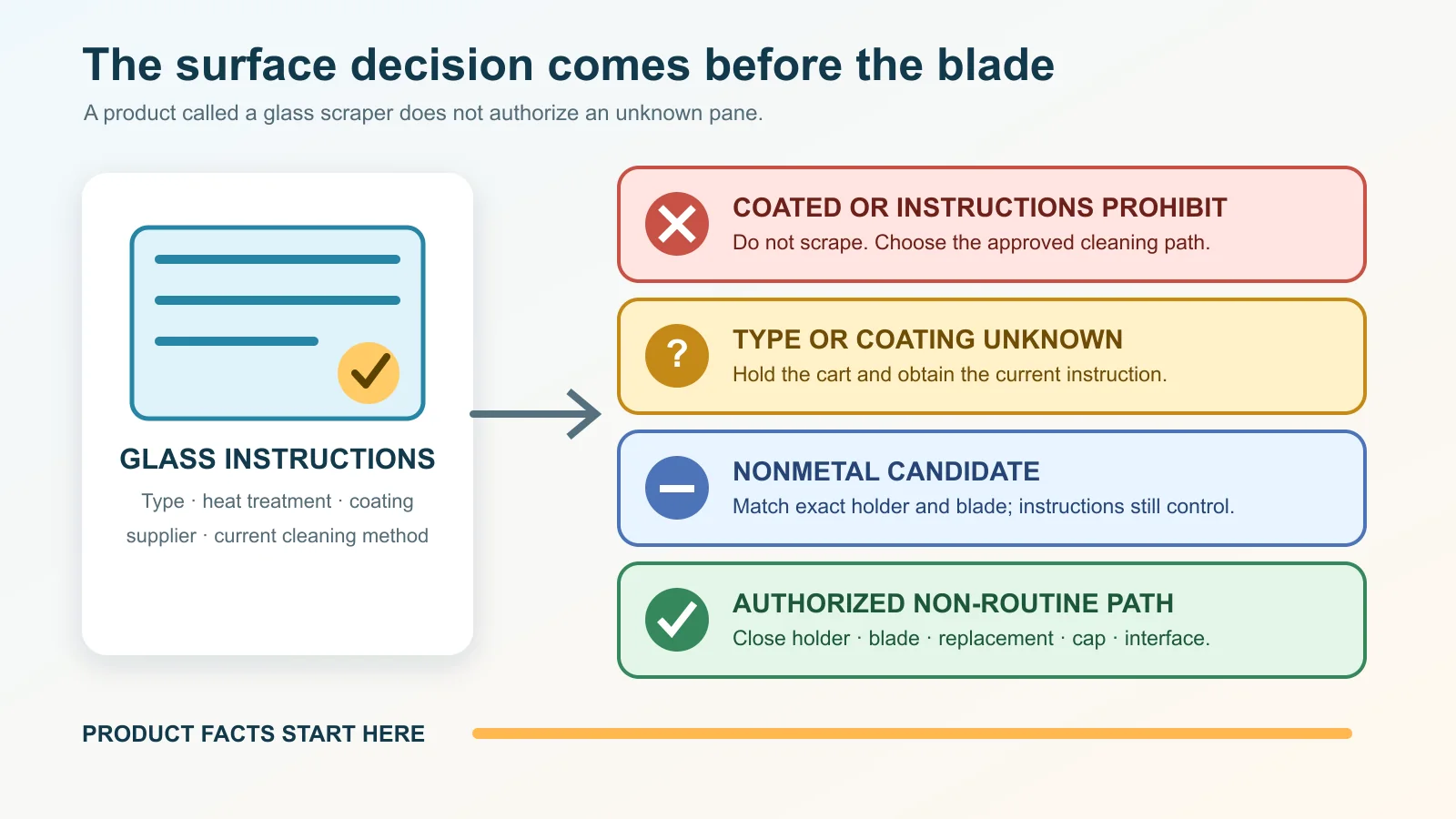
A product page can prove which blade fits a holder. It cannot prove that a steel edge is acceptable on an unidentified pane. If the exposed surface is coated, the National Glass Association says not to use razor blades. If the glass type, heat treatment or coating is unknown, the order is not ready.
Only after that surface question closes should blade material, width, head angle, replacement family, protective cap and pole interface enter the comparison. This order turns a scraper from a generic sharp tool into a documented, serviceable set for a specific non-routine task.
A scraper is one specialized line in a broader professional window-cleaning tool stack. It does not replace the washer and squeegee used for ordinary cleaning, and it does not belong in every kit by default.
The glass supplier gets the first decision
Start with the glass or window supplier, not a scraper brand. Record the manufacturer or fabricator when it can be identified, the glass construction, whether it is heat-strengthened or fully tempered, and whether a coating is exposed on the side to be cleaned. Then obtain the current cleaning instruction for that product.
The current NGA architectural-glass cleaning paper explains why a logo is not enough: it may indicate a supplier or heat treatment, but it may not reveal the glass type or an exposed coating. The absence of a visible logo does not prove the pane is ordinary annealed, uncoated glass.
| What is known | Authority | Scraper decision | Next useful action |
|---|---|---|---|
| An exposed coating is present | NGA prohibits razor blades on coated glass; exact supplier instructions may be stricter | Do not order a steel-blade scraper for that surface | Use the cleaning route approved for that product |
| Glass type, heat treatment or coating is unknown | No exact cleaning instruction is available yet | Hold the surface decision | Identify the unit and obtain current instructions |
| A plastic blade is marketed for sensitive surfaces | Blade manufacturer closes its holder and intended-use claim; glass supplier still controls the pane | Treat it as a candidate, not automatic permission | Match the exact SKU and confirm the method is allowed |
| The surface and non-routine cleaning path are documented | Current glass instruction plus exact scraper documentation | Compare a complete, protected scraper set | Close holder, blade, replacement and storage fields |
This is deliberately stricter than asking whether a product is sold as a “glass scraper.” The name describes a tool category. Surface permission belongs to the glass product and its current instructions.
Routine cleaning is the wrong reason to buy one
The NGA paper does not recommend blades or scrapers for routine glass cleaning. It recognizes that professionals may choose a more aggressive method for localized, non-routine contamination, while warning that particles caught under a blade can create fine scratches.
That distinction should appear on the shopping note. Write down the material you are trying to remove—such as a specific sticker adhesive or construction residue—and the affected area. “General grime” is not a reason to move past the washer-and-squeegee path.
If an authorized non-routine blade method remains, the NGA limits it to affected areas and calls for a new blade moving in one direction rather than back and forth. Those points are risk boundaries from an industry paper, not a promise that technique can make every surface safe. Heat-treated glass requires greater care, and a steel blade remains a last-option decision rather than a routine accessory.
The same separation helps avoid overlap with the site’s complete window squeegee guide. A squeegee removes cleaning solution during the ordinary workflow. A scraper addresses authorized, localized contamination. One is not a shorter or sharper version of the other.
Compare complete scraper families only after authorization
Once the glass line passes, compare exact orderable assemblies. Width alone does not establish a complete scraper. The holder, supplied blade, change mechanism, protective storage and replacement family must stay together.
| Current family | Blade and head | Protection and replacement | Pole statement | Open before ordering |
|---|---|---|---|---|
| Unger ErgoTec Ninja EN100/EN150 | 10 or 15 cm stainless-steel blade; head changes between straight and 30 degrees | Cap; carriage change; matching Unger premium stainless blade family | Unger Locking Cone | Exact 10 or 15 cm variant and the glass instruction for this job |
| Ettore Pro+ 1044 | Six-inch complete scraper; current page links a carbon-steel replacement blade; head angle not published | Yellow cover with complete variant; holder-only, cover-only and replacement packs are separate selector choices | Ettore extension poles | Complete versus component-only cart line, blade pack and surface instruction |
Neither row is a ranking. Unger closes an adjustable head and stainless replacement family. Ettore closes a six-inch complete option and separately orderable cover, holder and blade packs. The better record is the one that matches the authorized task without leaving a component to assumption.
Do not convert blade material into a universal performance verdict. Carbon and stainless steel are useful product facts because they identify the replacement family. They do not prove that one scratches less, removes a contaminant faster or is permitted on the pane.
A plastic blade is an alternative, not permission
Unger now lists plastic replacements for exact holders: the 15 cm N150P for the Ninja scraper, the 10 cm E100P for the ErgoTec glass scraper and the 4 cm SRB4P for the safety scraper. Its current plastic blade page positions them for sensitive surfaces and maps each size to its intended holder.
That mapping is useful. It lets a buyer avoid an improvised blade-holder combination. The broader surface language is still a manufacturer claim, not permission for an unidentified pane. A plastic edge can be a candidate when the exact glass instruction allows the proposed method; it is not a shortcut around missing coating or construction information.
Keep three separate questions in the record: Is this surface method allowed? Does the exact plastic blade fit the selected holder? Is it suitable for the residue named in the job note? A yes in one column cannot fill the others.
The cap and replacement path belong in the first order
A complete scraper order is not just a handle with a blade installed today. It should remain identifiable, replaceable and protected after the first blade is retired.
Write one cart line with these fields:
- Authorized surface and task: the exact instruction owner and the named non-routine residue.
- Holder and variant: brand, family, model/SKU and width.
- Supplied blade: material and exact width.
- Replacement: the manufacturer-declared blade family or SKU in the same width.
- Protection: cap, guard or retractable mechanism included with the exact cart variant.
- Connection: exact pole system only if pole use is actually intended and separately acceptable.
The Ettore selector demonstrates why this matters. “6-inch cover only” and “6-inch blade holder only” are not the 6-inch complete scraper. Likewise, a replacement pack does not prove the cap is in the order. Copy the exact variant name instead of relying on the family title at the top of the page.
Protected storage is a purchase field, not a decorative accessory. Unger declares a cap for the Ninja family; Ettore includes a yellow cover with the complete 1044 variant. If the chosen cart line lacks the declared protection, hold the set rather than planning to carry an exposed edge in a pouch or bucket.
Pole fit answers only the connection question
Both current families publish a pole path: Unger names its Locking Cone, and Ettore states compatibility with Ettore extension poles. That closes one mechanical interface inside each manufacturer’s system. It does not establish cross-brand fit, authorize the glass, or decide whether a blade should be controlled from a distance.
If a pole is part of the proposed setup, use the site’s extension-pole connection record to freeze the exact tip and tool family. Keep the surface instruction on the scraper row. The two records solve different failures and neither can substitute for the other.
The order can now end honestly in one of four places: do not scrape a prohibited surface; hold while the glass instruction is unknown; compare an exact nonmetal alternative that the instruction permits; or order an exact holder, blade, replacement and cap set for the documented non-routine task. If the row cannot reach one of those outcomes without guessing, leave it out of the cart.