A screen washer is not the first decision. First decide whether the screen should stay in its opening, come out and lie flat, pass through a washer, or stop for repair. The answer depends on the exact window line, the screen’s condition and the care method its manufacturer allows.
That order matters on a professional route. A light layer of dust may need only gentle vacuuming. A removable screen may have a flat-wash instruction. A retractable screen may need to be completely dry before it returns to its cassette. A bent frame, loose mesh or resistant release should not be pushed through a machine to keep the route moving.
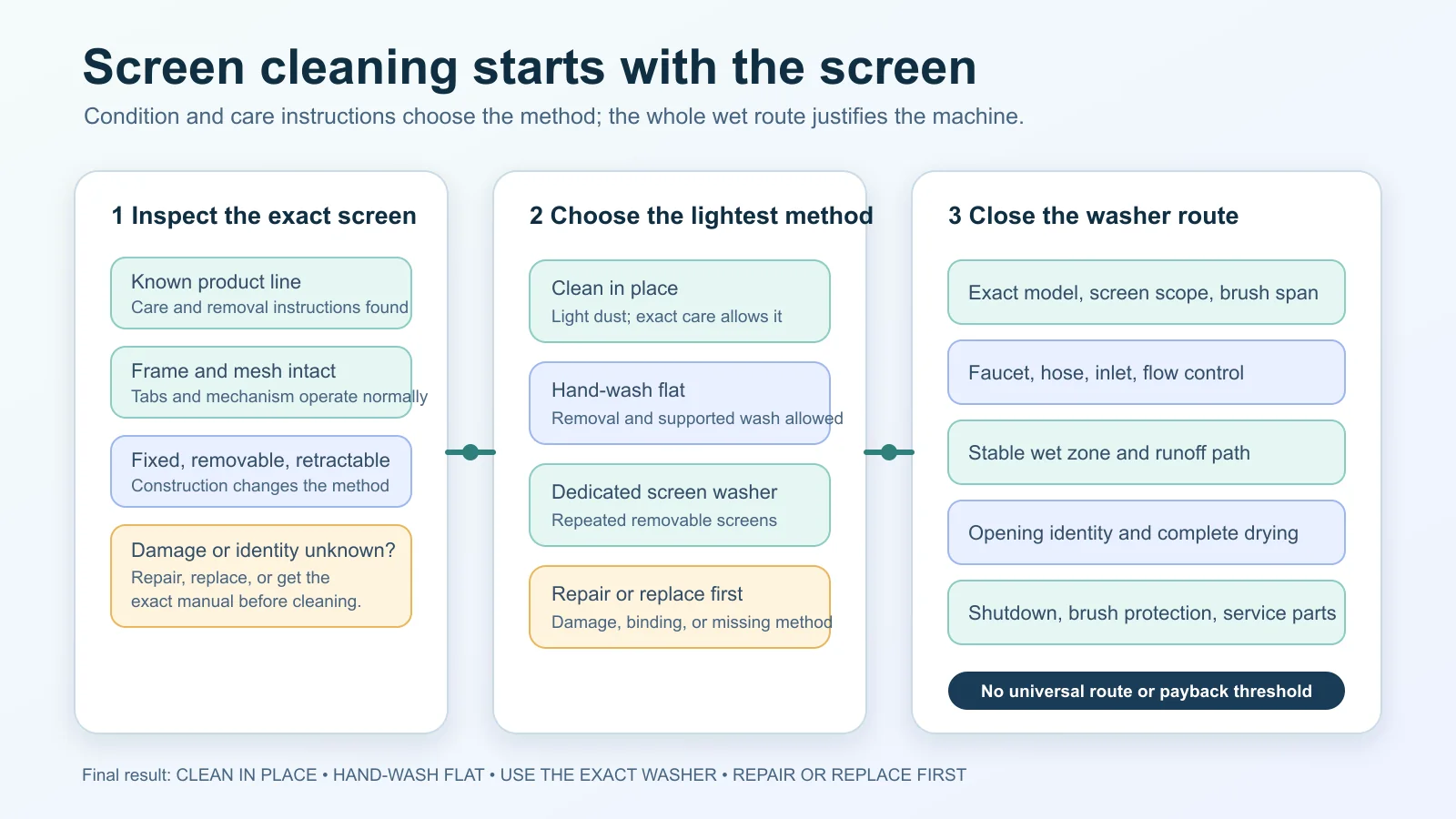
Use four working outcomes: clean in place, hand-wash flat, use a dedicated washer, or repair/replace first. The machine enters the decision only after the screen and the wet work area both pass. The professional window-cleaning tool setup remains the owner of the complete route stack; this page resolves only the screen-cleaning branch.
The screen decides whether it comes out
Record the window or door brand, product line and screen type before choosing supplies. Note whether the screen is fixed, removable or retractable, and whether the frame is straight, the mesh is held evenly and the release parts work as the exact manual describes. Do not copy a tab, pin or flexing method from a different window line.
Current manufacturer directions show why one universal sequence is unreliable. Andersen’s current insect-screen article uses mild soapy water, a soft-bristle brush and a clean-water rinse, then calls for completely drying the frame. Pella starts ordinary screen care with a vacuum and upholstery-brush attachment; it allows a gentle sponge, hot water and mild detergent for grease spots, while telling owners to follow the exact product-line manual. Pella also requires a Rolscreen or Hidden Screen to be completely dry before it goes back into its stored position. A Marvin Coastline manual instead describes removing the screen, laying it on a flat clean area, rinsing away dust and debris with a garden hose, and letting it air-dry completely.
Those directions are not interchangeable recipes. They are examples of how construction changes the permitted method. If the product line or removal method has not been identified, obtain its manual before taking the screen out. If the mesh is torn, the frame is bent or a retractable mechanism binds, route it to repair or replacement instead of using cleaning force as a diagnosis. An insect screen is not a fall-prevention device, so the screen itself never makes an open window safe to work around.
Use the least aggressive method the instructions allow
| Outcome | Choose it when | What the route needs | Do not use it to hide |
|---|---|---|---|
| Clean in place | The exact care allows gentle vacuuming or spot cleaning and the screen has light soil | Protected interior surface, suitable soft attachment and complete drying where required | A damaged screen or an unverified retractable mechanism |
| Hand-wash flat | The screen can be removed under its own instructions and the maker permits a supported wash or rinse | Clean flat support, permitted brush or sponge, clean rinse and labeled drying area | Forced removal, harsh chemistry or unsupported frame flex |
| Use a dedicated washer | Removable screens repeatedly appear on the route and their care permits the machine’s water-and-brush method | Stable wet zone, compatible water connection, flow control, handling space, drying, storage and parts | An invented screen-count or payback threshold |
| Repair or replace first | Mesh, frame, pull tabs or operating mechanism are damaged, or no verified method is available | Exact part/window identity and a repair or replacement path | Extra pressure, repeated passes or a generic removal trick |
The method can change by opening on the same property. A conventional removable screen may qualify for a supported wash while a nearby retractable screen stays in place. Keep each screen tied to its opening and its care instruction rather than writing one property-wide method.
A washer is a route decision, not a single-screen shortcut
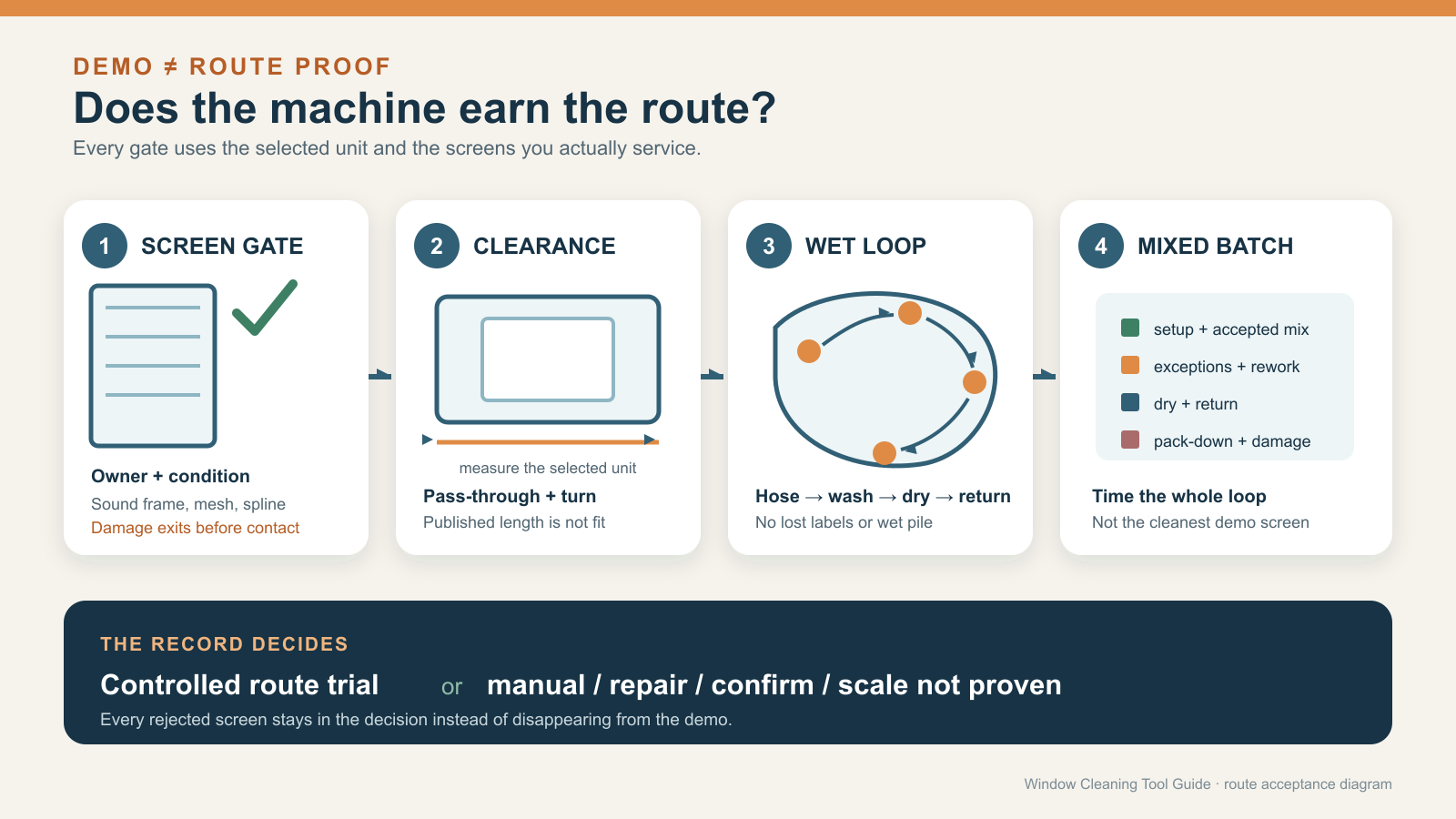
A dedicated washer can remove repeated hand-scrubbing from a route, but a product page cannot tell you whether that benefit exceeds the setup, water, drying and vehicle space your route actually requires. There is no defensible universal number of screens at which a machine becomes worthwhile.
Log your own route before buying. Count only screens that can be removed and cleaned by the proposed method. Record the time spent on identification, removal, carrying, setup, washing, drying, reinstallation and shutdown. Also record the wet area available at the typical property, the water source, hose path, drainage plan, stored machine envelope and the parts you can actually replace. A route with many unremovable or specialty screens does not create the same machine workload as the same headline screen count made up of standard removable units.
The equipment requirement should name the exact screen scope, brush assembly, water inlet, water control, movement, dry condition, shutdown steps, stored dimensions and service parts. If a field that changes fit or operation is absent, ask the manufacturer or keep it open. “Portable,” “fast” and a garden-hose photo do not close those fields.
Current machines publish different parts of the answer
| Exact current machine | Brush and screen handling | Water and control | Drying and shutdown | Still needed before order |
|---|---|---|---|---|
| XERO Screen Cleaner, SKU 209-60-01-XP | Flexible bristles; one screen at a time in circular motions, turning it periodically | Garden hose; pure water not required; operating flow control is not stated on the captured page | Air-dry before return; current page links valve, foot, plug, elbow and brush-set replacements | Brush span, pressure/flow, stored dimensions and full shutdown sequence |
| IPC Screen Washer II | Overlapping 36-inch brush assembly; move back and forth and rotate four times | Garden hose or tap water; foot lever operates a 1/2-inch brass ball valve | Remove most water and allow to dry; isolate, relieve, disconnect, drain and protect brushes | Complete machine dimensions, water pressure/flow and vehicle fit |
| Tucker Screen Cleaner, SKU T-SC | Water-bar brush; move the residential insect screen back and forth | Garden-hose inlet and foot valve | Manufacturer says towel dry; shutdown and drainage are not stated | Brush span, exact service parts, drainage sequence, stored dimensions and vehicle fit |
The 36-inch IPC number describes its brush assembly; it does not prove the widest or tallest screen the machine can accept. Likewise, a garden-hose inlet does not identify thread form, pressure, flow or a compatible quick-connect set. Close the physical water line separately.
The product pages also use performance language that is not a neutral comparison. XERO says the machine is faster than hand work, IPC describes simultaneous two-sided cleaning, and Tucker describes quick work and stability. Treat those as manufacturer claims. Your route log—not the adjective—decides whether the equipment earns its space.
Build the wet zone before the first screen comes out
Start with a flat, stable machine or hand-wash position where water can be controlled without sending it through an entry, across a walking route or into an unsuitable runoff area. Keep removed screens upright or supported as their instructions require; never make the mesh carry the frame’s load.
Give every removable screen a reversible opening identity before it joins the wash queue. Preserve orientation where it affects reinstallation. Run a clean-side and wet-side sequence so a finished screen does not return to the brush, ground or dirty towel pile.
For a washer, trace the faucet, hose, shutoff and machine inlet before setup. The separate garden-hose connection record explains why nominal size and a quick-coupler label are not enough. The machine’s foot control manages water at the unit only when the exact product documents that control; it does not fix an upstream connection that has not been specified.
Move the screen only as the machine manual and window care allow. Afterward, place it in the planned drying position and protect the frame from contact damage. If towel drying is permitted, assign a clean cloth to that role rather than reusing the cloth that handled tracks or frames; the route-cloth guide keeps those jobs separate.
Shutdown belongs in the purchase decision. The IPC manual explicitly calls for turning off the supply, relieving hose pressure, disconnecting, draining the spray bar and storing the machine so the brushes are protected. If another machine does not publish the same sequence, do not copy IPC’s parts or steps into it—obtain that model’s instructions.
Close the job with a reinstall record
| Record field | Ready value | Hold when |
|---|---|---|
| Opening identity | Screen is tied to its exact window or door and orientation | Two screens can be confused after washing |
| Screen condition | Frame, mesh, tabs and mechanism passed inspection or were repaired | Damage or binding remains |
| Approved method | Exact care supports the in-place, flat-wash or machine path used | The method came from another product line |
| Machine requirement | Model, screen scope, brush, inlet and control are recorded | A fit-changing field is unpublished |
| Wet route | Water connection, stable work area and runoff path are ready | Hose, control or work-zone condition is unresolved |
| Dry state | Screen meets its exact complete-dry or towel/air-dry instruction | A retractable or stored screen remains damp |
| Shutdown and storage | Water is isolated, pressure or drainage handled and brushes protected as documented | The machine cannot be drained, protected or carried as planned |
Write the final result beside that record: clean in place, hand-wash flat, use the exact dedicated washer, or repair/replace first. A clean screen in the wrong opening, a damp retractable screen or a machine without a workable wet route is not a completed screen-cleaning system.