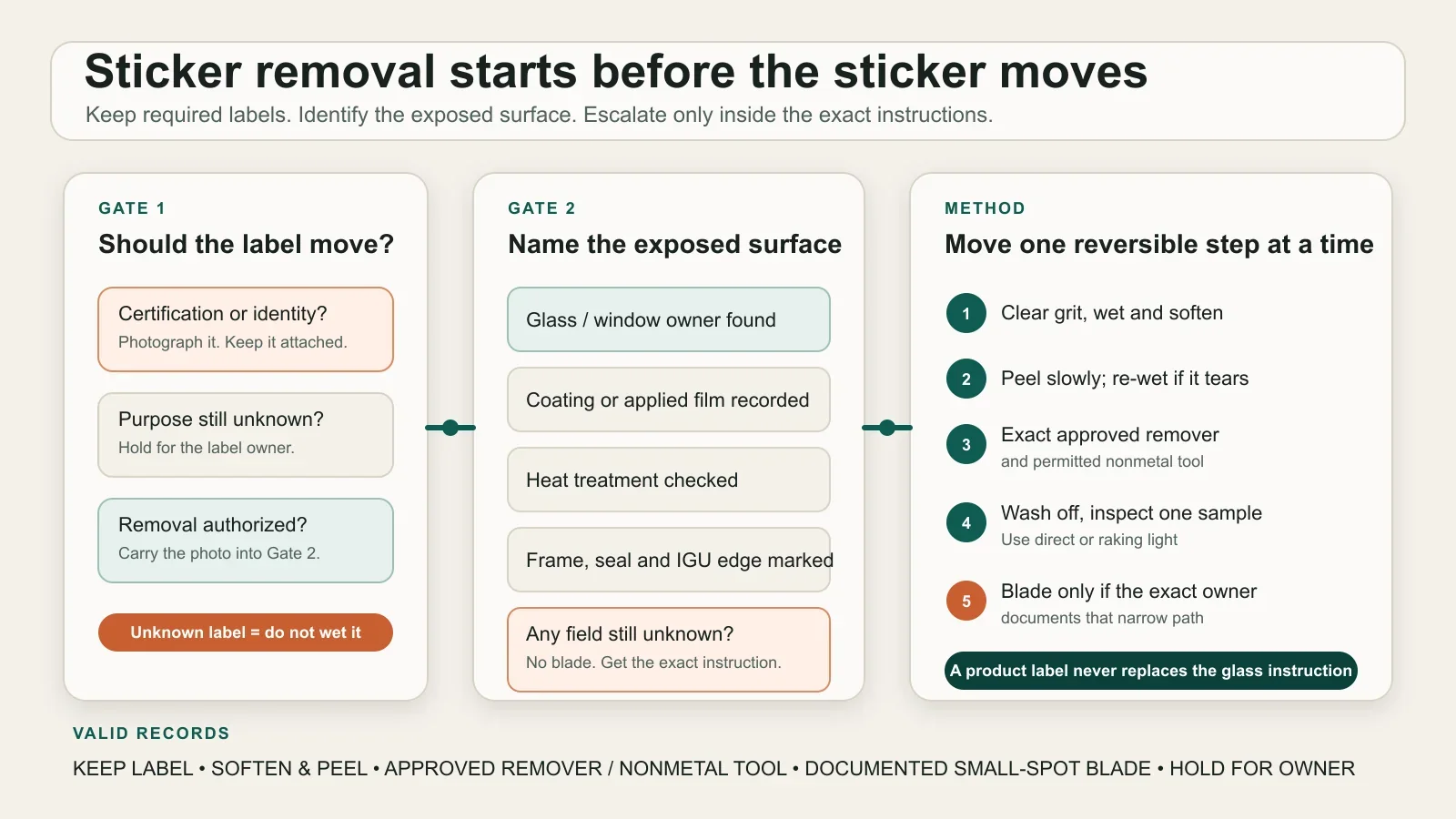
Before you wet a sticker on window glass, take one clear photo of the label and the surrounding frame. The photo may preserve a certification mark, a product identifier or the only clue to the glass owner’s cleaning instructions. Once the paper and ink dissolve, that clue is gone.
Next, identify the exposed surface. A window may have heat-treated glass, an exposed architectural coating or an applied film even when it looks like an ordinary clear pane. If the window product, coating side or cleaning instruction is unknown, do not reach for a metal blade. There is no blade rule that applies to every pane.
The useful sequence is narrower than the remedy lists found in most search results: decide whether the label should remain, find the surface instruction, start with the least aggressive liquid and tool that instruction permits, and prove the method on a small area before expanding the job.
Sticker removal is only one specialized task inside a professional window-cleaning tool setup. The complete tool guide owns the rest of the route; this page owns the label, adhesive and surface decision.
Some labels are part of the window, not the mess
Do not assume every adhesive label is temporary packaging. The current FGIA certification FAQ says removing an AAMA Gold Label voids the product certification. It also warns that the label may not come away in one piece and that the remaining material may be impossible to remove completely without damaging the surface to which it was attached.
If the label identifies a certification, rating, window line or warranty record, leave it in place until the window owner or manufacturer confirms what may be removed. A customer’s request to make the pane look clean does not turn an unidentified label into trash.
| What you know before starting | Permitted next move | Working result |
|---|---|---|
| The label is an AAMA Gold Label or another required certification mark | Photograph it and leave it attached | Keep certification label |
| The label’s purpose is unknown | Identify it from the window documents, installer or manufacturer | Hold for label owner |
| The label may be removed, but the glass or exposed coating is unknown | Find the exact glass/window cleaning instruction; do not use a blade | Hold for glass owner |
| The label and surface are identified, and mild wet cleaning is allowed | Begin with the documented wash or softening route | Soften and peel |
| The exact surface instruction and remover label both permit the proposed liquid/tool | Test a small area, inspect it, then continue only within that scope | Use approved remover/tool |
This gate is the first half of the job record. It prevents a successful adhesive removal from becoming a failed certification or warranty decision.
Map the exposed surface before choosing chemistry
Record the window or glass manufacturer, the product or unit when available, which side is being cleaned and any indication of coating, film or heat treatment. Also mark whether the residue touches the frame, glazing seal or the edge of an insulating glass unit. Those adjacent materials can be the limiting surface even when the center of the glass tolerates the cleaner.
The current Vitro TD-142 glass-cleaning document illustrates the level of detail that matters. It calls for clean, grit-free cloths and enough permitted wash solution to carry loose debris away rather than dragging it across the glass. For the Vitro surfaces within its scope, it names solvents that may be used for grease or glazing materials, but warns against excess strong solvent near glazing materials and insulating-glass seals. It also gives separate restrictions for Solarcool and Vistacool coated glass.
Coatings can be stricter. Guardian’s Clarity maintenance guide directs the user to pre-moisten the coated surface, work with low pressure and a nonabrasive cloth, and never use a scraper or razor blade. That rule belongs to Clarity; it is evidence that “glass” is not a complete surface description.
Write the instruction owner beside the job. If the best available description is “probably ordinary glass,” the surface line is still open. Do not let a household cleaner label, a scraper package or the absence of visible tint fill it.
Remove the sticker in reversible stages
Once the label is cleared for removal and the surface instruction is known, work from the easiest step to reverse toward the hardest. Do not stack several liquids together; a mixture makes it difficult to know which product caused a haze, softened a seal or left the final film.
| Stage | Action | Move forward only when | Return or stop when |
|---|---|---|---|
| 1. Clear loose grit | Use the glass owner’s permitted wash solution and a clean, grit-free cloth around the sticker | The work area is wet and free of particles that could be dragged | Grit remains trapped at an edge or the permitted wash method is unknown |
| 2. Soften the label | Keep the paper or film wet with the permitted mild solution for a short trial | A corner releases without force and the surface shows no change | Liquid reaches an unverified frame/seal or the label may be protected |
| 3. Peel slowly | Draw the loose material back at a low angle, re-wetting when it tears | The sticker releases while the adhesive stays localized | The film stretches, coating lifts, printing transfers or force rises |
| 4. Treat remaining adhesive | Use one exact remover or solvent only when both its label and the glass instruction permit it | The test area clears within the product’s own directions | Haze, color transfer, seal contact or an optical change appears |
| 5. Add a tool only if permitted | Use a fingernail or exact nonmetal tool within the surface instruction before considering any metal edge | The tool and surface method are both documented | Tool marketing is the only evidence, or heat-treated/coated status is unresolved |
| 6. Remove the remover | Follow the cleaner label and glass owner for the final wash, rinse and dry | No adhesive, cleaner film or disturbed edge remains | Residue persists or the finish looks different under useful light |
An old, sun-exposed sticker may need more time at an allowed stage, but age does not create permission for a stronger chemical or sharper edge. If the label resists, repeat the last approved step or pause for the surface owner instead of skipping a gate.
The blade rule changes with the glass owner
“Can I use a razor?” has no honest yes-or-no answer without the exact glass instruction. Current manufacturer documents reach different boundaries:
| Current guidance | What it says about tools | What S021 does with it |
|---|---|---|
| Vitro TD-142 | Do not use metal scrapers or tools. In extreme cases an appropriate solvent and carefully used plastic scraper may work, yet on heat-strengthened or tempered glass even a plastic scraper can dislodge fused surface debris and cause damage. | No metal blade on the Vitro path; plastic remains conditional, not automatic. |
| Guardian Clarity | Pre-moisten and use a soft nonabrasive cloth; never use a metal blade, scraper or razor on the coated surface. | The path stays liquid/cloth only within the exact Clarity instructions. |
| Guardian SunGuard HD | Widespread scraping is discouraged. If normal cleaning cannot remove a small spot, the guide describes a new one-inch blade only on non-coated glass, moved in one direction rather than back and forth. | This is a narrow documented exception, not permission for unknown, coated or differently owned glass. |
The deciding document is the one that owns the glass in front of you. Never copy Guardian’s non-coated exception into a Vitro, Clarity or unidentified-surface job. When a metal or plastic scraper is explicitly allowed and a purchase is actually needed, the separate window-scraper guide closes the holder, blade, replacement and protective-storage decision. It does not supply missing surface permission.
A remover label closes one field, not the whole window
A commercial adhesive remover can be useful after the glass route allows it. Keep the exact product name attached to the dwell, cleanup and excluded-surface directions rather than writing “adhesive remover” as if all formulas were interchangeable.
For example, the current Goo Gone Glue & Tape Remover page lists glass among its hard-surface uses. It calls for an inconspicuous pre-test, then apply, wipe and wash; for extra residue it gives a 5–10 minute dwell. Those are directions for that exact product. They do not prove compatibility with an exposed architectural coating, applied film, IGU seal or frame finish.
Apply a permitted liquid to a controlled cloth or small working area when the window instruction calls for protecting edges. Follow the product label and safety document for handling and ventilation. Do not borrow a dwell time from Goo Gone for alcohol, a citrus aerosol, another brand or a homemade mixture.
A plastic tool has the same two-owner problem. The tool maker can declare its intended use; the glass maker controls the surface. If the glass instruction warns that even a plastic scraper may move fused debris on heat-treated glass, a “won’t scratch glass” product claim cannot cancel that warning.
Let one small area decide whether the job expands
Choose a small part of the actual residue where a change can be seen, not a different pane assumed to be equivalent. Record the label photo, glass owner, exposed surface, cleaner, tool and start time. Use only the approved stage, remove its residue, then inspect before treating the rest.
Guardian’s SunGuard guide recommends cleaning one small area or one window and examining it for damage. It notes that some light scratches are much easier to see in direct sunlight than under a gray sky. Use available direct or raking light when you inspect; a quick straight-on look is a weak release test.
Continue only when the sample is clean, the optical appearance is unchanged, the edge materials stayed protected and the next area has the same documented construction. Stop when you see haze, fine lines, coating disturbance, color transfer or liquid where the instruction did not allow it. Photograph the result before changing chemistry or tools.
Use a genuinely clean finishing cloth rather than the one that handled dirty frames or adhesive. The window-cleaning microfiber cloth guide explains how to keep clean-detail and dirty-frame roles separate; its product-care instructions do not replace the glass or remover directions used here.
The completed record does not have to say “sticker removed.” It can say keep the certification label, soften and peel, use the approved remover and permitted nonmetal tool, use a documented small-spot blade path, or hold for the glass owner. Each result is more useful than a clean-looking pane reached by guessing which label, coating or edge could absorb the damage.