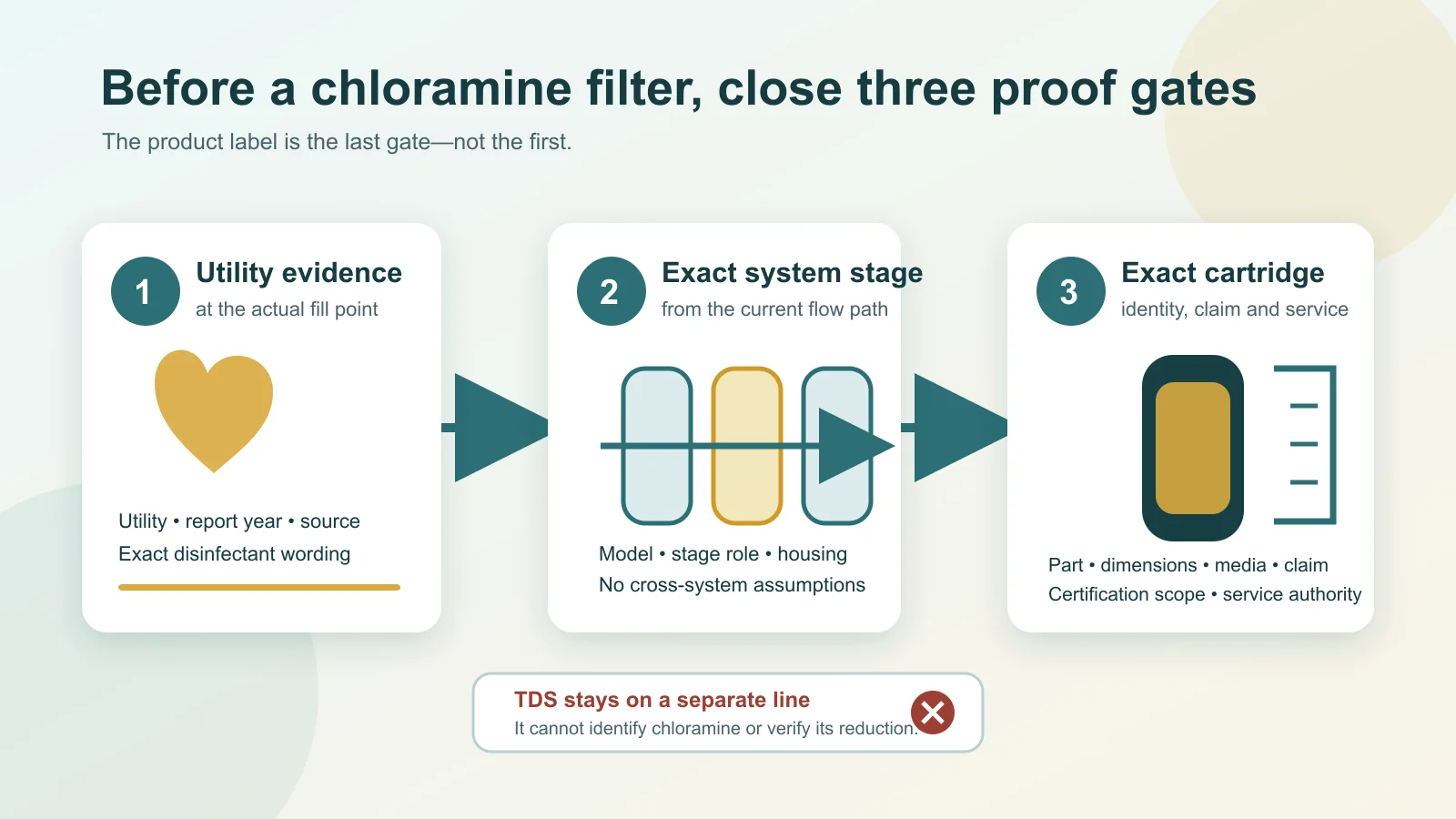
A chloramine filter is not the first thing to buy after seeing the word chloramine on a product page. First prove that the water used on the route is chloraminated. Then prove that the exact window-cleaning system has a documented place for that exact cartridge.
If either authority is missing—the water utility or the machine documentation—pause the order. A TDS reading, a “10-inch carbon” label and a cartridge that looks right cannot fill those gaps.
This is one prefilter decision inside a complete water-fed pole system. It does not redesign the filtration train or turn a generic housing into an authorized chloramine stage.
First, find the disinfectant at the route address
The EPA says chloramines are most commonly formed when ammonia is added to chlorine and that they provide longer-lasting disinfection as water moves through distribution pipes. It also says many, not all, public water systems use them. That distinction matters: a national explanation establishes possibility, not the water treatment at one service address.
Use the current water-quality report or disinfectant page from the utility that serves the fill point. Record the utility, report year and exact wording. Useful terms include chloramine, monochloramine, combined chlorine and secondary disinfectant. If a report describes only a residual without naming the disinfectant, ask the utility rather than interpreting the number.
Well water, purchased water and fills made in another service area require their own records. The customer’s window address is not automatically the same as the location where the tank or system was filled.
| Evidence at the fill point | What it supports | What it does not support |
|---|---|---|
| Current utility document names chloramine or monochloramine | A chloramine-specific equipment check is relevant | That any particular cartridge fits or performs as needed |
| Utility document names free chlorine instead | Keep the documented current treatment path unless the system owner says otherwise | A chloramine upgrade based on another city or an old report |
| Disinfectant is unclear or the source changes | Contact the utility and hold the cartridge decision | Guessing from odor, TDS, location or a national map |
Follow the machine’s water path, not the cartridge aisle
Once chloramine use is confirmed, trace the exact machine from its inlet. Photograph the manufacturer label and record the model and variant. Then read the current stage order from the owner manual or manufacturer-authorized support page.
Current XERO documentation shows why this step cannot be skipped. The XERO Pure Plus product page describes a sediment filter followed by a chloramine filter before the RO membrane. Its compatible-replacement list names both stages separately. A separate XERO Pure support record describes that system with a combined sediment-carbon prefilter. Brand familiarity does not make those layouts interchangeable.
| Documented path | The question to close | Unsafe shortcut |
|---|---|---|
| Dedicated chloramine stage | Which exact cartridge and housing does this stage require? | Dropping the cartridge into any available 10-inch housing |
| Chloramine cartridge replaces a carbon stage | Does the exact system authority permit that substitution? | Replacing a combined carbon/sediment stage because both contain carbon |
| Combined carbon/sediment stage | What combined role and exact part does the manual specify? | Adding another stage or splitting roles without manufacturer authority |
| No current chloramine path found | Can the manufacturer document an approved change? | Designing a plumbing modification from catalog dimensions |
The separate sediment filter cartridge guide handles housing, cartridge dimensions, micron basis, media and seating for that stage. Here those same physical fields matter only after the system has established a chloramine-specific role. A cartridge cannot create its own position in the flow path.
“10-inch carbon” is not a complete product record
The current specialist page for XERO part CMCM-2510-0.5 supplies several useful facts. It displays a 2.5-by-10-inch format, “0.5 micron” wording and a catalytic coconut-shell activated-carbon block. The page claims reduction of chloramine, chlorine and odor, and the seller states that the cartridge can replace a carbon filter in compatible 10-inch applications.
Keep each statement at that exact scope. The captured page does not state whether the micron value is nominal or absolute. It does not publish the complete flow direction, seal arrangement, pressure limit, rated chloramine challenge or capacity needed to turn the product description into a universal service plan.
Certification language needs the same care. The description says the carbon blocks are made with NSF-certified components. That is not the same statement as an independently verified chloramine-reduction certification for the finished cartridge. Record “certified components” unless a current certificate identifies the complete product, standard, claim and model.
| Field | Closed on the current CMCM-2510-0.5 page | Still needs exact authority |
|---|---|---|
| Identity | Product name, part number and displayed SKU | Confirmation that the selected item is still the same revision |
| Physical description | 2.5 by 10 inches; 0.5-micron wording | Micron basis, ends, seal and flow direction |
| Media and claim | Catalytic coconut-shell activated-carbon block; chloramine-reduction claim | Rated test conditions, capacity and finished-product certification scope |
| System relationship | Partial seller compatibility statements | Exact machine, stage, pressure and service sequence |
| Replacement | Seller answer says use affects timing | A route-specific trigger supported by exact product/system authority |
Do not use TDS as the missing chloramine test. A TDS meter estimates dissolved solids from conductivity; it is useful at feed, product-water and brush-end measurement points, but it does not identify the disinfectant. A low or unchanged TDS reading therefore cannot prove that chloramine is absent or that a carbon stage is working. Use the TDS meter guide for the measurement job it can actually perform.
Make one record that survives the next service date
The useful asset is not a generic filter checklist. It is one source-to-system record tied to the fill point, machine and installed part. Save the evidence beside the equipment record so the next change does not restart with a cartridge photo and no context.
| Record line | What to save | Decision it controls |
|---|---|---|
| Source water | Fill address/source, utility, report date and exact disinfectant wording | Whether chloramine-specific treatment is relevant |
| Machine | Manufacturer, model, variant/serial and current flow-path document | Whether the system has a documented chloramine role |
| Installed stage | Stage position, current role, housing label and inlet direction | Whether the candidate belongs in this position |
| Candidate cartridge | Part number, complete dimensions, media, stated claim and certification scope | Whether the product identity and promise are sufficient |
| Service authority | Shutoff/pressure steps, direction, seals, tightening, replacement trigger and source date | Whether installation and future service can follow exact instructions |
| Closeout | Installation date, water volume if tracked, leaks, flow change and documented disinfectant-specific verification | Whether the system can return to service without inventing a performance result |
Post-service checks must stay within the exact instructions. Observe the housing for leaks and record flow behavior, but do not convert “no leak” into proof of chloramine reduction. If the manufacturer specifies a verified disinfectant test or performance check, record that method and result separately. Otherwise the reduction result remains unverified.
The same rule applies to replacement timing. Calendar reminders are useful prompts to inspect the record, not proof that a cartridge is exhausted. Source concentration, flow, gallons processed and product capacity affect the decision, and the captured product page does not close all of those inputs. DI resin life and TDS records remain separate because carbon-stage condition and DI exhaustion are different questions.
Let the first missing field choose the next action
| Evidence state | Action now | Reason |
|---|---|---|
| Current local evidence does not show chloramine | Keep the documented current stage | A chloramine-specific purchase has no demonstrated route need |
| Chloramine is confirmed and the exact system names a compatible cartridge with service instructions | Install that exact documented cartridge | Source need, system role and product fit point to the same path |
| Fill-point disinfectant is unknown or changes across routes | Get current utility evidence | The equipment decision cannot start from an unidentified source |
| Chloramine is confirmed but the machine stage or housing is unclear | Ask the system manufacturer for the exact model path | A cartridge page cannot authorize a machine modification |
| Fit is documented but rating, certification scope or service trigger is still required | Get the exact certificate or technical record | Marketing wording cannot close the missing performance authority |
The shortest defensible order is therefore: utility evidence, machine stage, exact cartridge, service authority. Stop at the first blank line. That may delay one order, but it prevents a much more expensive result—adding the wrong stage, removing a combined treatment role, or believing a TDS number answered a disinfectant question.