“Universal” appears in the seller title for Ettore part 45006. Ettore’s own page gives it a narrower home: Professional REA-C-H aluminum poles. The standard Ettore angle adapter, part 48520, follows another pole-tip path, and a specialist seller explicitly says it will not work with the Pro+ pole tip.
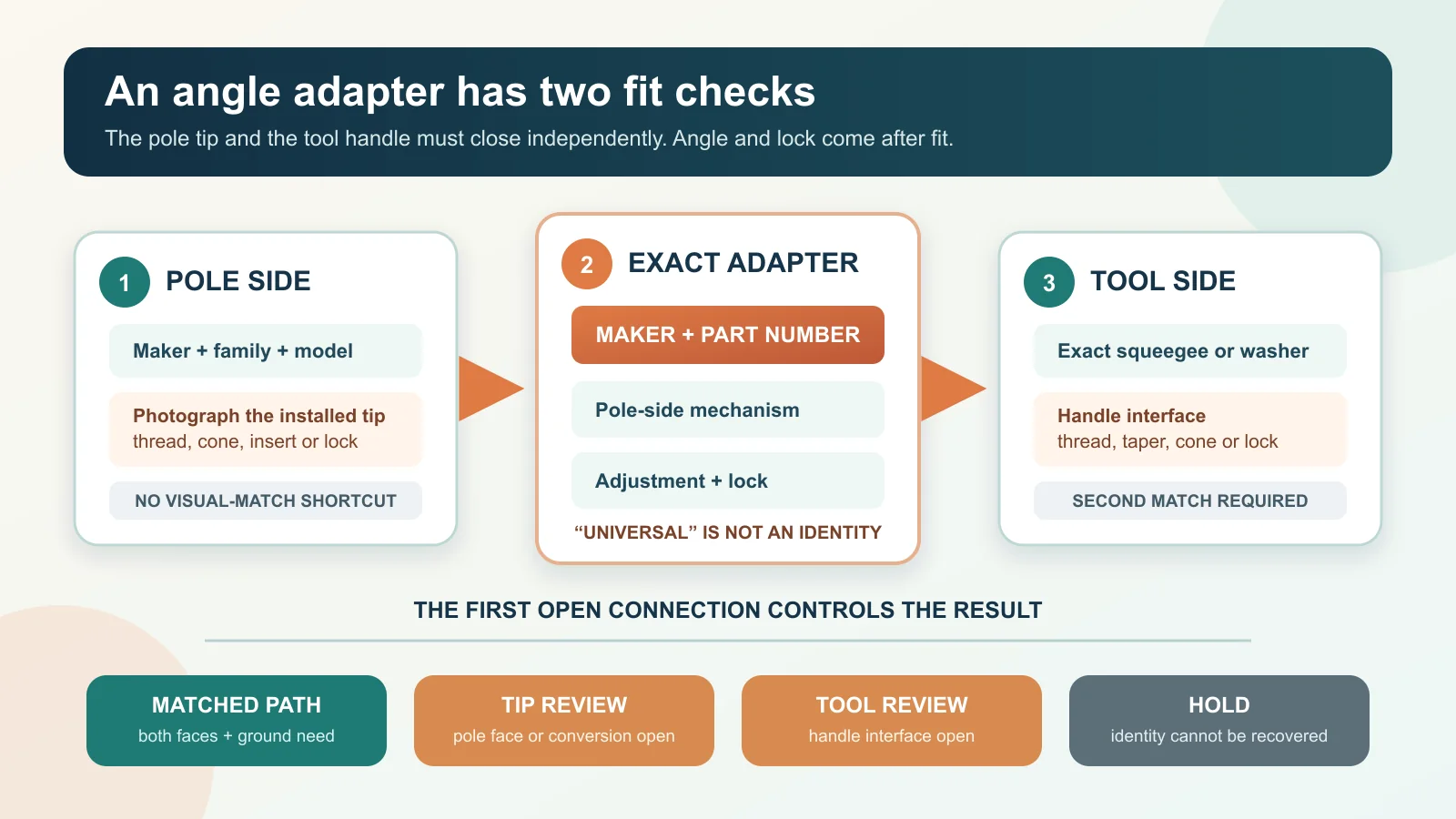
That is the purchase problem in miniature. An extension pole angle adapter has two connection faces. Its underside must match the pole body and the tip already installed; its other side must accept the exact squeegee, washer or handle. An adjustable joint can solve an awkward glass angle only after both faces are identified.
Before shopping, photograph the complete pole label and the end from the side and straight on. Record manufacturer, family, model or generation, and every removable cone, tip, thread, insert or quick-release part. If the tip is missing, modified or impossible to identify, the next action is manufacturer confirmation—not a search for the closest-looking thread.
Photograph the pole end before opening another cart
A cart photo usually shows the adapter, not the evidence on your pole. Preserve the pole label and installed tip while they can still be tied together. A brand name without a family is weak: one manufacturer can sell standard, professional and quick-release systems at the same time.
Take one full-label photo, one side view of the installed end and one straight-on view. Write down any molded number, removable tip, locking button, external thread or insert. Do not remove a part merely to discover what may be beneath it; the pole manufacturer should define whether a conversion exists and which current instruction controls it.
Write the tool side separately. Name the complete squeegee or washer, exact handle or part number, and its connection. “Pole compatible” can describe a tool family while leaving the required cone, thread or click-lock unnamed. If the actual working head is still undecided, finish that choice before buying its joint. The exact Ettore Mighty washer, Unger squeegee system or Ettore ProGrip squeegee defines its own handle and service parts.
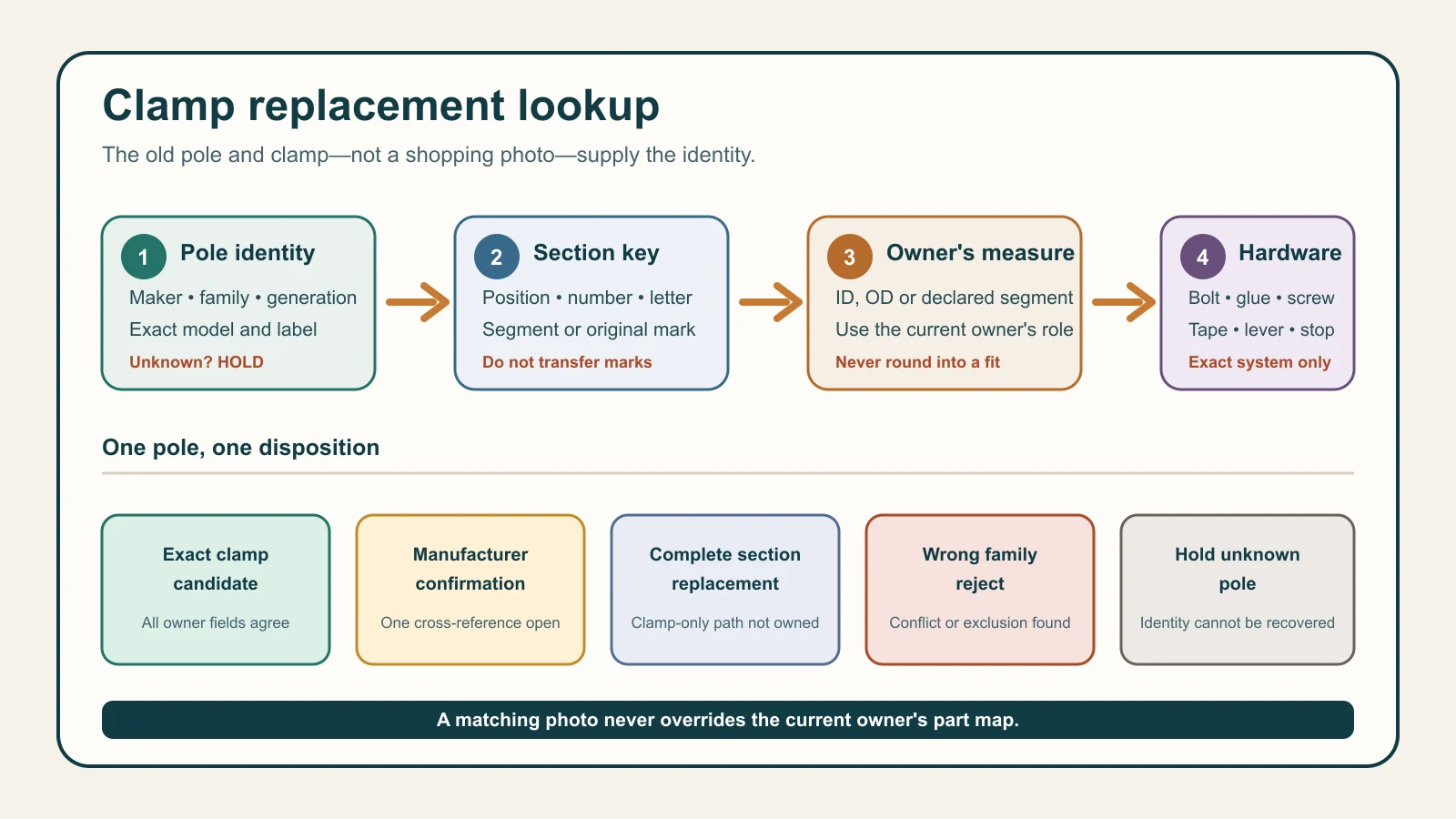
This article begins after the pole itself has been selected. Return to the water-fed pole guide when reach, material, transport or the complete pole assembly is still open. If the problem is a slipping or broken section clamp rather than the end connection, use the telescoping-pole clamp replacement lookup.
One adapter, two independent fits
Read the joint from left to right: identified pole, observed installed tip, exact adapter part, then exact tool handle. The angle and lock belong after that chain. A single matching word on opposite sides of two listings is not a closed connection.
| Connection field | Record from the selected assembly | Evidence that can close it | Result when open |
|---|---|---|---|
| Pole identity | Maker, family, model or generation and full label photo | Current exact pole page, catalog or manufacturer reply | Missing-identity hold |
| Installed pole face | Tip, cone, thread, insert, button or quick-release as currently assembled | Photos plus the named interface in the pole or adapter documentation | Pole-tip conversion review |
| Adapter identity | Manufacturer and exact part number—not only a seller title | Current manufacturer product or catalog | Missing-identity hold |
| Tool face | Exact squeegee or washer handle and thread, taper, cone or lock | Current tool and adapter documents naming the same interface | Tool-interface review |
| Adjustment | Declared adjustment and positive-lock or system mechanism | Current exact adapter page; model-scoped wording only | Hold the functional claim |
| Ground geometry | Usable standing zone, pane angle and chosen tool route | The recurring job record and responsible worksite decision | Do not add the joint yet |
The first open field controls the result. A known standard pole with an unnamed washer handle is a tool-interface review, not a probable match. An exact adapter beside an unidentified pole tip is still a missing-identity hold. Words such as ACME, threaded, universal and pole-ready describe features; none carries all four identities through the card.
Ettore 48520 and 45006 split at the pole tip
The current Ettore 48520 product page places that adapter on the standard REA-C-H path, gives it a threaded-handle tool side and calls it fully adjustable. Ettore’s current adapter comparison lists heavy-duty plastic, a weight of 0.198 lb and dimensions of 2.00 by 4.75 by 5.75 inches for this exact part. Those facts identify 48520; they do not identify the pole in your truck.
The current specialist 48520 cart adds an important negative: it says the adapter does not work with the Pro+ pole tip. The same seller reports fit with certain named Garelick, Moerman and Mr LongArm products, while its Q&A distinguishes two Unger thread observations. Treat those as seller-tested observations, not a manufacturer-issued cross-brand map. A different model, tip revision or unlisted pole remains unresolved.
The current Ettore 45006 product page instead names Professional REA-C-H aluminum poles, a threaded tool tip and a ratcheting positive-lock adjustment. The manufacturer comparison lists polypropylene, 0.258 lb and dimensions of 1.25 by 6.25 by 2 inches for 45006. Its specialist cart says the standard pole tip must be removed and that the adapter does not fit over it.
| Exact part | Named pole lane | Tool side and adjustment | Boundary before ordering |
|---|---|---|---|
| 48520 Angle Adapter | Standard REA-C-H path | Threaded-handle tools; fully adjustable | Specialist seller excludes the Pro+ pole tip; unlisted cross-brand fit remains unproven |
| 45006 Pro+ Angle Adapter | Professional REA-C-H aluminum poles | Threaded tool tip; ratcheting positive lock | Seller says remove the standard tip and does not say the adapter fits over it |
| Unidentified or mixed cart | Unknown, assumed or based on appearance | Generic thread or feature wording only | Recover the exact part and both interfaces; do not choose by “Universal” |
The seller’s “Universal” title therefore cannot be the compatibility decision. If the pole is an exact Professional REA-C-H model and the manufacturer confirms the required tip state, 45006 can enter a system-specific candidate line. If removing or replacing the tip is still an assumption, the result is pole-tip conversion review.
Keep NCPAN inside the Unger connection system
Unger’s current US product catalog identifies NCPAN as the Ninja Angle Adapter and names compatible Unger pole families. Its current Ninja Carbon pole page describes a quick-release angle adapter and a universal locking cone compatible with Unger tools.
The second half of that statement matters. “Universal locking cone” remains bounded by Unger’s named tool scope; it is not a promise that any threaded or tapered handle from another brand locks correctly. Identify the exact Unger pole model and the working tool before treating NCPAN as a system-specific candidate.
This boundary works in both directions. An exact Unger squeegee record can identify its handle and pole interface, but it cannot approve an Ettore adapter. An Ettore washer or squeegee can identify its own handle path, but a shared use case—cleaning glass from a pole—does not merge the hardware.
Let the glass angle earn the extra joint
Even a fully matched adapter is not automatically useful. Photograph or sketch the recurring pane from the usable ground position: lower and upper glass, deep sill, recess, canopy or another feature that prevents the selected head from meeting the glass in its documented route. Record whether that angle occurs often enough to justify another joint, part number and service item.
If a straight documented connection already gives the tool the needed contact from the approved standing zone, the cleaner cart is to omit the adapter. If the geometry does require an adjustable joint, preserve the exact need without converting it into a height promise. An angle adapter does not extend the pole’s documented working range, approve overhead work or authorize another access method.
Adjustment language also remains model-scoped. “Fully adjustable” describes 48520, while “ratcheting positive-lock” describes 45006. Neither phrase supplies a load rating, proves retention on the selected assembly or tells the operator how to use it. Those conclusions require the exact current instructions and the actual worksite record.
Finish with one line that another person can audit:
I have [pole maker / family / model] with [photographed installed tip]. I want to connect [exact tool / handle] through [adapter maker / part] for [ground-positioned glass geometry]. Please confirm the pole-side interface, any manufacturer-approved tip change, the tool-side interface and the current instruction for this exact assembly.
Place one result beside it: standard-thread candidate, system-specific adapter candidate, pole-tip conversion review, tool-interface review or missing-identity hold. Stop at the first open field. A cart becomes ready through a documented chain of exact parts, not through the number of products described as universal.