Ask how many surgical towels are in a 10-pound box and current listings answer with estimates, not a fixed conversion. WindowCleaner.com says approximately 50–60 for its Ultra Premium Recycled box. U.S. Wiping says about 55 for its SW-G-10 reclaimed green package. J. Racenstein estimates 5–6 per pound for ProTool 24-331 while warning that sizes, shapes, thicknesses and textures vary from box to box.
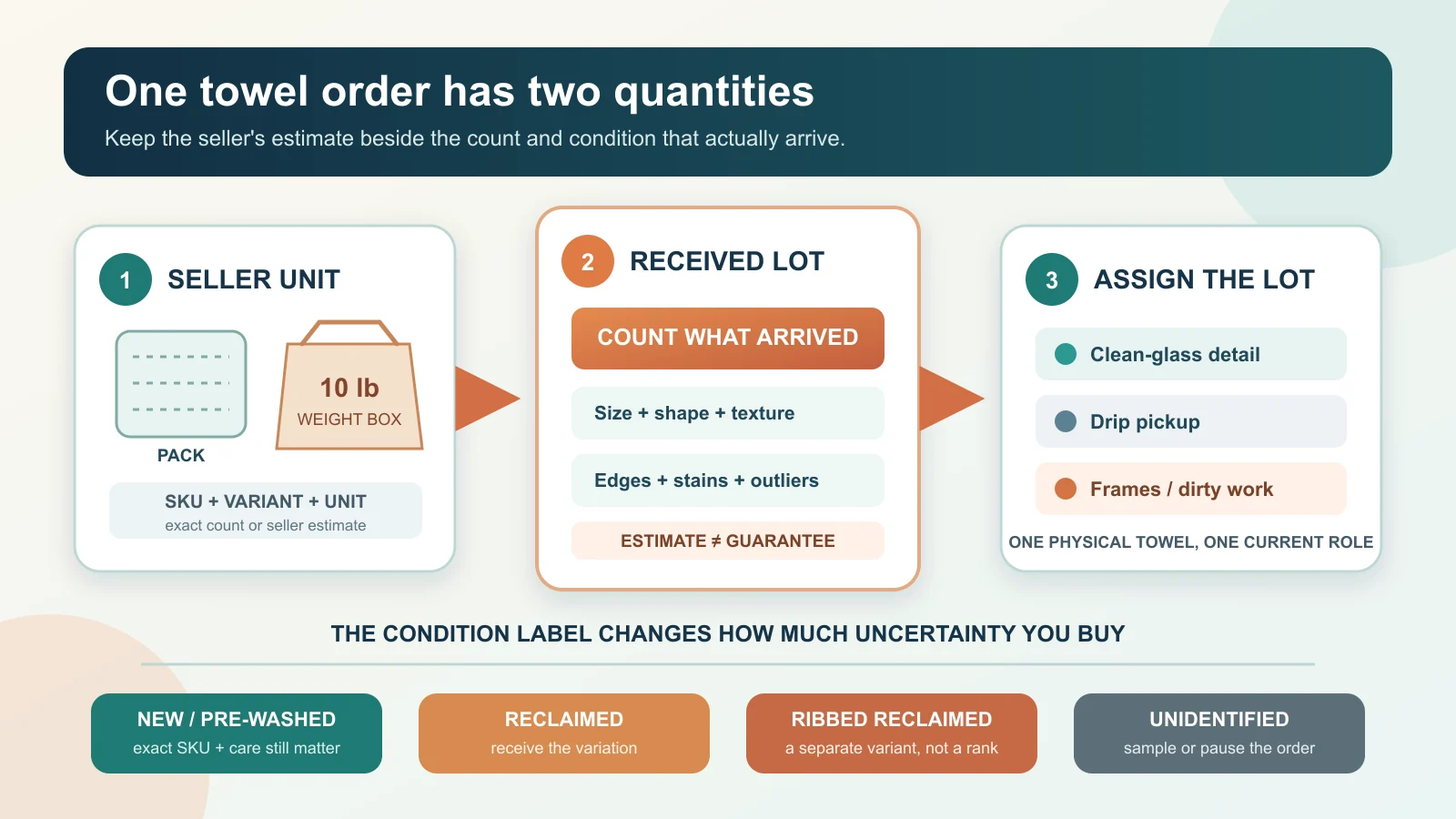
That is the buying lesson in one line: ten pounds identifies what the seller weighs; it does not guarantee how many interchangeable towels will arrive. Choose the exact SKU and sale unit first. Then decide whether its declared variation is acceptable at the quantity you are ordering, and inspect the delivered lot before giving any towel clean-glass duty.
This is narrower than assembling a complete professional window-cleaning tool setup. It also differs from choosing microfiber by weave and role. Here the difficult question is whether a commercial lot has enough identity and consistency to enter the route at all.
Ten pounds is a purchasing unit, not a towel count
A piece or count pack closes quantity before the box ships. A per-pound or 10-pound listing closes weight and may add an approximate count. Keep those fields separate.
For example, U.S. Wiping’s approximately 55 towels in 10 pounds implies about 5.5 towels per pound. That arithmetic helps estimate storage and receiving work for SW-G-10. It does not create a 5.5-per-pound rule for every reclaimed huck towel. ProTool 24-331 publishes its own 5–6-per-pound estimate and explicitly describes a mixed lot. The two pages support a similar planning range while still requiring separate product records.
Do not use the estimate to promise route capacity. The product pages do not know the panes, soil, wet pickup, laundering turnaround or number of clean towels your work consumes. Count the delivered lot, assign each accepted towel a job, and let actual turnover determine future quantity.
New, pre-washed, reclaimed and ribbed carry different uncertainty
New describes product condition, not readiness for every task. New pre-washed adds a seller-declared preparation state. The exact page or supplied label still needs to supply the applicable care instructions.
Reclaimed introduces prior use and usually more variation. Current sellers disclose differences in size, shape, thickness, texture, color or visual appearance. That does not make reclaimed towels unusable. It means consistency has to be treated as a purchase field instead of assumed from the category name.
Ribbed reclaimed is a separate variant, not an automatic upgrade. WindowCleaner.com gives its Ribbed Recycled Surgical Towels a different SKU and lists a ribbed texture, recycled/pre-washed state, 12-pack or 10-pound option and approximate size/count. Those facts identify the product; they do not establish that ribbed towels will outperform a non-ribbed lot on your glass.
The words lint-free and low lint also need their publishers. Several sellers use one or the other, but the pages are commercial claims rather than independent field tests. Preserve the exact wording, then judge the received towels under your own accepted work and care process.
Four current listings make four different promises
The exact examples are not ranked. Each one shows a different amount of quantity and consistency evidence.
| Exact current listing | What the page closes | What can vary or remains unknown | Sensible commitment |
|---|---|---|---|
| WCR Ultra Premium Recycled 241-15-21 | Recycled, pre-washed, cotton; pack choices or box; approximately 24 × 16 in; about 50–60 in the named box | Slight size variation plus color, texture and visual variation; delivered count and condition | Choose the exact pack or box, then receive it as a variable lot |
| WCR Ribbed Recycled 241-15-77 | Ribbed, recycled, pre-washed, cotton; 12-pack or 10 lb; roughly 50–60 per 10 lb; approximately 24 × 16 in | Size and color may vary; no independent performance comparison | Use only when the ribbed variant itself is wanted and inspect it separately |
| ProTool Recycled 24-331 | Per-pound SKU; pre-washed cotton; four-side hem; approximately 5–6 per pound | Roughly 14–15 in square through shapes up to 15 × 21 in; mix varies by box | Treat every weight order as a mixed-lot estimate |
| Windows101 L106 | One exact dark-blue recycled cotton SKU; approximately 22 × 12 in; declared for window cleaning and detailing | Seller performance and life claims are unverified; broader lot consistency is not established | Useful when this exact piece identity is the intended choice |
| U.S. Wiping SW-G-10 | Reclaimed cotton, low-lint, four-side hem; 10 lb; approximately 55 towels | Style, weave and color may change by order; seller says complete consistency is not guaranteed | Sample or plan a receiving check before a larger repeat commitment |
The most useful product is not the one with the strongest adjective. It is the one whose remaining uncertainty you can see and manage. An exact piece can reduce count ambiguity. A weight lot can be efficient for bulk restocking, but only if its estimate and variation are acceptable before the order is placed.
Open one box before assigning the route
Keep the listing open when the shipment arrives. The product page describes the seller’s promise; the carton supplies the missing facts.
Record the seller and SKU, selected condition, sale unit, published estimate and every declared variation. Then count the actual towels, note the observed size range, check hems and edges, and isolate any stained, damaged, contaminated or materially different pieces. Preserve the supplied care label or exact product instructions rather than importing a laundry rule from another cloth.
| At the carton | Copy before opening | Observe after opening | Result |
|---|---|---|---|
| Identity | Seller, SKU, selected variant and sale unit | Label and cart match | A mismatch pauses the lot |
| Quantity | Seller’s exact or approximate count | Actual received count | Store both numbers; do not overwrite the estimate |
| Consistency | Published size, color, weave, texture and condition variation | Actual range and outliers | Accept, split by role, or use a smaller sample next time |
| Construction | Material and hem or edge description | Tears, fraying, residue or unusual pieces | Isolate questionable towels |
| Care | Exact product instruction or not published | Supplied label and later care outcome | Follow only the matching product path |
| Assignment | Intended clean-detail, drip, frame/sill or dirty-work job | Which pieces meet that inventory standard | Admit by role, not by carton name |
A large first order makes sense only when the exact product is already known or the receiving variation is inexpensive to absorb. If count, consistency or care is still material to the decision, a smaller pack or sample is more informative than a bigger claim on the product page.
A color is useful only after it owns one job
Color can make an inventory boundary visible, but it does not create one. Assign the accepted lot deliberately: clean-glass detail, drip pickup, frames/sills or dirtier work. Once a physical towel enters dirty work, it is no longer part of the clean-detail stack until it completes the exact care path and again meets that stack’s condition.
If the route needs a different material-and-role decision, use the site’s window-cleaning microfiber cloth guide. If the unresolved issue is a scrim’s first-use preparation and US availability, use the scrim cloth guide. Surgical or huck selection begins earlier, at the commercial lot and what actually arrives.
Avoid making one color responsible for every job because the seller lists many uses. A towel described for glass, frames and general cleaning can perform only one current physical role at a time. Use another color or clearly separated stack for dirtier work when that makes the boundary easier to maintain.
Buy the uncertainty you can inspect
Choose a new or new pre-washed lot when consistency is important and the exact SKU closes the needed fields. Choose a reclaimed or ribbed lot when its seller-stated variation is acceptable and you can count and inspect the shipment before clean-glass use. Start smaller when the seller publishes only a weight, a wide size or texture range, or no usable care path.
Pause the purchase when the cart cannot identify the SKU, condition or sale unit. Those omissions cannot be repaired by a familiar blue or green photo.
The order is ready when you can say what is being weighed or counted, what the seller only estimates, what may vary, what you will inspect and which job the accepted towels will own. That is more dependable than asking the word surgical to promise a fixed count or a finished pane.