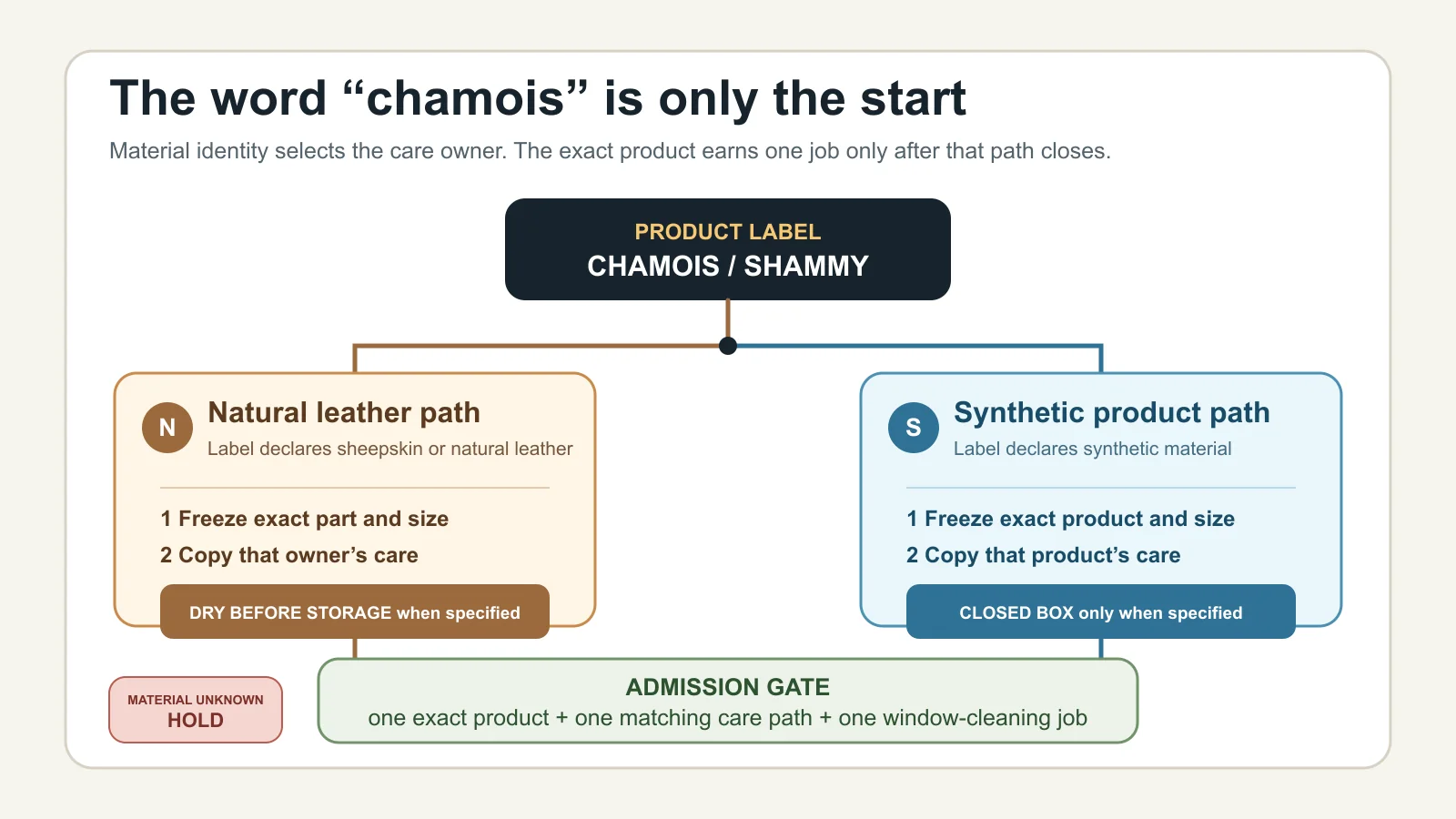
A product can use the word chamois without being leather. Unger identifies its professional FS450 and FS550 chamois as sheepskin. SONAX calls product 04177000 a Synthetic Chamois. Those are not two labels for the same material, and their care instructions should not be blended.
The storage difference makes the distinction consequential. A current natural-chamois care owner says to rinse natural leather, dry it away from direct sunlight and not store it damp. SONAX tells the owner of its exact synthetic product to rinse and wring it, fold it into the supplied box and keep that box closed. Generic “shammy care” cannot safely replace either product owner.
Before buying, freeze four things: the exact product, the declared material, the selected size and the matching care instructions. Then give the cloth one narrow job. If the label does not disclose material, or the care path is missing or contradictory, hold the purchase.
This is a small decision inside a complete professional window-cleaning tool setup. A chamois does not replace the squeegee, washer, bucket or the route’s other cloth roles simply because a seller lists several uses.
Read the noun after chamois
Color, feel and a product photo are weak identifiers. Start with the manufacturer’s or seller’s material line. Sheepskin, natural leather and synthetic lead to different records. A page that says only chamois or shammy has not closed the first field.
An exact part number matters because useful claims are narrow. Unger’s current product owner identifies FS450 and FS550 as sheepskin. Its current product catalog lists them at approximately 0.4 m² and 0.5 m². Those facts do not establish a care routine that the inspected Unger pages do not publish.
J. Racenstein’s current Chamois Natural page shows a 27-0M family with Small, Medium and Large choices and maps them to 2.5, 4 and 6.5 square feet with approximate rectangular dimensions. The body also mentions an X-Large even though the visible selector shows three sizes. That copy conflict is a reason to preserve the selected cart variant, not to invent a fourth choice.
SONAX closes a different object: art. no. 04177000 is explicitly synthetic, measures 43 × 32 cm and has its own use and storage path. Its facts do not transfer to another synthetic product merely because both are sold as a shammy.
| Exact listing or label | Material actually declared | Size the owner publishes | Care evidence available | Purchase disposition |
|---|---|---|---|---|
| Unger FS450 / FS550 | Sheepskin | Approximately 0.4 / 0.5 m² | Complete care not found on the inspected product/catalog owners | Request the matching current care instruction before committing |
| J. Racenstein 27-0M family | Natural chamois | Small 2.5, Medium 4, Large 6.5 sq ft; approximate dimensions | Seller says rinse after use and hand-wash with soap and water when needed | Freeze the selected size and preserve seller-scoped wording |
| SONAX 04177000 | Synthetic | 43 × 32 cm | Exact cold-soak, rinse, wring and closed-box path | Synthetic candidate only for the intended drying/glass task |
| Generic chamois or shammy listing | Not established | Any number remains attached to an unidentified material | Generic advice only | Hold until the material and current owner are named |
Seller claims such as lint-free, streak-free, absorption multiples, chemical resistance and long life are not material identifiers. They also are not independent field results. Keep them out of the purchase rule unless a current exact owner and your own accepted observation give them a legitimate role.
The storage instruction is the material test you cannot skip
The care path is where a vague label can become an expensive mistake.
A current natural-leather path ends dry
Natural Chamois instructs owners to wash the natural chamois in warm soapy water before use, rinse thoroughly, and leave it slightly damp for use. After use, its current guidance says to rinse well, dry away from direct sunlight and not store damp. It also warns against harsh detergents, petroleum products and machine washing.
That is manufacturer-class guidance, not permission to ignore a selected product’s label. If the exact natural chamois supplies its own instructions, those instructions control. If it supplies none, record the gap rather than pretending that every oil-tanned leather has the same limits.
The named SONAX synthetic path returns to a closed box
SONAX tells the owner of 04177000 to immerse it in cold water for one to two minutes before use. After use, the instruction is to rinse, wring, fold it into the resealable box and keep the box closed.
That closed-box instruction belongs to this exact synthetic product. It is not a universal rule for all PVA, microfiber or other synthetic chamois. The useful conclusion is narrower: material and product identity decide which care owner applies. The word chamois alone decides nothing.
Do not compromise between the two paths by leaving the material unidentified and choosing whichever care tip looks easier. First resolve the label. Then copy the current preparation, rinse, drying and storage instructions from that product.
Size tells you what to trial, not what will perform
Natural leather is often sold by approximate area; a synthetic sheet may use rectangular dimensions. Those units can help compare the amount of material in the exact cart, but they do not rank glass results.
Use size to plan a handling check. Can the selected piece be folded into useful faces without becoming awkward? Can it be wrung and returned to the correct storage state? Does it fit the pouch or clean container that will own it? Those are user observations after an exact purchase, not conclusions that can be read from square feet or centimeters.
Larger is not automatically more economical. Extra area that never leaves the van adds no decision value, while a smaller piece that cannot cover the intended detail task may force unnecessary handling. Choose the smallest commitment that lets the exact material, care path and job be observed. Expand only after the record closes.
Give the cloth one job before it enters the pouch
A chamois candidate still needs a reason to exist. Name one current job: edge and corner water pickup, a controlled drying pass, or a clean-glass inspection cloth. Do not assign it simultaneously to dirty frames, sills and final glass simply because a seller lists all-purpose uses.
If general damp wiping and cloth rotation are already handled, keep the existing window-cleaning microfiber system. If the missing task is dry polishing and first-use preparation, make that decision in the scrim guide. If the listing is really a reclaimed surgical or huck towel sold by pack or weight, use the surgical-towel lot guide instead. Material categories are not interchangeable merely because they all fit in a cloth pouch.
The clean-versus-dirty boundary is operational rather than promotional. A physical cloth that has entered grit-heavy frame or sill work does not remain the clean-detail cloth at the same time. Return it through its exact care path and your own acceptance standard before reassigning it.
Put material and care on the same receipt
Use one row per exact product. Do not complete the card with a category page, a familiar yellow photo or instructions copied from another material.
| Receipt field | Evidence that closes it | If it closes | If it stays open |
|---|---|---|---|
| Exact identity | Manufacturer, product name, part/SKU and selected variant | Claims remain attached to one object | Hold the unidentified listing |
| Material | Current owner says sheepskin/natural leather or synthetic | Enter the matching care branch | HOLD_UNVERIFIED_MATERIAL |
| Selected size | Exact or approximate area/dimensions from the same variant | Plan a bounded handling trial | Do not infer size from another option |
| Product care | Preparation, rinse, drying, storage and chemistry from the exact owner | Preserve the instruction with the cloth | PRODUCT_SPECIFIC_CARE_REVIEW |
| Assigned job | One gap not already owned by microfiber, scrim or another towel | Admit the product to that role | USE_EXISTING_MICROFIBER_OR_SCRIM |
| Observed result | Your exact cloth under the accepted task and care path | Keep, correct or retire the assignment | No lint, streak, life or productivity claim |
An exact natural product with a closed care path and a real detail job may leave as NATURAL_DETAILING_CANDIDATE. An exact synthetic product with its own instructions and a real drying task may leave as SYNTHETIC_DRYING_CANDIDATE. These are purchase candidates, not promises of performance.
If the label says only chamois, stop at material identity. If the material is known but the supplied instruction conflicts with a seller page, ask the manufacturer or current product owner which document governs that part and region. If the route already has a cloth that closes the job, buy nothing.
The smallest safe commitment is the exact product whose material, size, care and job fit on one receipt. That is a more useful definition of natural chamois leather for window cleaning than any color, texture adjective or generic shammy tip.