If OneRestore is sitting beside your window soap, the first question is not how much to pour into the bucket. The current EaCo Chem data sheet says OneRestore is used undiluted. Its current safety data sheet restricts it to professional use and advises against household use.
That puts it in a different job. OneRestore is a restoration cleaner for named stains and substrates, including glass under the manufacturer’s conditions. It is not the next stronger dose when routine window soap leaves a mark.
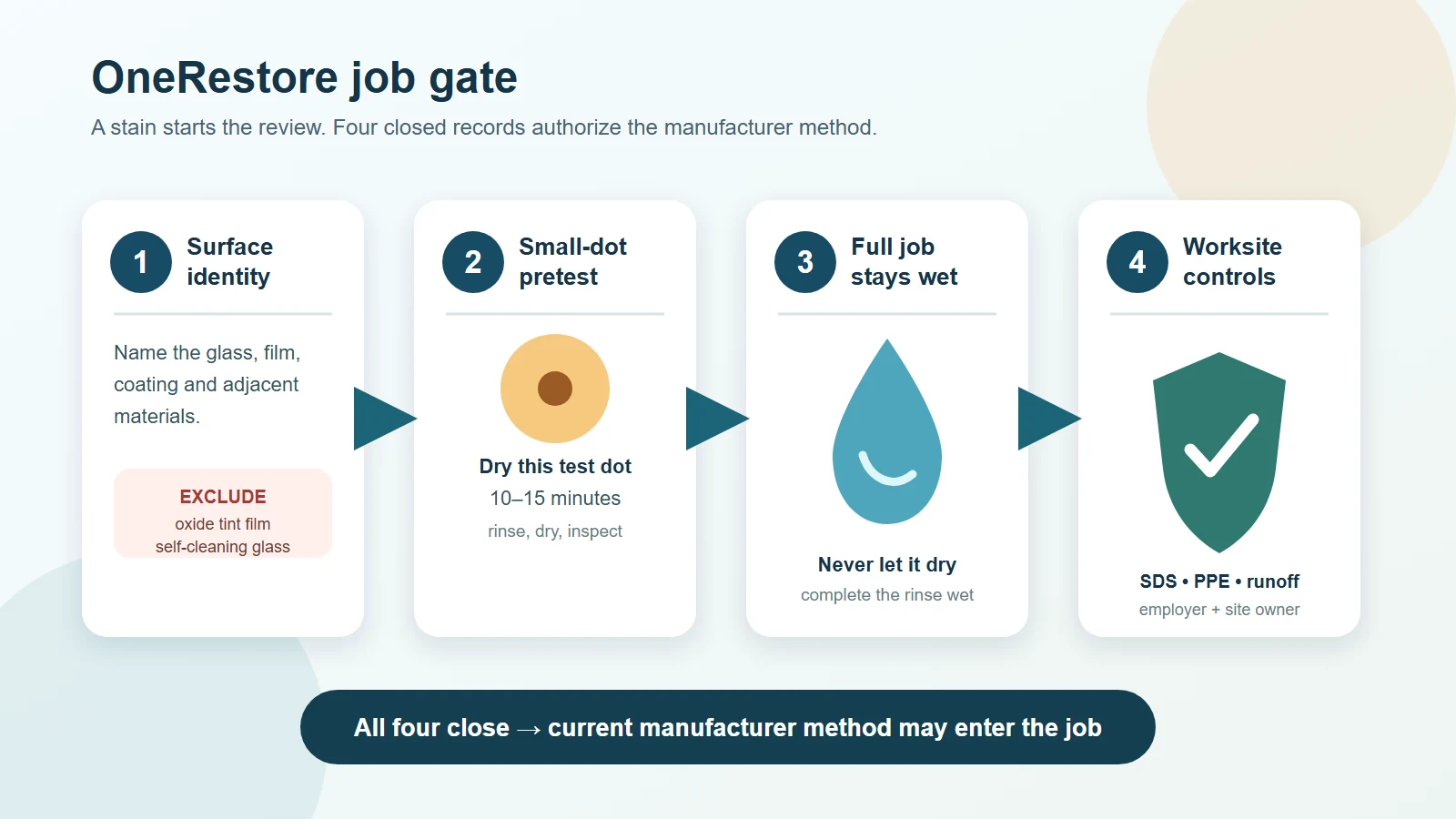
Before buying it for a glass job, close five things: the current product documents, the exact exposed surface, the manufacturer’s small-dot pretest, a full-scale plan that keeps the product wet through rinsing, and the workplace controls required by the current SDS. A stain can start the investigation. It cannot authorize the product.
OneRestore begins after routine cleaning ends
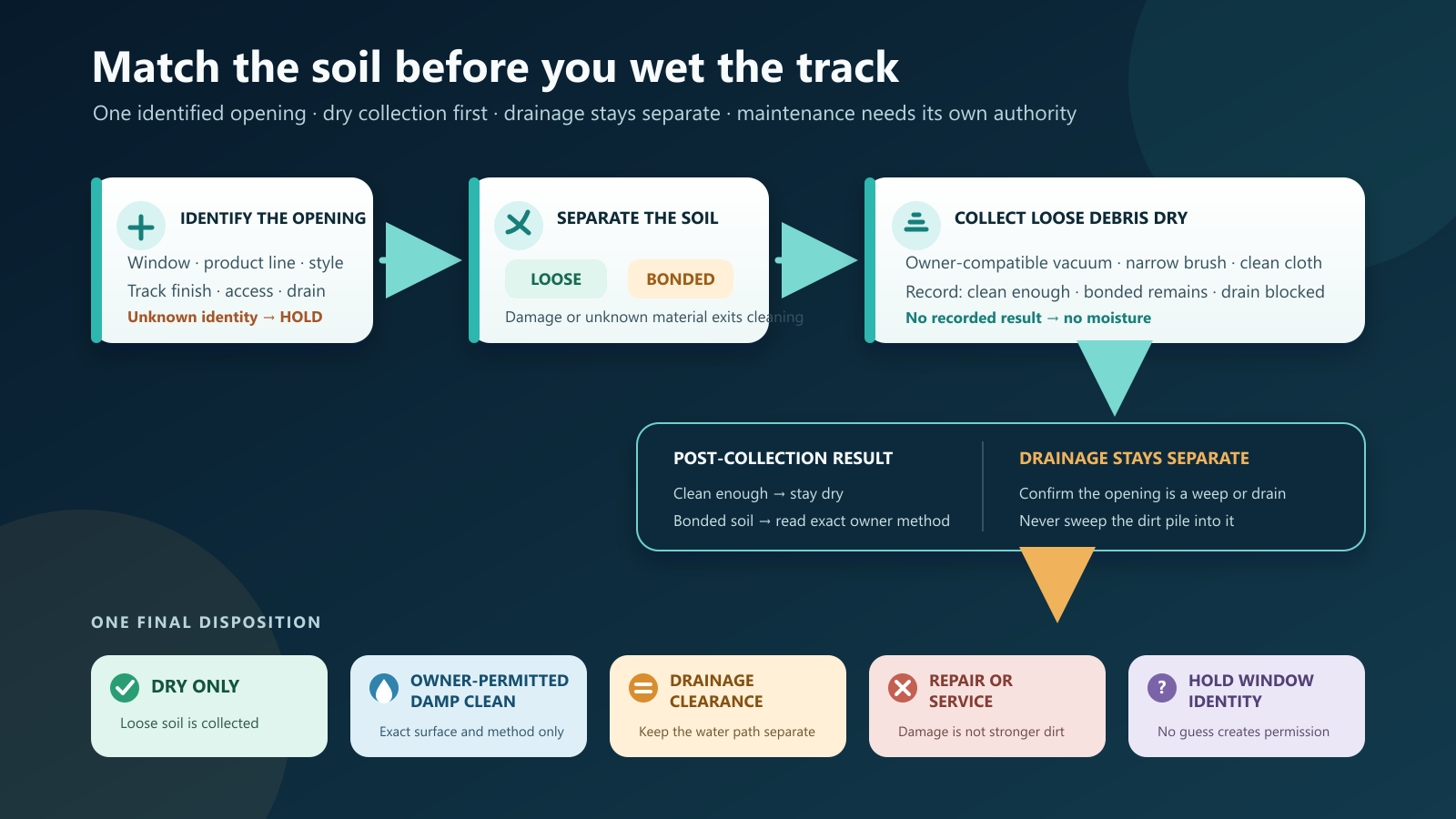
Begin with the work the pane actually needs. Fingerprints, ordinary route soil and squeegee glide belong to a repeatable window-cleaning soap batch. Adhesive and labels belong to the sticker-removal surface path. Scratches, optical damage and some persistent marks may require a named polishing system or a trained restoration specialist, not a stronger liquid; the cerium oxide guide owns that decision.
The current OneRestore product data sheet names mineral oxide stains, pollution stains, concrete leaching, sealant stains, caulk bleed, hard-water stains on glass and sealer overspray on glass. Those are declared uses, not a promise that every similar-looking mark will respond. The stain still needs an owner, and the surrounding construction still needs to accept the method.
| What is known about the job | Correct product lane | Why OneRestore is not automatic |
|---|---|---|
| Routine washable soil; current glass-care method is known | Use the routine cleaner and tool system | Restoration chemistry adds no proven value |
| Adhesive, label or film residue | Follow the exact glass and remover instructions | OneRestore’s stain list does not become adhesive-remover authority |
| Named deposit on documented, non-excluded glass | Continue the OneRestore acceptance record | Substrate, conditions, pretest and worksite controls are still open |
| Scratch, haze, coating change, crack or damage location is uncertain | Diagnose the glass and restoration path first | A chemical cannot identify where the damage sits or whether material removal is acceptable |
| Stain or surface cannot be identified | Hold the product choice | Similar appearance is not product compatibility |
This boundary also protects the rest of the professional window-cleaning tool stack. A restoration chemical should not quietly become the default bottle on every route.
Cross out excluded glass before discussing dwell
The phrase “safe on glass” is conditional. EaCo Chem’s 2025 data sheet lists glass among tested suitable substrates under standard conditions, then excludes oxide films used for tinting glass and self-cleaning glass. It also excludes polished stone and galvanized metal and adds restrictions for colored horizontal surfaces and certain low-fire tiles.
“Tinted window” is not enough information. Tint may be within the glass, applied as a film, or produced by a surface treatment. The data sheet names oxide films used for tinting as an exclusion. If the window owner cannot identify what is exposed on the side to be treated, keep that pane out of the job.
Tempered status does not settle this. The tempered-glass identification guide separates pane identity from permission for the next contact method. A corner mark may identify safety glazing, but it does not prove the absence of a film, coating or self-cleaning surface.
| Surface record | OneRestore disposition | Evidence still needed |
|---|---|---|
| Current owner confirms oxide tint film on the treatment side | Reject the product for that surface | None; the current exclusion controls |
| Current owner confirms self-cleaning glass | Reject the product for that surface | None; the current exclusion controls |
| Film, coating or self-cleaning status is unknown | Hold surface identity | Manufacturer, fabricator, project or window-owner record |
| Documented glass with no current exclusion identified | Continue to the exact pretest | Adjacent frame, seal, metal, stone and runoff exposures |
| Polished stone or galvanized metal lies in the exposure path | Exclude or obtain a manufacturer-approved protection plan | Exact adjacent-material owner and site plan |
| Another listed substrate is present under standard conditions | Do not transfer the glass method by name alone | That substrate’s current preparation, test and rinse conditions |
A product-data-sheet pass is not a site pass. Wind drift, foliage, vehicles, pedestrians, frames, seals and adjacent facade materials all sit outside the word “glass.” If they cannot be controlled under the current instructions, the job stays with the property or restoration owner.
The pretest is the only place the product is meant to dry
OneRestore has an easy-to-miss instruction split.
For windows, window frames and door frames, the current data sheet describes a small test: place the product on the end of a pencil eraser, put a dot on each surface in question, allow that test dot to dry for 10 to 15 minutes, rinse completely, and check the result after the test areas have dried thoroughly. If a surface discolors, the sheet says the product should not contact it during cleaning.
Full-scale work has the opposite drying rule. The data sheet repeatedly says not to allow the product to dry on the surface and to rinse thoroughly while it is still wet.
| Stage | Size and purpose | Drying rule | Release condition |
|---|---|---|---|
| Window/frame pretest | Pencil-eraser-size dot on every surface in question | Deliberately dry the test dot for 10–15 minutes | Rinse completely, let the area dry thoroughly, then inspect for discoloration or another adverse reaction |
| Full-scale cleaning | Only the job area represented by the accepted test and documented construction | Keep the product wet; do not let it dry | Complete the current manufacturer rinse while wet and confirm adjacent controls held |
| New surface, new pane construction or changed conditions | Not represented by the earlier test | No inherited permission | Return to identity and pretest; do not stretch one dot across a different material |
This distinction is the center of the buying decision. A contractor needs enough access, water, time and control to honor both procedures: a deliberately harsh little compatibility test, then a larger operation that must never reach the same dry state.
Record the test pane, treatment side, dot locations, adjacent materials, start and rinse times, fully dried appearance and person who accepted the result. A pass on the center of one pane does not silently clear the frame, sealant, metal trim or a neighboring window from another product line.
The five-to-ten-minute clock has prerequisites
The manufacturer’s clock does not begin when the sprayer leaves the truck. The data sheet says the best results are obtained when air and surface temperatures are above 40°F and below 90°F. Those are strict boundaries, not a 40-to-90 inclusive range. It also addresses freezing conditions, hot-surface cooling and the need to prevent product drying.
When the job and pretest are accepted, the published method is narrow: pre-wet without saturating, use the product undiluted, apply with a low-pressure sprayer, and normally allow one five-to-ten-minute wet application. For deeper stains or very porous surfaces, the sheet describes two applications five to ten minutes apart without rinsing between them.
Then the rinse owns the finish. EaCo Chem directs a thorough cold-water rinse, warns against pressure that marks the substrate and says not to use a zero-degree nozzle. This page does not invent a pressure setting or recovery method; those depend on the substrate owner, equipment and site plan.
| Published field | Current direction | What it changes before the job |
|---|---|---|
| Air and surface temperature | Strictly above 40°F and below 90°F | Measure both; outside the range, do not borrow the dwell wording |
| Concentration | Undiluted | Keep it out of the soap bucket and ignore unofficial dilution advice |
| Preparation | Pre-wet, do not saturate | Prove water access and adjacent-material control |
| Application | Low-pressure sprayer; brushing is not necessary in the published method | Match the exact applicator and drift control to the site |
| Wet dwell | Usually one 5–10-minute application; named deeper/porous branch allows two | Staff the area so the product can be watched and kept wet |
| Rinse | Thorough cold-water rinse while wet; no zero-degree nozzle | Provide continuous water, controlled runoff and a substrate-approved pressure path |
| Coverage | 75–250 sq ft per gallon, condition-dependent | Estimate a range; never turn the high endpoint into a quote guarantee |
The 75-to-250-square-foot spread is too wide to function as a fixed productivity number. Porosity, texture, temperature, craftsmanship and stain severity all change it. Quantity planning should retain that range until the real test area and site constraints provide better evidence.
The SDS can reject an otherwise compatible pane
The current OneRestore SDS is version 3.1, revised September 24, 2025. Its signal word is WARNING. It classifies the mixture as potentially corrosive to metals, harmful if swallowed, irritating to skin and eyes, potentially irritating to the respiratory system, and harmful to aquatic life.
That changes the purchase beyond adding goggles to a cart. The SDS calls for protective gloves, protective clothing and eye/face protection, adequate ventilation, splash-minimizing work, closed original packaging, and controls that keep the product from waterways or storm drains. It also identifies strong alkali and oxidizing compounds as incompatible materials.
For covered US work, OSHA’s PPE rule places workplace hazard assessment, protection selection, fit and training on the employer. OSHA’s Hazard Communication rule addresses labels, SDS availability and employee information and training. A mobile crew may keep the program at its primary workplace, but the required information still has to be immediately obtainable in an emergency.
| Workplace field | Current owner | If it is not closed |
|---|---|---|
| Exact current container label and SDS | Manufacturer plus employer Hazard Communication program | Do not transfer or deploy the product |
| PPE selection, fit, care and training | Employer hazard assessment under applicable rules | The article cannot choose the missing protection |
| Ventilation and occupant exposure | Site and employer plan informed by the SDS | Route the work away from occupants or to a qualified specialist |
| Rinse water, runoff and storm-drain protection | Property/site environmental controls | The wet-rinse method is not operational |
| Storage and transport | Current SDS, original container and employer route controls | Hold the cart; do not store beside known incompatible materials |
| Eyewash, response and emergency information access | Employer/site emergency plan and current SDS | Do not start the chemical task |
A compatible pane with an incomplete worksite is still a rejected deployment. Product fit and worker protection are two separate approvals.
Write the outcome before the product leaves the cart
The acceptance card should finish with one named result, not “use caution.”
| Result | Use it when | Next move |
|---|---|---|
| Proceed under current manufacturer method | Current documents, non-excluded surface, conditions, passed pretest, wet-rinse path and workplace controls all close | Retain the exact record with the job and follow the current manufacturer instructions |
| Hold current documents | Product, PDS or SDS identity is missing, old or conflicting | Obtain the current manufacturer owners before any method or purchase decision |
| Hold surface identity | Glass, film, coating, self-cleaning status or adjacent material is unknown | Return to the window, fabricator, project or property owner |
| Reject excluded surface | The treatment side or exposure path includes a current explicit exclusion | Choose a method authorized by that surface owner |
| Reject test result | The prescribed small test shows discoloration or another adverse response | Keep the product off that surface and document the failed test |
| Route to a restoration specialist | Rinse continuity, runoff, occupants, PPE, emergency controls or the damage itself exceeds the crew’s closed capability | Transfer the exact glass, stain, documents and test evidence without improvising a method |
The completed cart line is therefore longer than a product name: OneRestore + current PDS/SDS revisions + exact treatment surface + accepted pretest + measured conditions + wet-rinse plan + workplace owner. If one part is missing, the blank is the decision.