A clean screen coming out of a demo machine proves one thing: that screen completed that pass. It does not prove that your loose spline, oversized patio frame, retractable mesh, narrow side yard, hose run, drying rack and return order will cooperate.
The current XERO product page does answer several useful questions. The unit takes a garden-hose connection; pure water is not required; the legs unfold against support nubs; one screen moves through the bristles while you turn it; and the screen air-dries before it goes back. The current WindowCleaner listing adds four nylon brushes on aluminum rods, a shutoff, a 12-pound statement, 23.5-inch brush length and 38-inch frame length.
Everything that determines route fit sits outside those facts. The opened pages do not publish the brush pass-through, the unfolded working footprint, pressure or flow requirements, a controlled throughput test, your exception rate or the time needed to label, dry and return a mixed group of screens. Treat those as measurements, not as blanks to fill with a sales video.
| Question | Published now | What your route still owns |
|---|---|---|
| Which unit? | XERO lists SKU 209-60-01-XP; WCR lists 209-60-01 and XeroSC1 | Confirm the selected seller, unit and package |
| What touches the screen? | WCR describes four nylon brushes on aluminum rods | Confirm the exact screen owner, mesh and condition |
| What water source? | Standard garden hose; pure water not required | Hose reach, shutoff access, pressure/flow, runoff and permitted chemistry |
| How large and heavy? | WCR says 23.5-inch brushes, 38-inch frame and 12 pounds | Actual pass-through, unfolded footprint, largest frame and current-unit weight |
| How fast? | Seller pages promise a quicker workflow | Setup, rejected screens, rework, drying, return and pack-down time |
Start with the screens the machine should never receive
Do the first sort while each screen is still associated with its opening. Put the window or door owner, product or screen type, room/opening label and orientation on the record. If the screen has to come out, use the screen’s actual retainer and return path rather than prying from a convenient corner. The screen-removal guide covers that identification step; this page starts after removal is known to be valid.
Next, look at the assembly rather than the dirt. A loose spline, torn mesh, bent frame, failed corner or brittle material is a repair decision before it is a cleaning decision. Sending damage between brushes makes the machine an uncontrolled test fixture.
Product instructions can also remove a sound-looking screen from the machine lane. Andersen’s current care page tells owners of the matching insect screens to wash with a mild soap solution and soft brush, then rinse with clean water. Pella’s current screen guidance says methods vary by product, warns that screens can bend, and requires retractable or stored screens to be completely dry before they return. Phifer’s current care article describes removed screens, light hose pressure, soft-brush contact, thorough drying and return to the original opening. Those pages do not approve the XERO machine; they show why the exact screen owner comes before a general “window screen” label.
| Intake finding | Machine lane | Next route |
|---|---|---|
| Exact owner method permits removed-screen water and soft-brush contact; frame, mesh and spline are sound | Continue to measurement | Keep the owner method with the screen label |
| Fixed, retractable or product-specific method does not support the proposed pass | No | Use that owner’s in-place or manual method |
| Loose spline, tear, bent frame, failed corner or brittle condition | No | Repair or replace before cleaning |
| Product, coating, mesh or cleaning permission is not established | No | Confirm with the current screen/window owner |
| Screen cannot be removed and returned by its exact hardware path | No | Return to the removal owner; do not improvise movement |
This does not replace the broader choice between in-place care, flat hand washing and a dedicated washer. The window-screen cleaning guide owns that method split. This page narrows one later question: which already-eligible screens should be included in a XERO trial?
The published dimensions still leave the important opening unmeasured
The 23.5-inch and 38-inch figures on the current WCR page are useful product facts, but neither is labeled as maximum frame width or brush opening. A patio-door-size claim is not a dimension. Measure the actual opening between contact surfaces on the selected unit, then measure the widest, longest and thickest representative frame in the orientation you intend to use.
Keep room for the turn. XERO directs the operator to move one screen in circular motions and turn it periodically. A frame that can be inserted straight may still strike the rods, ground, hose or operator position when it rotates. Dry-run the largest accepted screen without forcing it and without water.
Weight needs the same discipline. The current WCR page says 12 pounds. A Northern Tool page that is still accessible but marks the item unavailable lists 15.8 pounds as both product and ship weight, along with 39 × 8.25 × 8 inches. Those figures are not a range to average. If packed weight or storage size changes lifting, shelf or vehicle fit, measure the current selected unit and its carried configuration.
| Measurement | Record it on | The result you need |
|---|---|---|
| Brush pass-through and interference points | Selected current unit | Largest accepted screen clears without forced bowing or contact with hard structure |
| Widest, longest and thickest frame plus turning envelope | One sample from each planned screen family | Every machine candidate can enter, turn and leave under control |
| Unfolded legs, operator stance, hose bend and dry-rack area | A typical route stop | The work zone fits without blocking access or mixing dirty and clean screens |
An unresolved measurement does not automatically reject the machine. It returns a precise action: inspect or measure the selected unit before purchase, or keep the manual method for that screen family.
Rehearse the wet loop before you wash anything
Set up a typical stop while the machine and screens are dry. The goal is to find crossings and missing supports before water makes them expensive.
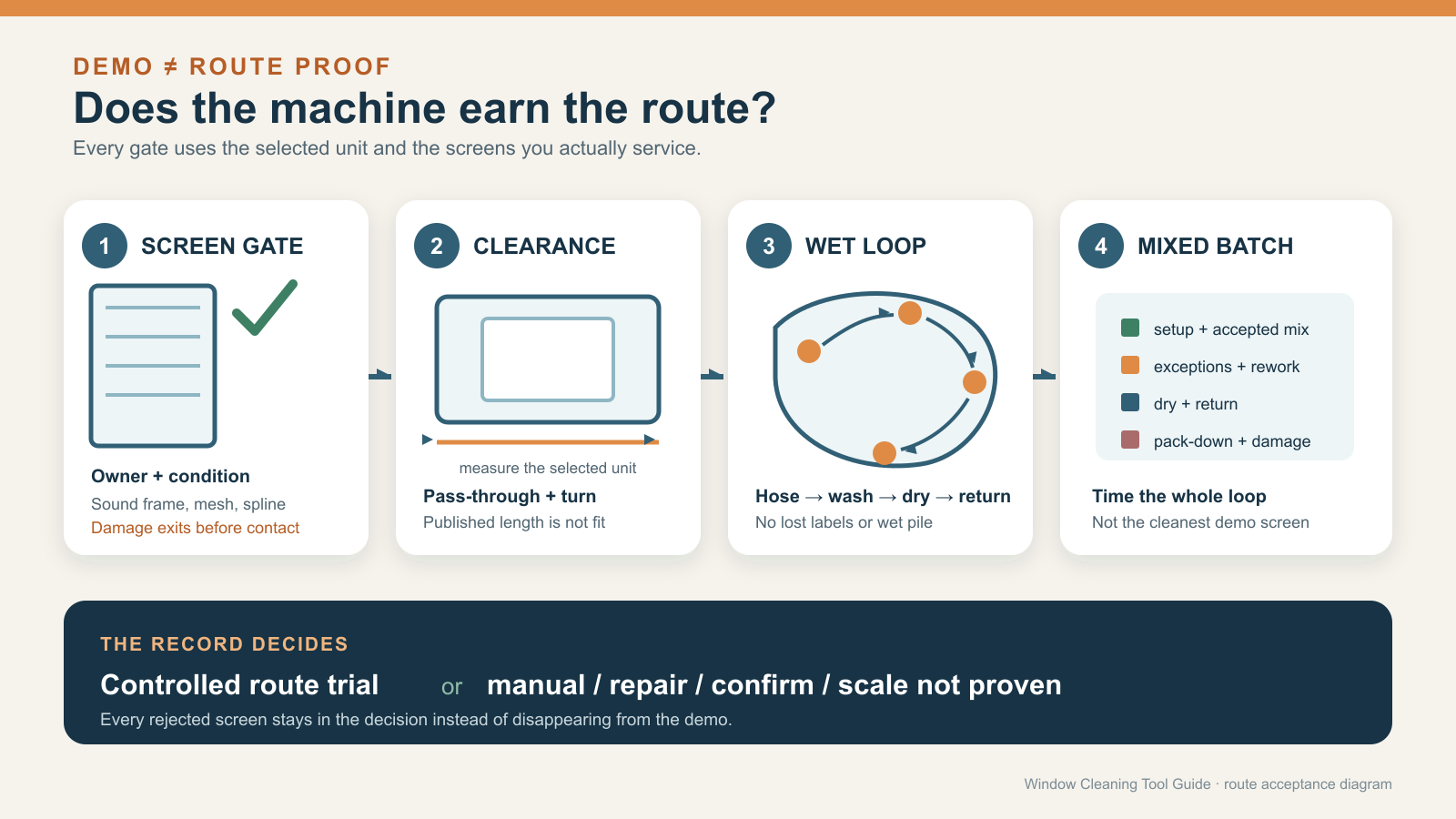
Start at the opening label. Move the screen through an intake position where damage and owner method are visible. From there, the accepted screen reaches a hard, stable machine location; each leg touches its support nub, the garden hose reaches without pulling the frame, and the shutoff remains accessible. Plan where water and overspray go instead of discovering the route beside an open door, finished wall or pedestrian path.
After the pass, the screen needs a clean support that does not distort the frame. Air drying is part of the current XERO instruction, not idle space to omit. Pella’s complete-dry warning for retractable or stored screens makes the distinction especially important: washed and ready to return are different states.
The final station is the original opening. A label has to survive the wet process, preserve orientation and stay attached to the correct screen. If your route cannot keep intake, washed, drying and ready-to-return screens distinct, the machine has not simplified the job; it has moved the bottleneck.
Use six stations in the rehearsal: labeled intake, condition decision, measured machine, runoff boundary, supported dry zone and verified return. This is a route loop, not a required physical layout. A small job may place the stations close together; a large patio group may need separate racks. The important test is that a screen cannot skip its condition gate or lose its identity.
Pure water is optional according to the XERO page. That statement does not select soap, local water pressure or a discharge route. Keep any cleaner inside the exact screen owner’s method, and record pressure/flow as an actual site and unit observation rather than a guessed product specification.
Run one mixed batch, not a best-case demonstration
A fair trial includes every screen family you expect the machine to handle—not a fixed number chosen for appearance. If the route contains standard aluminum frames, large patio screens and a permitted flexible-frame product, include representative eligible examples of each. Damaged screens and screens without an identified owner stay in the rejection record; they do not enter just to make the sample look difficult.
Start the clock when the machine leaves its transport position, not when the first frame touches a brush. Separate setup, screen handling, rework, drying/return and pack-down. Record the comparable manual route honestly as well. A faster brush pass can disappear inside hose placement, screen sorting or a full dry rack.
| Trial field | Record | Why it changes the decision |
|---|---|---|
| Screen mix | Eligible families, sizes and soil; manual, repair or unconfirmed exclusions | Shows whether the trial represents accepted work |
| Setup | Unload, legs, hose, runoff boundary and labels | Exposes fixed time and site friction |
| Processing | One-at-a-time handling, turns and active wash time | Measures the demonstrated machine work |
| Exceptions | Rejected frames, interference, owner-method conflict and awkward turns | Shows how much of the route bypasses the machine |
| Quality/rework | Missed corners, retained soil, displaced spline, bent frame or repeat pass | Prevents speed from hiding correction or damage |
| Dry and return | Supported drying, wait, correct opening and seated condition | Measures the actual finished state |
| Pack-down | Water isolation, drainage, brush protection and transport | Closes the loop the demo usually omits |
Do not turn one trial into a public throughput claim. Weather, screen mix, layout, worker familiarity and owner methods vary. The record belongs to your accepted jobs. It can support your own operating choice without pretending to be a universal minutes-per-screen promise.
Let the exception pile make the buying decision
Lay the completed screens beside the screens that went manual, needed repair, lacked owner permission, did not clear the machine or waited too long for the planned dry zone. That exception pile tells you more than the cleanest result.
| Result | Use it when | What happens next |
|---|---|---|
| Controlled route trial | Exact unit, eligible screen families, geometry and dry rehearsal pass | Run and record the representative mixed batch before broad adoption |
| Manual clean only | Screen owner, fixed/retractable configuration or site flow does not support the machine | Keep the exact in-place or hand-wash method |
| Repair or replace first | Frame, mesh, spline, corner or retainer is already unsound | Remove it from cleaning production until repaired by the proper owner |
| Confirm screen owner or unit | Identity, permission, suffix, clearance, weight or current package matters but is not established | Get the current owner fact or measure the selected unit |
| Route scale not proven | Trial omits real screen families, exceptions, rework, drying, return or pack-down | Do not convert seller speed into an operating or purchase conclusion |
Serviceability is one last input, not proof of value. The current XERO page states three years of protection and links replacement valve, foot, plug, elbow and brush-set paths. Recheck the current terms and exact part fit at purchase time; a parts menu does not guarantee stock or a claim result.
If the machine survives the screen gate, the measurements, the dry rehearsal and the mixed batch, add that accepted role—not every seller promise—to your professional tool setup. If it does not, the general screen-cleaning path still gives the job a complete manual route. Either outcome is better than discovering after purchase that the machine cleaned one demo screen while the rest of the route waited outside its lane.