Post-construction glass is not one cleaning surface. A single project can combine clear, heat-treated, laminated, coated and filmed glazing, while the residue changes from one elevation—or even one lite—to the next. A work order that says “remove all construction debris” has not yet named a safe method.
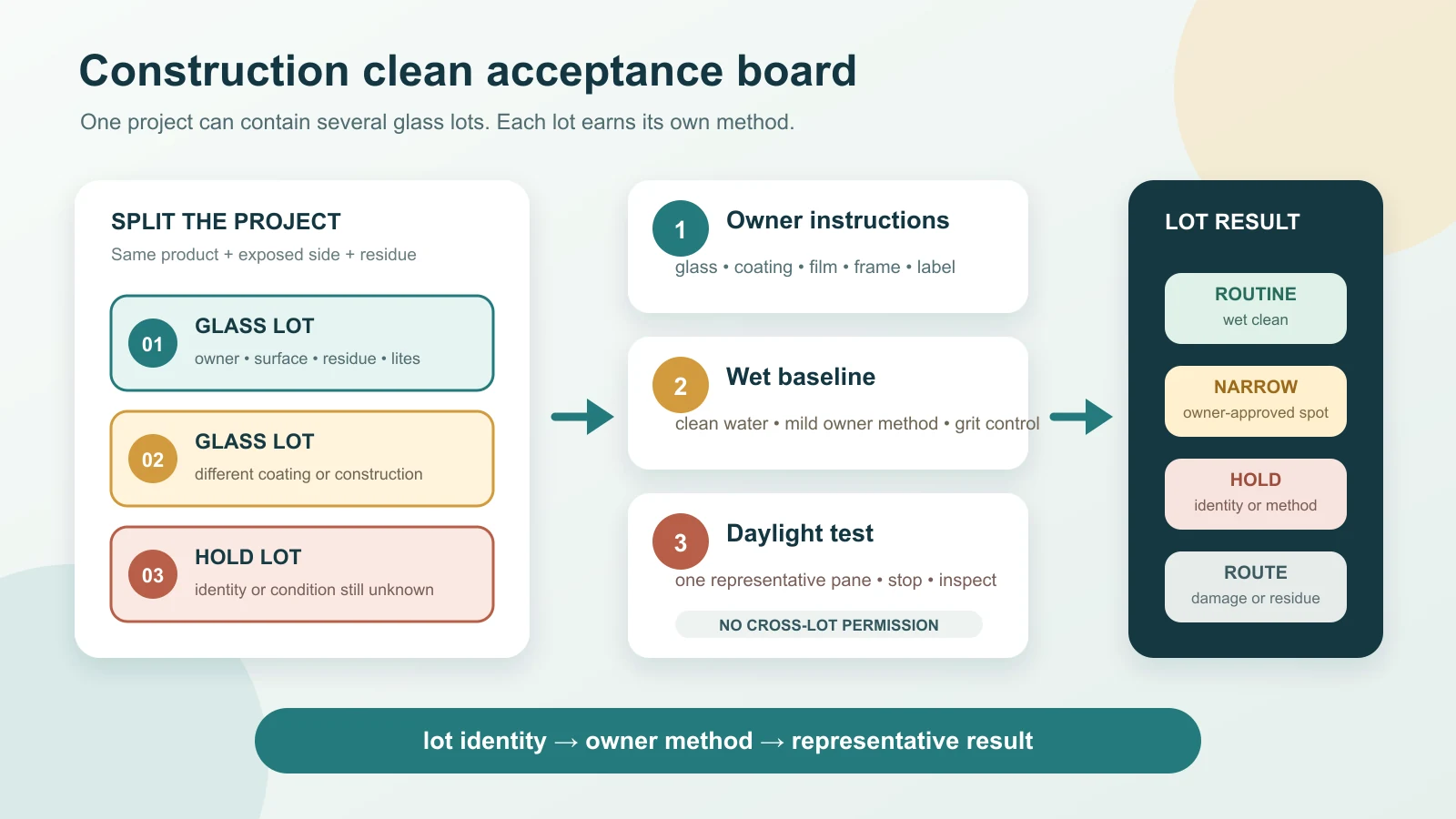
The workable unit is a cleaning lot: panes with the same exact glass construction, exposed surface, current cleaning owner and residue class. Photograph their condition, attach the controlling instructions, use the owner-compatible wet baseline, then test one representative pane in daylight. Only that result can expand to the rest of that identical lot.
This is deliberately slower than reaching for a favorite tool and much faster than discovering, after a whole elevation is clean, that the glass schedule contained three different surfaces.
Turn the glass schedule into cleaning lots
Start with the project glass schedule, window supplier records, corner marks and coating or film documentation. The current NGA construction-site paper explains why that work matters: modern glazing may combine coatings, insulating units, heat treatment and lamination, and damage can come from adjacent trades as well as bad cleaning.
Do not group panes merely because they look alike or share an elevation. Each lot needs the exact product owner, heat-treatment or lamination record, exposed cleaning side, adjacent assembly and residue class. If any of those changes, start another lot.
| Lot field | What belongs in the record | Why it changes the method |
|---|---|---|
| Glass identity | Manufacturer, product or system, opening/lite ID and current source | Finds the instructions that can actually authorize contact |
| Construction | Annealed, heat-treated, laminated, insulating unit or another documented construction | A corner mark may identify one property without proving the exposed surface or cleaning permission |
| Exposed side | Clear, tinted, reflective, coated, filmed or unknown | The contact tool and chemistry touch this surface, not the hidden label in the work order |
| Adjacent assembly | Frame, gasket, sealant, hardware and nearby finish | A glass-compatible liquid may still damage the assembly around it |
| Residue class | Loose grit, label/adhesive, sealant, paint, masonry runoff, weld damage or unknown | Each material needs its own owner and may need a different disposition |
The equipment cart comes after this split. The professional tool setup can help organize the eventual kit, but it cannot decide which lot permits a blade, solvent or abrasive.
Photograph the dirt before you move it
The first walk is an evidence pass, not a cleaning pass. Give every opening and lite a stable ID, then photograph the whole pane and close views of scratches, chips, edge damage, coating changes and visible residue. Use light from more than one angle when possible. A clean-looking patch on an overcast morning is not proof that the surface is unmarked.
NGA identifies weld splatter, paint, plaster, sealants, fireproofing, alkali or chemical attack, concrete and masonry runoff, hard-water deposits, scratches and edge damage as construction-site concerns. Those are not one category called “stuff on glass.” Some are removable soil, some may already be permanent damage, and some cannot be classified from appearance alone.
| Observation | Record it as | Do not infer |
|---|---|---|
| Loose dust or grit | Location, amount, whether it is dry or already wet, nearby trade | That a dry cloth can move it without dragging abrasive particles |
| Paint, label, tape, sealant or unknown film | Exact location, photos, known installer/product and age if documented | That one solvent or blade covers every material and every glass owner |
| Concrete, mortar, plaster, alkali runoff or mineral deposit | Source area, contact time if known, affected glass lot and visible surface change | That a stronger acid, abrasive or scraper will restore rather than damage it |
| Scratch, chip, edge damage, weld/grind mark or broken lite | Pre-work condition and immediate project contact | That cleaning caused it—or that cleaning can repair it |
| Corner mark or safety code | Every readable character and its exact lite | That “tempered” tells you the coating side or grants tool permission |
Use the tempered-glass identification guide to record what a mark establishes and what it does not. Keep that identity line separate from the cleaning-method line.
Give every residue an owner, not a favorite chemical
A post-construction cart often contains products that work well inside a narrow label and surface scope. The mistake is assigning the product before identifying both the residue and the installed assembly.
| Material on the lot | Controlling owners to collect | Decision before escalation |
|---|---|---|
| Loose construction dust and ordinary soil | Exact glass/coating owner | Confirm the normal wet method and keep grit out of contact tools |
| Manufacturer label, tape or adhesive | Window/glass owner, label purpose, adhesive-remover label | Preserve required marks; choose only a surface-compatible staged path |
| Sealant, grease or unknown organic residue | Glass owner, sealant/frame owner, exact chemical label and SDS | Close compatibility, ventilation, PPE, runoff and occupant controls before use |
| Concrete, mortar, plaster, alkali or masonry runoff | Glass supplier/fabricator and responsible residue specialist | Decide whether typical cleaning remains possible or the lot needs escalation |
| Weld splatter, deep scratch or edge damage | Glass supplier/fabricator and project owner | Treat as a damage assessment, not a stubborn cleaning task |
The sticker-removal path owns labels and adhesive stages. It does not turn a preserved certification label into debris, and it does not authorize a remover on an unknown coating or seal.
Scraper advice is especially easy to overgeneralize. Guardian’s current-hosted coated-glass guide says not to use scrapers of any size as a general rule. Later, it describes a narrow exception: after normal cleaning fails, a new one-inch razor may be used on a small spot of non-coated glass, in one direction. That sentence is not permission to scrape a whole pane, another manufacturer’s glass or a lot whose exposed surface is unknown.
Current Kärcher professional guidance is narrower in other places: it says to avoid glass scrapers on tempered glass and never use one on a filmed side; it also warns that plaster on tempered glass may not be removable without damage. These differences are the reason the installed glass owner—not a generic technique page—gets the final method field.
The baseline pass is wet and deliberately boring
For a lot whose owner permits normal cleaning, the first pass is not a weak version of restoration. It has a different job: remove loose material with enough liquid and clean contact surfaces that grit is carried away instead of dragged across the pane.
Vitro’s current guidance starts with generous clean water and a mild, non-abrasive solution, applied with a clean non-abrasive applicator, followed by rinse water and a clean squeegee. Guardian similarly calls for soaking construction dirt before a mild wash and requires metal parts and trapped abrasive particles to stay off the glass.
| Baseline action | What it accomplishes | Stop or reset when |
|---|---|---|
| Flush or soak with clean water as the owner permits | Loosens and moves free grit before wiping | Runoff cannot be controlled or water is not permitted on the assembly |
| Apply the exact approved mild solution with a clean applicator | Creates lubrication and lifts ordinary soil | Product identity, mix or coating compatibility is not closed |
| Agitate lightly while checking the contact face | Keeps picked-up grit from circulating across more glass | Grit, metal fragments or a bonded unknown enters the tool |
| Rinse and squeegee without metal contact | Removes suspended soil and solution residue | The holder, edge or contaminated rubber can contact and mark the surface |
| Dry gaskets, sealants and frames as their owners require | Prevents the glass method from leaving the surrounding assembly wet | Adjacent-material instructions conflict or remain missing |
For repeatable routine solution, use the window-soap batch sheet and its exact bottle direction. “Mild” is not authority to improvise additives, and it does not decide a bonded-residue method.
If the wet baseline leaves a spot behind, rename the work. You now have a specific residue on a specific glass lot—not permission to make the baseline more aggressive everywhere.
One representative pane earns—or stops—the rest of the lot
Vitro recommends test-cleaning a small area, stopping and inspecting the surface before proceeding. It also notes that scratches can appear differently with sky condition and sun angle. Guardian likewise calls for a small-area check and direct-light evaluation.
The representative pane must actually represent the lot. Choose the same product, heat treatment, exposed side, residue class and owner method. A clear annealed pane near the loading door cannot prove a coated or tempered lite on the upper elevation.
| Test record | Required entry | Expansion rule |
|---|---|---|
| Lot match | Product, construction, exposed surface and residue all match | Any mismatch creates another lot and another test |
| Starting condition | Whole-pane and close photos with preexisting marks identified | Unresolved damage is reported before contact |
| Method | Exact owner document, solution/tool, spot size and contact limits | No unrecorded substitute or larger working area |
| During contact | Grit, sound, drag, coating change, frame/seal reaction and residue movement | Unexpected response stops the test immediately |
| After cleaning | Dry pane, daylight/relevant-angle view, photos and remaining residue | Only an unambiguous acceptable result can expand to identical panes |
A small test does not discover permission that the owner never gave. If the exact owner allows a scraper or nonmetal alternative for that surface and residue, the window-scraper guide can close the holder and blade family. If an abrasive pad is proposed, the grade-0000 steel-wool page explains why grade, contamination, rust and surface permission remain separate fields. Neither tool enters because the test corner merely looked fine.
Close each lot as cleanable, held, or already damaged
Finish the project record lot by lot. Do not use a percentage-complete number to hide an unresolved coating or a damaged pane. A waiver or contractor instruction may allocate business responsibility, but it cannot change the surface or manufacture cleaning permission.
| Lot result | Use it when | What remains on the handoff |
|---|---|---|
| Routine wet clean | Exact owner permits the baseline and the representative daylight result is acceptable | Lot identity, method, test pane, photos and completed openings |
| Owner-approved spot method | Exact owner and residue-product instructions permit a narrow escalation and its test passes | Product/label/SDS identity, spot limits, adjacent controls and result |
| Hold glass or exposed-surface identity | Manufacturer, product, coating/film side or controlling instruction is missing | Missing record and the party who can supply it |
| Reject the proposed method | The owner prohibits it, scope does not match or instructions conflict | Rejected tool/chemical and controlling owner statement |
| Route damage or bonded residue | Broken glass, edge damage, weld damage, deep scratches, unknown deposit or failed typical method remains | Condition photos, untouched area and supplier/fabricator or responsible specialist route |
The completed post-construction clean is not a claim that every mark disappeared. It is a set of glass lots whose identities, accepted methods, test results and exceptions can survive the final walk-through without the crew having to remember which pane was the exception.