A worn rubber pad makes replacement look like a dimensions problem: measure the rail, count the holes and buy the closest black foot. That shortcut misses the part that controls the decision. On many ladders, the model and manufacturing revision determine the shoe assembly, pivot pieces and hardware even when two parts look nearly identical.
Start at the ladder label, not the product photo. Record the manufacturer, complete model and Mark or revision, then identify exactly what failed. A tread pad, swivel shoe, pivot plate, bracket and rail are different objects. If the damage extends beyond a manufacturer-supported replaceable assembly, a new foot does not return the ladder to service.
| What the evidence shows | Purchase disposition |
|---|---|
| Exact ladder identity, foot-only defect, current supported kit, complete contents and current instructions all close | Exact supported kit |
| Manufacturer is known but Mark, fit row, contents or instructions are unresolved | Manufacturer confirmation required |
| Rail, bracket, rung, fastener area or another structural component is damaged or condition is uncertain | Whole ladder out of service |
| Identity cannot be recovered or the manufacturer no longer supports the exact part | Replacement path unavailable |
The label-to-foot map below keeps those outcomes separate. It is not an installation diagram. Its job is to prevent a plausible-looking part from entering the cart before identity, component scope and the responsible return-to-service decision are closed.
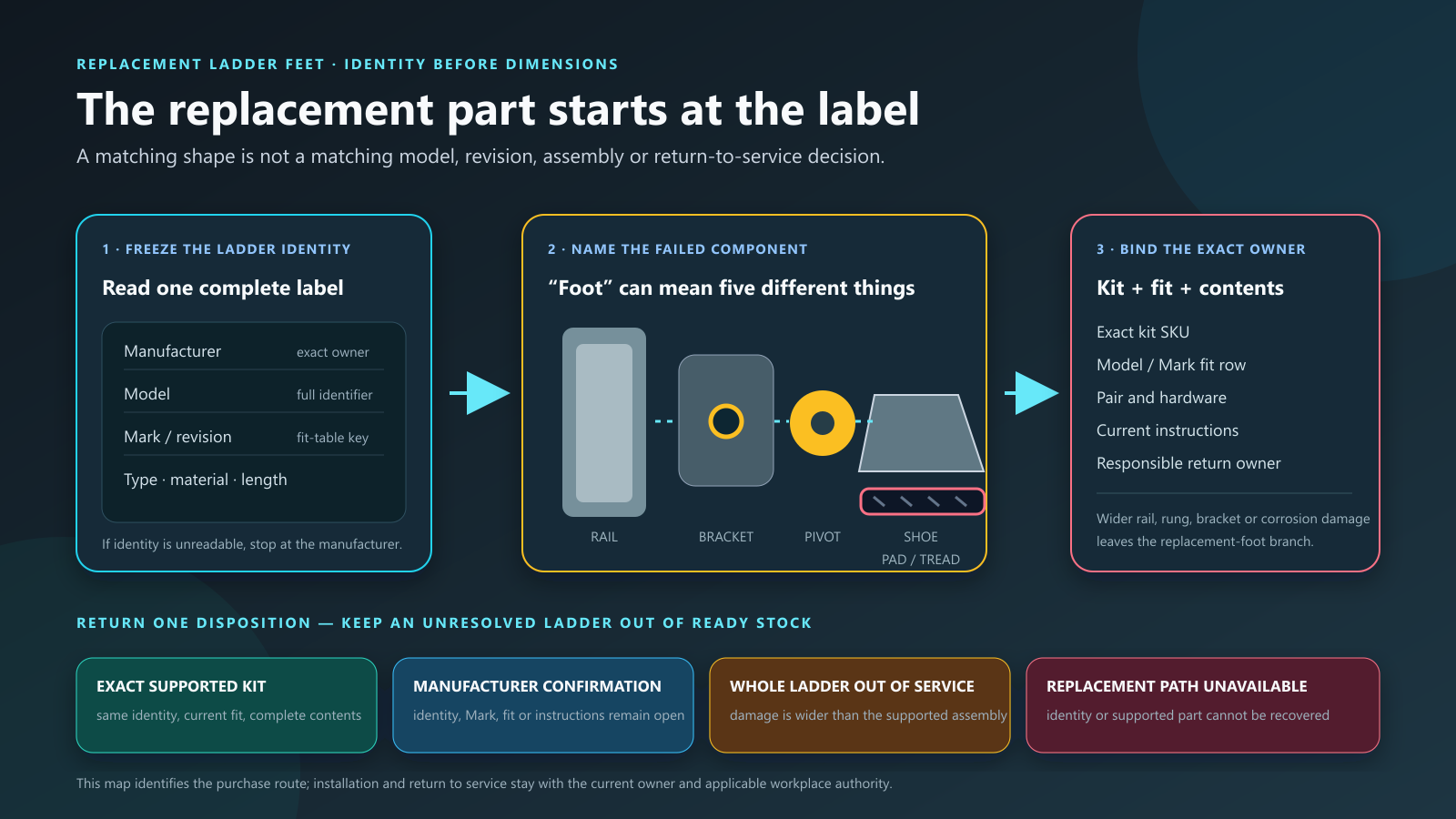
The label decides what the picture cannot
Photograph the whole label while it is still readable. The useful fields are the manufacturer, full model, Mark or revision, ladder type, material, length and duty rating. Preserve the label as one record; do not copy only the model number into a note and discard the rest.
The Mark matters because a manufacturer can change parts inside one model family. The current Werner-parts page for Safety Shoe Kit 26-1, for example, lists the D700-2 series only at Marks 2 and 3, while D1124-2 is listed across Marks 10 through 17. The same current page includes several other model-specific ranges. “Werner extension ladder” is nowhere near precise enough.
Werner’s current replacement-parts fit FAQ makes the consequence explicit: an unreadable model or Mark can prevent the seller from recommending a kit, and a similar-looking part from another ladder does not establish compatibility. A photo, hole spacing or rail width can support a manufacturer question, but it cannot replace the identity that the fit table requires.
| Identity field | Where to obtain it | If it is missing |
|---|---|---|
| Manufacturer and complete model | Original ladder label and owner records | Do not select by brand color or ladder shape |
| Mark/revision or manufacture identifier | Label plus current manufacturer or parts owner | Ask the manufacturer; do not borrow another revision’s kit |
| Ladder type, material and length | Exact label and manual | Do not infer from one section or a marketplace title |
| Duty rating and label condition | Exact ladder label | Return to the whole-ladder owner if the identity record is unreliable |
If this inspection shows that the business needs a different ladder type, material or load capacity, leave the repair-part question and use the window-cleaning ladder guide for the whole-ladder decision. A replacement foot cannot correct a ladder that was wrong for the job before the pad wore out.
Name the failed part before shopping
“The foot is bad” is not specific enough for an order. Look at the component chain without taking it apart: rubber tread or sole, metal or molded shoe, pivot or plate, attachment hardware, mounting bracket, rail end and the surrounding material. Record the condition of both sides, because one visibly worn pad may accompany a bent opposite shoe or an uneven pair.
A pad-only listing supplies friction material. A complete swivel-shoe kit may supply the shoe and fasteners but exclude pivot plates or springs. A bracket or rail problem sits upstream of both. Treating these objects as interchangeable can leave the original defect in place or create an assembly that the owner never specified.
| Observed area | The part question | Route |
|---|---|---|
| Rubber pad or tread only | Does the exact manufacturer publish a pad for this shoe and revision? | Exact pad path or manufacturer confirmation |
| Complete shoe or foot assembly | Does one current kit list this model/Mark and both sides? | Verify kit, pair and hardware |
| Pivot plate, spring or bracket | Is it included and owner-supported for this exact assembly? | Separate supported part or hold |
| Rail, rung, elongated hole, corrosion or unknown deformation | Is the defect still limited to a replaceable foot assembly? | Whole ladder remains out of service |
This is also where improvised “upgrades” exit. A larger pad, generic anti-slip cap or 3D-printed plug may fit a measured opening but has no authority to restore the ladder’s original design. This page does not provide a drilling, riveting, fastening or field-modification method.
Three current kits draw three different boundaries
Current owner pages show why there is no useful universal dimensions chart. Each owner defines a different unit of compatibility.
| Current owner and exact part | Published scope | Contents boundary | What still has to close |
|---|---|---|---|
| Werner Safety Shoe Kit 26-1 | Named Werner models and Mark ranges | Aluminum safety-shoe kit; hardware included; pivot plates and springs excluded | Exact live fit row, observed assembly and omitted parts |
| Bauer Replacement Shoe Kit 07016 | Bauer aluminum/fiberglass extension ladders 16–32 ft and straight ladders 8–16 ft | Two shoes and installation hardware | Exact Bauer ladder, condition and current instructions |
| Duo-Safety safety-shoe family | Duo-Safety ladder models with model/plate routing | SSW-B has no hardware; SSA-585 includes hardware for model 585A; SSA-U follows the manufacturer’s plate system | Exact Duo model and complete selected variant |
This is a scope comparison, not a ranking. Bauer’s broad length range does not make SKU 07016 a Werner part. Duo-Safety’s “universal” kit remains within the Duo-Safety model and plate route stated by that manufacturer. Werner’s 26-1 name does not cover every Werner ladder, or even every revision of one family.
The current Werner climbing-equipment FAQ adds another boundary: foot assemblies are among the replacement parts available for its step and extension ladders, but the exact kit is routed through customer care. The same FAQ says damaged ladders should not be used and that Werner does not offer a damaged-ladder repair service. A supported part path must not be stretched into a general repair authorization.
The bag contents determine whether the order is complete
Once the exact kit is known, copy the contents line by line. Count both left and right assemblies, pads, pivots or plates, bolts, nuts, washers, springs, labels and instructions. Note what the page explicitly excludes. “Hardware included” is incomplete if the old pivot plate is the damaged component and the new kit does not supply one.
The current J. Racenstein Level-EZE replacement shoe kit shows the level of detail an order record can contain: SKU 73-402, two steel swivel feet with rubber pads, two bolts, two nuts, a safety label and installation instructions. The page also publishes dimensions. Those facts identify that kit; they do not prove it fits an unnamed ladder.
| Order line | Evidence to preserve | Do not assume |
|---|---|---|
| Exact kit | SKU, manufacturer, current fit row and selected variant | A family photo identifies the cart item |
| Pair or quantity | Left/right or pair wording and quantity | One product image means two complete sides |
| Hardware | Every included bolt, nut, plate, spring and label | Old hardware is reusable or equivalent |
| Instructions | Current kit-specific document and responsible installer | A marketplace video replaces the owner method |
| Missing items | Explicit exclusions and separate supported identifiers | A similarly sized generic item closes the gap |
Installation belongs to the current instructions and the business’s responsible competent owner. Preserve the completed part identifier and work record, but do not improvise a fastener or procedure from this article. If instructions are absent, incompatible with the observed assembly or require an unsupported modification, return to the manufacturer-confirmation or whole-ladder route.
A new foot does not erase a damaged ladder
The final decision happens after the part is selected, not at checkout. For construction work covered by OSHA 1926.1053, portable ladders with faulty or defective components must be marked or tagged and withdrawn from service until repaired; the repair must restore the ladder to its original design criteria before return. Other work may have a different applicable authority, so the employer has to bind the actual workplace rather than treating this page as a compliance determination.
Use the narrowest supported result. An exact foot-only defect plus a current model/Mark-matched kit, complete contents, owner instructions and responsible return record can reach exact supported kit. A readable maker but unresolved revision or fit row reaches manufacturer confirmation required. Damage beyond the supported assembly reaches whole ladder out of service. An unreadable identity or discontinued unsupported part reaches replacement path unavailable.
That last result is not a reason to adapt a near match. It moves the business back to whole-ladder selection and the broader professional window-cleaning tool setup. Keep the old ladder tagged and separate from ready equipment until its responsible owner closes the disposition. The purchase record should make that separation obvious even to someone who was not present when the worn foot was found.