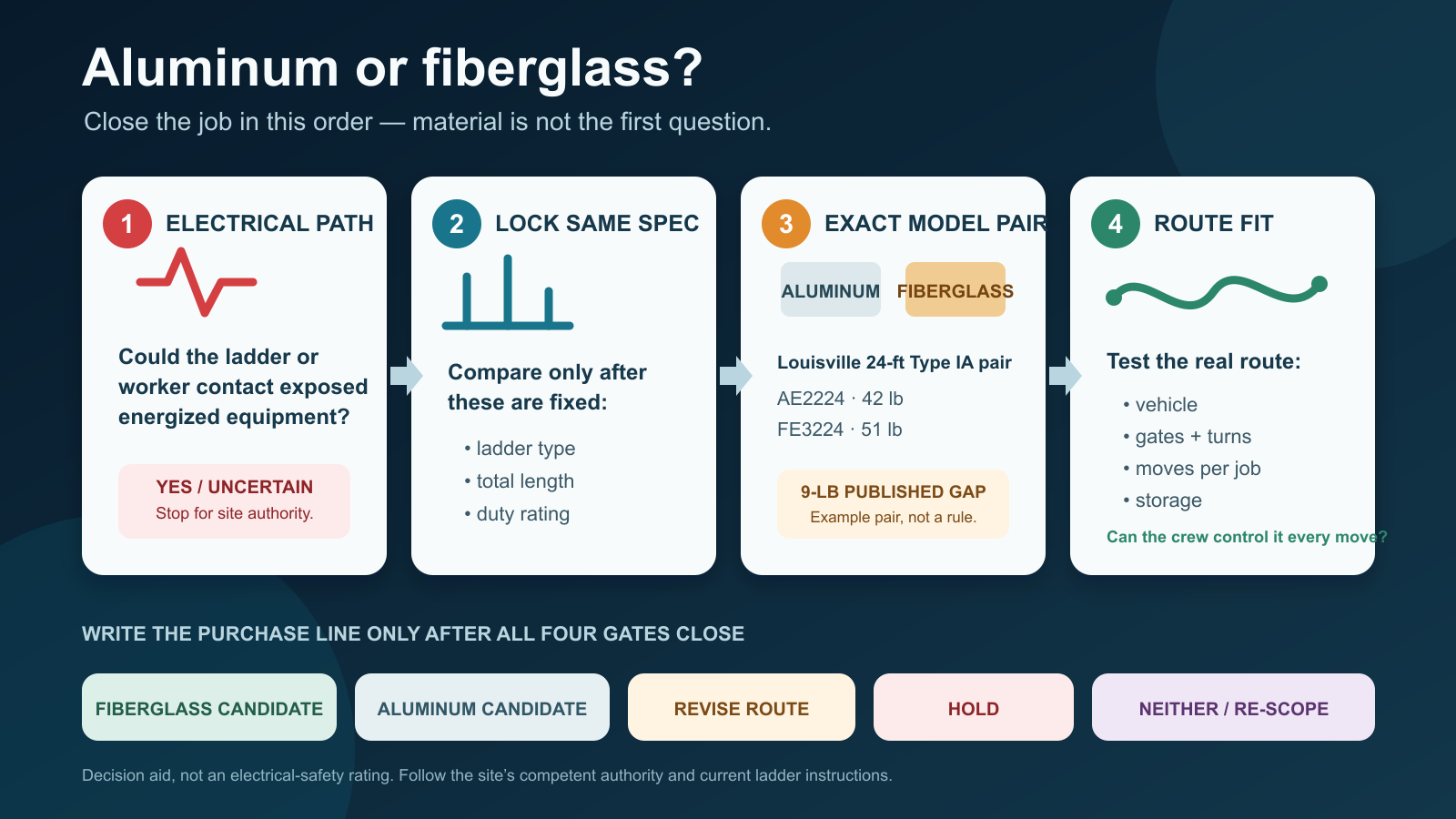
Two current Louisville Ladder models make the material choice more precise than “fiberglass is safer, aluminum is lighter.” The aluminum AE2224 and fiberglass FE3224 are both 24-foot Type IA extension ladders with a 300-pound rating and a published maximum extended length of 21 feet. The aluminum model is listed at 42 pounds; the fiberglass model at 51 pounds.
That nine-pound difference matters on a route. It does not decide the purchase by itself. If the employee or ladder could contact exposed energized equipment, the cited OSHA construction rule requires nonconductive side rails. And fiberglass rails are an added precaution, not electrical protective equipment: the ladder still has to be clean, dry and undamaged, while the worksite owner controls the electrical plan.
Use this order: authorize the ladder job, close the electrical exposure, hold type, length and duty rating constant, then test the exact model against the vehicle and carry path. If the earlier decisions are still open, return to the window-cleaning ladder guide. Material cannot repair a bad access plan.
Start with the exposure map, not a pros-and-cons list
An aluminum weight advantage has no purchasing value on a job where aluminum side rails are not admissible. OSHA 1926.1053(b)(12), in its construction-work scope, requires nonconductive side rails where the employee or the ladder could contact exposed energized electrical equipment. That is a condition, not a preference score.
The word “could” also prevents a narrow reading that looks only at the final ladder position. OSHA’s power-line case describes a worker moving an aluminum extension ladder after completing one window; the extended ladder fell into an overhead line. Moving, turning and repositioning are part of the exposure map.
Fiberglass does not close the electrical decision by itself. OSHA describes nonconductive rails as an added precaution and says ladders are not rated as electrical protection. The site still needs the applicable clearance, de-energization and work controls from the responsible employer, utility or qualified owner. This page does not calculate them.
| What the job record says | Material effect | Purchase result |
|---|---|---|
| Employee or ladder could contact exposed energized equipment | Aluminum leaves this comparison; the cited rule requires nonconductive side rails | Hold until the site authority closes the work method and an eligible ladder |
| No possible contact path has been established by the responsible site owner | Both materials may proceed to the exact-model comparison | Do not infer this merely because no wire is obvious in a product photo or estimate |
| Energy state, line ownership, work classification or clearance is unknown | Material cannot resolve the missing authority | Stop the purchase decision at the electrical owner |
| Fiberglass candidate is dirty, wet, cracked or otherwise damaged | Its nonconductive premise is not closed | Remove it from the material comparison and follow the inspection/withdrawal owner |
The useful fiberglass result is therefore “eligible for further comparison under the site’s controls,” not “safe around electricity.”
Hold the specification constant before comparing material
A material comparison breaks down when one side is a stepladder and the other is an extension ladder, or when length and duty rating change with the material. Any difference could be doing the work.
Freeze four fields first: design type, nominal size, manufacturer’s maximum extended or working length, and duty rating. Then compare exact models. The Louisville pair below is useful because those fields line up on the current product pages.
| Current manufacturer field | AE2224 | FE3224 | What it changes |
|---|---|---|---|
| Product type | Standard extension ladder | Standard extension ladder | Keeps the work-position class constant |
| Side-rail material | Aluminum | Fiberglass | The variable being compared |
| Total length | 24 ft | 24 ft | Prevents a taller ladder from masquerading as a material effect |
| Maximum extended length | 21 ft | 21 ft | Keeps the published working configuration aligned |
| Duty rating / load | Type IA / 300 lb | Type IA / 300 lb | Shows that capacity comes from the exact label, not the material name |
| Published product weight | 42 lb | 51 lb | Supplies a real route-handling input |
| Closed H × W × D | 148.875 × 19.438 × 6.625 in | 149.5 × 17.812 × 6.25 in | Shows why the rack and openings need exact dimensions too |
The values come from the current Louisville AE2224 aluminum page and FE3224 fiberglass page. This is not a ranking of the two ladders. A different size, series, duty rating or feature set needs its own pair of current product records.
The 300-pound label also does not mean “300-pound user.” The load total has to include the worker plus every tool and material the ladder supports. Sizing and total load belong in the whole-ladder decision before material is compared.
Nine pounds becomes a route question
“Heavier” is incomplete. A route has a truck or van, a rack height, a storage position, a carry from the parking point, corners and gates, surface changes, and a number of moves between windows. The exact 42- and 51-pound values become useful only when placed on that route.
| Route segment | Evidence to record | What an open field means |
|---|---|---|
| Load and unload | Vehicle/rack model, ladder retention owner, lift path and available competent help | The catalog weight has not yet proved controllable transport |
| Carry to the first position | Distance, grade, steps, gates, turns, overhead conflicts and surface condition | A model that fits the rack may still fail the site path |
| Reposition along the building | Number of moves, obstacles, traffic and orientation changes | Daily handling cost and exposure remain unknown |
| Return and storage | Cleaning/drying location, inspection owner, protected storage and rack clearance | Fiberglass condition and either ladder’s readiness can deteriorate between jobs |
Do not turn nine pounds into a universal one-person or two-person rule. OSHA’s power-line case used two workers to control a heavier fiberglass ladder in that scenario, but it does not publish a weight threshold for every crew and route. The defensible decision is whether the employer’s actual handling plan controls the selected exact ladder through every move.
This is where aluminum can retain a real advantage when the electrical gate is closed: a lower exact product weight may reduce route friction. That advantage is conditional, not material-wide. Another aluminum/fiberglass pair may have a different gap, and accessories or configurations can change the complete carried weight.
Fiberglass condition belongs in the electrical decision
Fiberglass is described as nonconductive only when clean and dry. OSHA’s case adds undamaged. The Oregon OSHA portable-ladder guide notes that improper handling can chip or crack fiberglass, while age, sunlight and humidity can contribute to exposed fibers that hold moisture. A purchase plan that chooses fiberglass for its rail material but has no drying, protected-storage or inspection owner is unfinished.
Aluminum has a different failure vocabulary. Oregon OSHA describes it as lightweight and corrosion-resistant, but metal rails remain electrically conductive and can be damaged. Neither description authorizes a field repair. The visible condition of the exact ladder controls whether it stays in the comparison.
| Observed condition | Decision |
|---|---|
| Fiberglass is clean, dry, undamaged and accepted by the responsible inspection owner | Keep the exact model in the comparison; do not call it electrical protective equipment |
| Fiberglass is wet, contaminated, cracked, split or has questionable exposed fibers | Hold it out of the purchase decision until the responsible owner resolves its condition |
| Aluminum is bent, corroded or has another faulty component | Remove it from service under the applicable inspection/withdrawal process |
| Foot or shoe is the isolated question and the ladder identity is readable | Use the replacement-ladder-feet guide to check for an exact supported part path |
| Any structural scope is uncertain | Do not use the preferred material as evidence that the ladder is serviceable |
Material selection is a purchase decision. Inspection and return to use remain separate responsibilities.
Write the purchase line only after material survives the job
A complete order note should identify the exact model, not just “24-foot fiberglass” or “lightweight aluminum.” It should also carry the reason that model survived the job.
For example: “24-foot Type IA extension ladder; exact model FE3224; nonconductive-side-rail branch required by the responsible site owner; 51-pound published product weight and 149.5 × 17.812 × 6.25-inch closed dimensions checked against the named vehicle, gates and handling plan; current condition/inspection owner recorded.” The record does not certify the job, but it prevents the material label from swallowing the real decision.
| Result | Evidence that must be closed |
|---|---|
| Fiberglass candidate after site controls | Nonconductive rails required or preferred by the responsible owner; exact model/rating fit; clean, dry, undamaged condition; route handling controlled |
| Aluminum candidate with no electrical-contact path | Responsible owner has closed the electrical exposure; exact model/rating fit; route handling controlled |
| Revise route or access method | The exact ladder cannot be controlled through vehicle, gates, turns, traffic or repeated moves |
| Hold condition or electrical authority | Energy state, applicable control, fiberglass condition or inspection ownership is unresolved |
| Neither exact ladder authorized | The ladder method, type, load, support, condition or handling plan fails upstream |
If neither ladder survives, the next move is not to shop a third material. Return to the complete professional window-cleaning tool setup and select a ground-based or otherwise authorized access path. The material question has done its job when it makes an unsuitable ladder easy to reject.