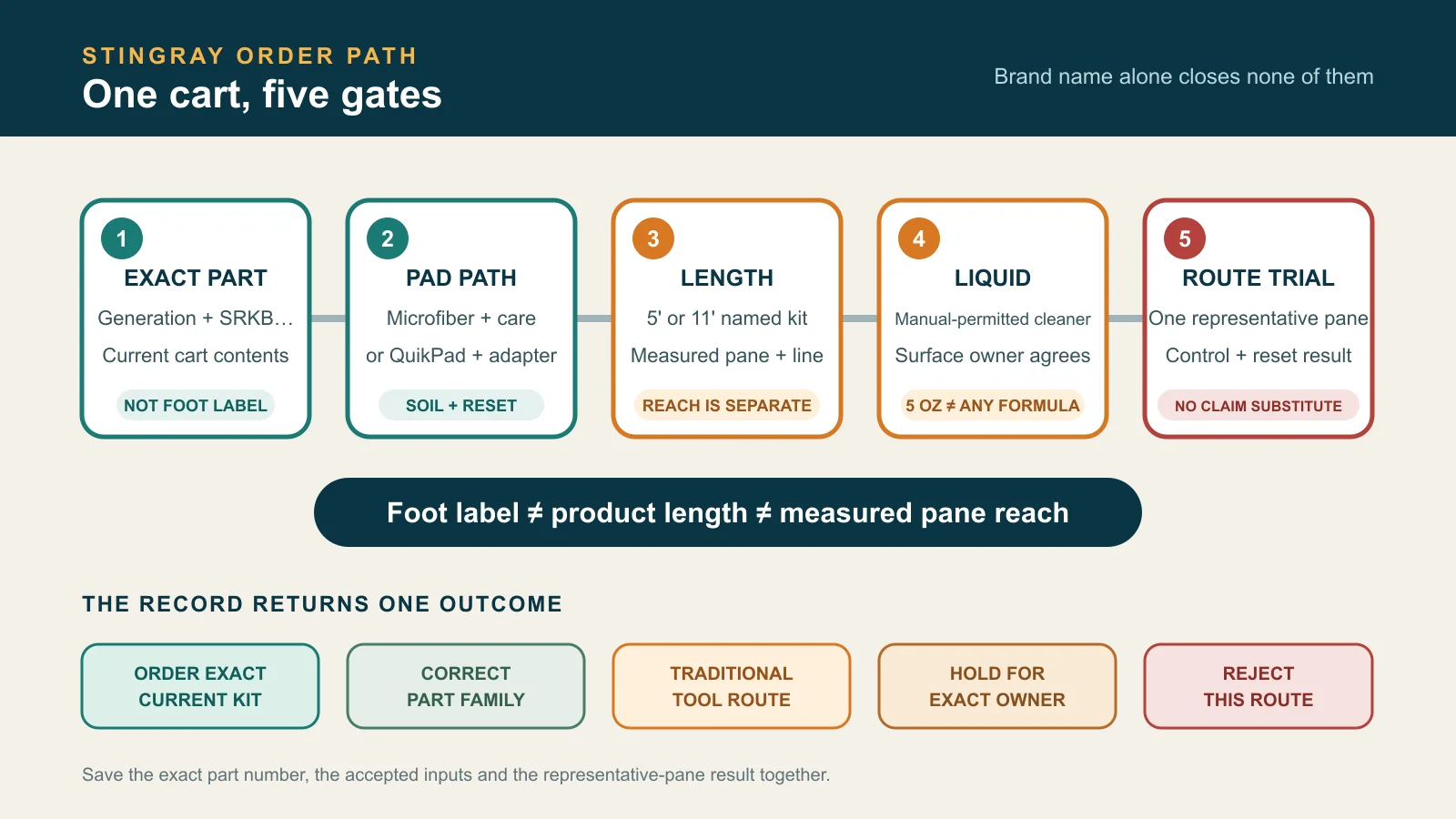
Two boxes can both say Unger Stingray and still contain different working systems. One may use a refillable bottle and reusable microfiber. Another may use a QuikPad adapter and disposable pads. An older listing may point to a pouch-era or discontinued three-foot kit. Even the long current kit appears as 10 feet on one specialist cart and 11 feet in Unger’s current US catalog.
The part number resolves that ambiguity. For a current US purchase, the first fork is straightforward: SRKB2 is the 5-foot QuikPad kit; SRKB1 is the 11-foot QuikPad kit; SRKB5 is the 5-foot microfiber kit; SRKB4 is the 11-foot microfiber kit; and SRKB7 is the 11-foot microfiber deluxe kit with a bag. That is only a provisional choice. The exact pad, permitted liquid, actual pane geometry and replacement path still have to fit the route.
If the route itself is undecided—traditional tools, a low-moisture pad system or another ground-based method—make that choice in the high-window tool guide first. This page starts after Stingray is a plausible indoor method.
The part number resolves two different kit paths
Unger’s current US product catalog places five refillable kits in one matrix. Read across the exact part-number column rather than shopping from a photo or foot label.
| Kit part | Pad path | Named length | Included route | What it does not settle |
|---|---|---|---|---|
| SRKB2 | QuikPad | 5 ft | Handheld, one SREPL long section, SRADK adapter, two SRBT1 bottles and the named QuikPad supply | Whether the disposable-pad workflow fits the route or the pane is within controlled reach |
| SRKB5 | Reusable microfiber | 5 ft | Handheld, one SREPL long section, two SRPD2 washing pads and two SRBT1 bottles | Whether the heavier-soil pad is appropriate for the surface and cleaning frequency |
| SRKB1 | QuikPad | 11 ft in the current catalog | Handheld, two SREPL long sections, one SREPS short section, SRADK adapter, two bottles and the named QuikPad supply | Why a merchant may call it 10 ft, or whether the head can reach and move on the real pane |
| SRKB4 | Reusable microfiber | 11 ft | Handheld, two long sections, one short section, two SRPD2 pads and two bottles | Whether reusable-pad handling and laundering fit the route |
| SRKB7 | Reusable microfiber deluxe | 11 ft | SRKB4-style working components plus SRBAG carrying bag | Whether the bag has operational value for this crew rather than simply increasing the bundle |
The catalog also says Stingray handheld units come with AA batteries. Treat that as a current catalog inclusion, then confirm the live cart before checkout. A dated catalog does not prove what a merchant will ship today.
The three-foot rows need special care. Unger’s 2025 US price index places SRKB3, SRKB6 and the SRPD3 25-pack QuikPad in its discontinued section. It suggests SRKB1/SRKB2, SRKB4/SRKB5 and SRPD4 as substitutes. A suggested substitute reopens the decision; it does not preserve the old kit’s length, pad workflow or cart total automatically.
The current specialist refillable-system cart illustrates why the part number matters. It presents 5- and 10-foot choices and identifies SRKB2/SRKB1, while Unger’s current catalog calls SRKB1 11 feet. Do not average the labels or assume a different pole set. Copy the part number and included sections from the current seller, then compare that exact line with the current manufacturer record.
Choose what happens when the pad gets dirty
Microfiber versus QuikPad is not a small accessory choice. It changes what the crew carries away from the pane.
The current green SRPD1 Glass Cleaning Pad is presented for dust, fingerprints and light dirt. It attaches with elastic bands and its product page says it can withstand up to 200 machine washes. The gray SRPD2 Glass Washing Pad uses a 13 mm looped microfiber pile and is presented for heavier indoor soil. Its current product page says up to 300 machine washes.
There is a documentation wrinkle worth preserving. The refillable-system manual gives a general “up to 200 times” statement for microfiber pads, while the exact SRPD2 page says 300. That is not a reason to invent a blended life estimate. Record SRPD1 or SRPD2, read the care tag supplied with that pad and make route economics from observed laundering and replacement—not a catalog maximum.
The QuikPad path requires SRADK adapter hardware and the correct disposable pad. It can remove laundering from the route, but it adds used-pad inventory and disposal. The current catalog lists SRPD4 as the 100-pack replacement. Confirm that the adapter is in the selected kit and that replacement pads are obtainable from a current source; a triangular pad from another family is not a documented substitute.
Choose from route operations, not from a generic “reusable versus disposable” preference:
- Name the recurring soil: light fingerprints, heavier deposited dirt or something that needs a different surface method.
- Decide where dirty reusable pads will be isolated, laundered and returned to service—or where disposable pads will be counted, stored and discarded.
- Record the exact pad and adapter parts in the same order line as the kit.
If the surface needs scraping, abrasive treatment or restoration, stop expanding the pad choice. Stingray is a low-moisture indoor cleaning system; it does not grant permission for a different residue-removal process.
Refillable does not mean any liquid
The current Stingray Refillable System manual gives the bottle a five-ounce maximum. More importantly, it limits the system to conventional window and glass cleaners. It says not to use concentrates, creams, gels, abrasive formulas or products containing bleach.
That rule is narrower than “fill it with your preferred solution.” The liquid in the route record needs an exact product, current ready-to-use direction, label and safety data sheet. If the product requires dilution from concentrate, do not perform that chemistry inside the Stingray bottle. If its formula class falls under the manual prohibition, the refillable feature does not rescue it.
Surface permission is another owner. The manufacturer’s current Stingray family page names indoor glass and several other surface classes, and excludes automotive use, aquarium interiors and eyewear. A film, tint, coating or treated glass system can impose a narrower method. Save that owner’s current cleaning instruction with the route. An inconspicuous patch can reveal an immediate problem; it cannot replace a missing surface instruction.
Product length is not pane reach
Four numbers can appear around the same system: 5 feet, 10 feet, 11 feet and 18 feet. They do not share one measurement basis.
The 5- and 11-foot values name current kit configurations in the US catalog. The refillable manual identifies the main unit as 20 inches, the SREPS short section as 1.5 feet and the SREPL long section as 3.5 feet. It permits no more than three long and one short extension section, describing that maximum product configuration as approximately 12 feet. Unger’s current category page separately says an operator can reach up to 18 feet from the ground.
Those statements can coexist because product length and operator reach are different. Neither number proves that a specific pane can be worked. Before choosing the long kit, record:
- the highest point the pad must contact;
- the horizontal offset from the actual standing position;
- furniture, counters, displays, partitions or other obstacles that move that standing line;
- the exact handheld, long-section and short-section combination; and
- whether the head can remain visible and controlled through the top edge, corners and return stroke.
Do not add operator height to a catalog label and call the result a product specification. Do not add an undocumented fourth long section because a pane is slightly higher. If the accepted work requires another ground-based tool or changes access method, return to the professional window-cleaning equipment setup and route the job there.
Build the second-use cart
A kit that cleans one pane but cannot be reset for the next route is not a closed purchase. Put the service items beside the working kit:
- exact SRPD1, SRPD2 or SRADK/SRPD4 pad path;
- SRBT1 bottle for the refillable generation, without assuming it replaces a legacy pouch;
- SREPL and SREPS sections only where the exact current system documents them;
- two AA batteries and a planned battery-removal step for long storage;
- a dry, upright storage position; and
- a current manufacturer distributor or merchant path for each replacement part.
The specialist cart’s seller answers say the refillable system uses the Stingray pole rather than a generic traditional pole. Keep that statement in seller scope, but treat it as a practical rejection of an undocumented mixed-pole cart. The traditional extension-pole interface guide does not create a Stingray adapter; it explains why both sides of a connection need explicit owners.
Legacy equipment deserves its own record. If the tool uses a pouch, an older head or an early pole, capture its labels before ordering a refillable bottle or current extension. Similar shape and brand do not establish generation compatibility.
Let one representative pane write the decision
Run the completed cart against one representative pane before assigning the system to a route. This is not a public performance test; it is the buyer’s acceptance record for the exact surface, configuration and crew.
| Route field | Record before the pane | The route breaks when |
|---|---|---|
| Listing identity | Current URL/date, generation, exact kit part and every included section | The seller cannot tie the box to one current part and content list |
| Surface and soil | Glass/film/coating owner, permitted method and recurring soil | The owner is unknown or the soil needs another process |
| Pad and liquid | Exact pad/adapter, exact ready-to-use cleaner, label/SDS and five-ounce limit | Pad hardware is mixed, cleaner is prohibited or surface permission is missing |
| Working line | Pane height, offset, obstacles, floor protection and exact section count | The head cannot be seen, kept on the pane or returned without entering another access method |
| First-pane result | Edge/corner access, liquid control, visible residue after drying and operator control | The accepted result is not achieved without changing an unrecorded input |
| Reset for the next job | Dirty-pad handling, replacement source, bottle, batteries, drying and storage | The system cannot be serviced with identified current parts |
The outcome should be one sentence. Order the exact current kit when every row closes with the same part family. Correct the component family when the method fits but the pad, adapter, bottle or pole is wrong. Use a traditional indoor tool route when the surface or soil needs another controlled method. Hold for the exact owner when a current cart, surface instruction or compatibility statement is missing. Reject the route when the measured pane cannot be worked and reset under the accepted conditions.
Save that sentence with the kit part number and the representative pane. The word Stingray alone should never return to the order record.