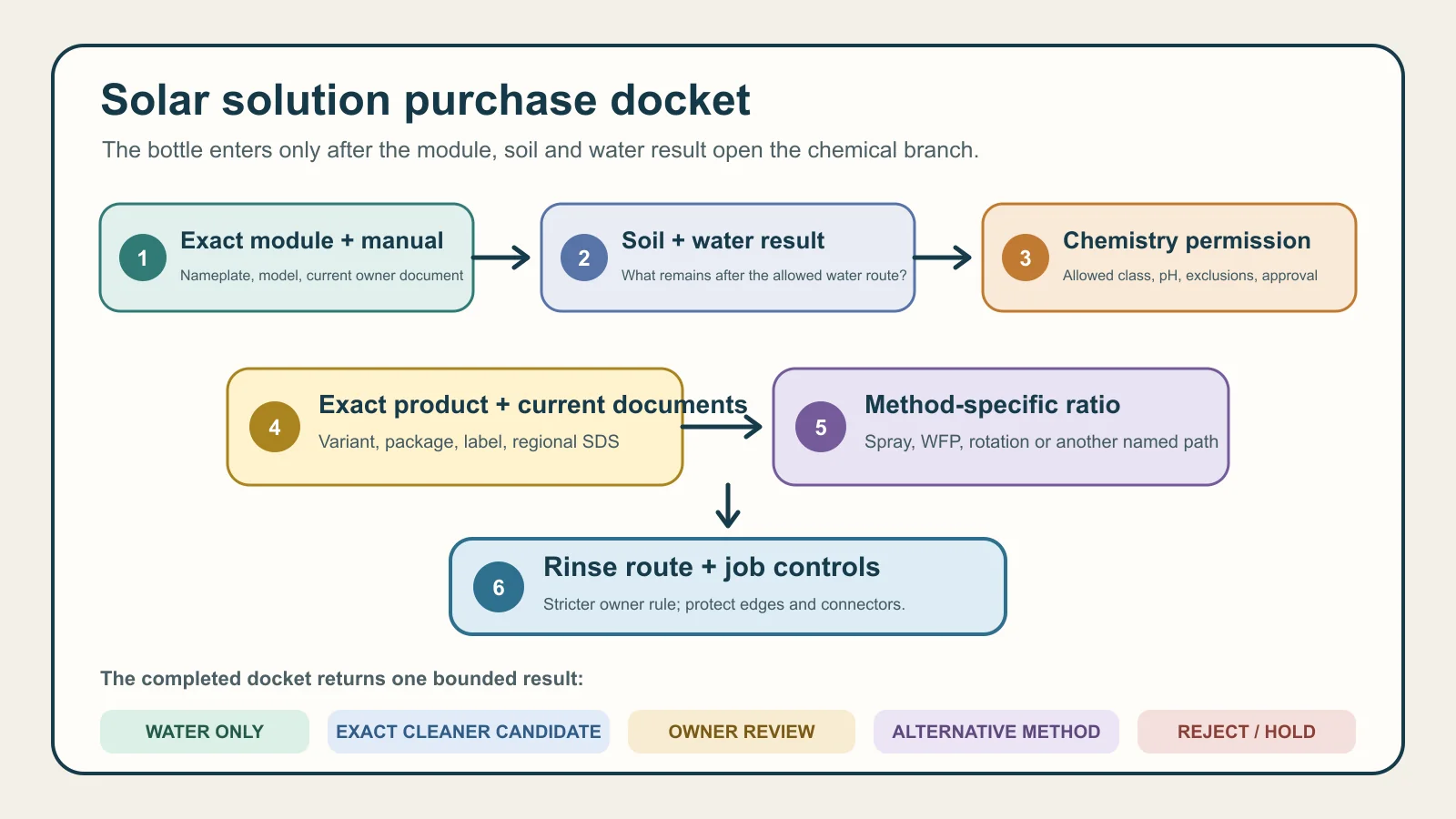
A bottle has not earned a place on the truck merely because water left something behind. First identify the installed module, open its current cleaning document and name the contaminant. Those three facts decide whether a chemical is allowed to enter the job at all.
The short answer is to begin with the module owner’s water route. If compliant water solves the soil, buy no cleaner. If the owner permits a cleaner for the remaining contaminant, bind one exact product and current label/SDS to one application method, then obey the stricter applicable rinse rule. “Solar-safe” on a product page cannot close any of those fields by itself.
| Field | What must be written down | Why it changes the order |
|---|---|---|
| Module owner | Manufacturer, model or series, nameplate and current cleaning document | Another module’s chemical rule does not transfer |
| Soil | Dust, ordinary removable dirt, grease, organic residue or unknown deposit | The contaminant determines whether chemistry has a role |
| Water result | Water quality, allowed water method and what remained | A successful water route removes the bottle from the order |
| Chemistry permission | Allowed cleaner class, pH, exclusions and required approval | A product can be well documented and still be ineligible |
| Product and method | Exact variant, package, label, SDS, application route and ratio | One brand can publish different ratios for different methods |
| Rinse and controls | Rinse water, bypass or separate supply, edges, connectors and responsible site owner | The mix is incomplete until residue and site boundaries are closed |
The module manual decides whether chemistry enters the job
Panel makers do not publish one universal detergent rule. Their instructions differ in both scope and sequence, which is why a cleaner’s compatibility list cannot replace the document for the installed module.
LONGi’s current O&M manual starts with water. Municipal domestic water may be used, while other water sources must meet the listed quality limits, including pH 6–8. Commercial glass-cleaning agents, alcohol or methanol enter only when water cannot clean the module. The same section rejects abrasive and polishing cleaners, sodium hydroxide, benzene, nitro thinner, acids, alkalis, steam and corrosive reagents, and it requires the treated area to be rinsed with compliant water.
Canadian Solar’s Installation Manual v3.1 takes a soil-specific route. It sends soft dirt such as dust to compressed air when that method is effective. For wet cleaning, it calls for low-mineral water near pH 6–8. When grease is present, it conditionally allows an authorized, environmentally friendly cleaning agent. That is a narrow branch, not permission for any bottle carrying a solar label.
The currently hosted First Solar Module Cleaning Guidelines provide a third answer inside their uncoated-module wet-cleaning section. Fresh water is the base route; if needed, a mild, nonabrasive, noncaustic detergent may be used when the final solution is above pH 6.5 and below pH 8.5 at 25°C. The document also excludes abrasive cleaners, degreasers, hydrochloric acid, D-limonene, ammonia and sodium hydroxide. Its uncoated scope must not be borrowed for a coated module or another First Solar series.
| Current owner scope | When a cleaner may enter | What the rule does not approve |
|---|---|---|
| LONGi modules controlled by O&M V2.0 | After compliant water does not clean the module, within the named cleaner classes and rinse rule | An unrecorded chemical, a no-rinse shortcut or another module family’s limits |
| Canadian Solar families listed in v3.1 | An authorized environmentally friendly agent, with caution, for the stated grease branch | A general-purpose cleaner for dust, an unidentified module or an unauthorized product |
| First Solar uncoated-module section in PD-5-804 Rev 3.4 | If needed, a mild nonabrasive noncaustic detergent within the stated final-solution pH range | Transfer to anti-reflective-coated modules, another series or a prohibited chemistry |
The manufacturer’s name on a conformity letter is useful supporting evidence, but it still does not identify the module on the roof, the controlling revision, the contaminant or the proposed method. Keep the module owner’s instruction at the top of the job record.
Let the contaminant earn the cleaner
“Dirty” is too vague for a chemical purchase. A layer of loose dust, a greasy exhaust film and a hard unknown deposit may look like three degrees of the same problem, but the owner documents route them differently.
Use the least expansive branch that actually fits the evidence. Dry or loose dust may remain in the owner’s air or water route. Ordinary dirt that releases with compliant water gives no reason to introduce a concentrate. Grease can open a narrow agent branch where the exact manual says so. Organic residue can make an organic-soiling product worth investigating, but only after the module owner allows that product class.
| What remains | Purchase implication | What not to infer |
|---|---|---|
| Loose dust or soil the owner’s water route removes | Water-only result; no cleaner goes on the order | That a chemical will make an already complete method better |
| Grease on a module whose current owner permits an authorized agent | Investigate one exact eligible product and its documents | That every “environmentally friendly” product is authorized |
| Bird residue, pollen, sap or other named organic soil | An organic-soiling cleaner may become a candidate after module permission | That a broad organic-soil claim proves coating, seal or warranty fit |
| Mineral scale, paint, cement, lichen, metal oxide or an unidentified film | Diagnose and return to the module owner or a qualified specialist before choosing chemistry | That the strongest product in a merchant category is the correct escalation |
| Cracked glass, loose connections, exposed conductors or unresolved array authority | This is not a cleaner-selection job | That a detergent choice supplies an electrical or access procedure |
Do not use a hidden patch as a universal compatibility test. A limited observation can confirm whether an already authorized method is producing the expected result on that job; it cannot rewrite the module owner’s exclusions or turn an unknown deposit into a known one.
This soil decision also protects the surrounding equipment choice. If the remaining work needs contact, settle the module’s contact class in the soft-brush solar-panel guide before letting bristles or rotation influence the chemical method.
The bottle name is not the method
Chemitek Solar Wash Protect 50 shows why an exact product name is still not enough. The current SWP product page positions the concentrate for organic soil and describes an antistatic coating. Those are manufacturer claims about the product, not a permission statement for the installed module.
The SWP50 technical datasheet MKT.013.01.06.EN supplies a usable identity. It lists a base dilution of 1 kg of SWP50 to 50 L of water, product pH of 7 ± 1 and full miscibility in water. It instructs the user to apply the diluted solution, brush the surface and rinse away dispersed soil and excess product. The diluted solution is to be used within 48 hours, which matters when deciding batch size; it does not predict how much a particular site will consume.
Chemitek’s separate application-method guide MKT.067.00.00.ML then changes the ratio and water path with the equipment. That is the purchasing trap: copying one ratio from a product description before choosing the method can create the wrong mix for the planned delivery system.
| SWP50 method in the current guide | Published product route | Still required before use |
|---|---|---|
| Spray before manual brushing | 1:50; spray the full surface, brush without adding water, then rinse with demineralized water | Module permission for the cleaner and contact tool, current label/SDS and a workable rinse supply |
| Dosing pump with a water-fed pole | 1:50; apply through the dosing branch, stop the solution and use the bypass for plain-water rinsing | Verified pump ratio, bypass operation, module-approved brush method and enough compliant rinse water |
| Water-driven rotating brush | 1:150 in the named branch, followed by the soft-water bypass rinse | Explicit module-owner permission for rotation, not merely permission for a manual soft brush |
These rows are not a universal recipe and are not instructions for SWP300, a ready-to-use product or another cleaner. They show what belongs on a purchase record: exact variant, exact document, exact method and the ratio attached to that method.
The hosted SWP50 Safety Data Sheet Version 2 identifies professional or industrial use. Obtain the current regional SDS and matching label for the selected package rather than assuming this hosted copy is the latest transaction document. A current US specialist cart is evidence that a purchase route exists, but its price, stock, reviews and broad benefit claims are not part of this selection.
A no-rinse claim can lose to the module owner
The application guide also contains a very dilute SWP additive branch—1:300 to 1:500—in which it says a separate rinse is unnecessary. That statement belongs only to that product method. It does not erase a module owner’s instruction.
On a LONGi job controlled by O&M V2.0, using a detergent invokes the module manual’s rinse requirement. A no-rinse product branch therefore cannot be copied into that job merely because it appears in a later product document. On another module, the current owner may prohibit the chemistry, allow it with different conditions or require technical review. The controlling answer is the overlap of both documents, not whichever rule is easier to execute.
Treat the rinse as a purchased capability. The crew needs enough owner-compliant water, a reliable way to switch from solution to rinse water, and a route that does not spray connectors, junction boxes, cable interfaces or other excluded areas. If the product is mixed into the only tank and the method needs a clean-water rinse, the job may require a separate supply or a verified dosing bypass. That equipment gap is visible before a bottle is ordered.
Water quality remains attached to the same module owner. Use the water-fed pole system guide to size the treatment and flow path after the manual defines acceptable water; do not borrow a low-TDS target or pressure number from a different module family. If the plan is a complete solar package, the solar-panel cleaning kit audit keeps the rinse water, hose, brush, pole, transport and service handoffs together.
Put six lines on the order before the bottle
Write the purchase record for one identical module group, not for “the solar panels” as a single category:
- Module: manufacturer, full model or series, nameplate or project reference and current cleaning document.
- Soil: named contaminant, water quality, permitted water method and what remained after that method.
- Permission: allowed cleaner class and pH, prohibited chemistry, required technical approval and rinse rule.
- Product: exact brand, variant, package, current label and current regional SDS.
- Method: spray, dosing-pump WFP, rotating brush, robot or another named route, with only its published ratio.
- Completion: rinse supply and switch-over, contact-tool permission, edges and connectors, adjacent materials, responsible site owner and accepted result.
| What the record shows | Buying result |
|---|---|
| Water closes the soil within the module owner’s method | Keep the job water-only |
| The owner permits the chemistry, and one product, method, ratio and rinse all agree | Exact cleaner candidate—subject to the selected label/SDS and job authority |
| The manual calls for authorization, technical review or project-specific confirmation | Return to the module owner before ordering |
| The soil or access route does not fit the proposed chemical method | Use an owner-approved alternative or qualified service |
| The product variant, label, SDS, ratio or rinse cannot be tied to the selected package | Leave the product off the order until the documents close |
| The chemistry conflicts with the module instruction | Reject that cleaner for this module |
A robot changes the contact, water and recovery method, so route that branch through the solar-panel cleaning robot guide rather than reusing a manual-brush ratio. For the rest of the paid-job stack, the professional window-cleaning tools guide keeps chemical, water and contact decisions in their proper place.
Until all six lines agree, the bottle stays off the purchase order.