The glass may pass while the frame fails. That is the first useful fact in a Cleansol BC decision.
EaCo Chem’s current Product Data Sheet lists glass among suitable substrates under standard conditions, but the same document excludes unpainted metal and warns that polished aluminum can whiten or brown. A window is rarely a sheet of glass floating by itself. It is a pane, an exposed coating or film, seals, a frame, hardware and nearby finishes sharing the same spray and rinse zone.
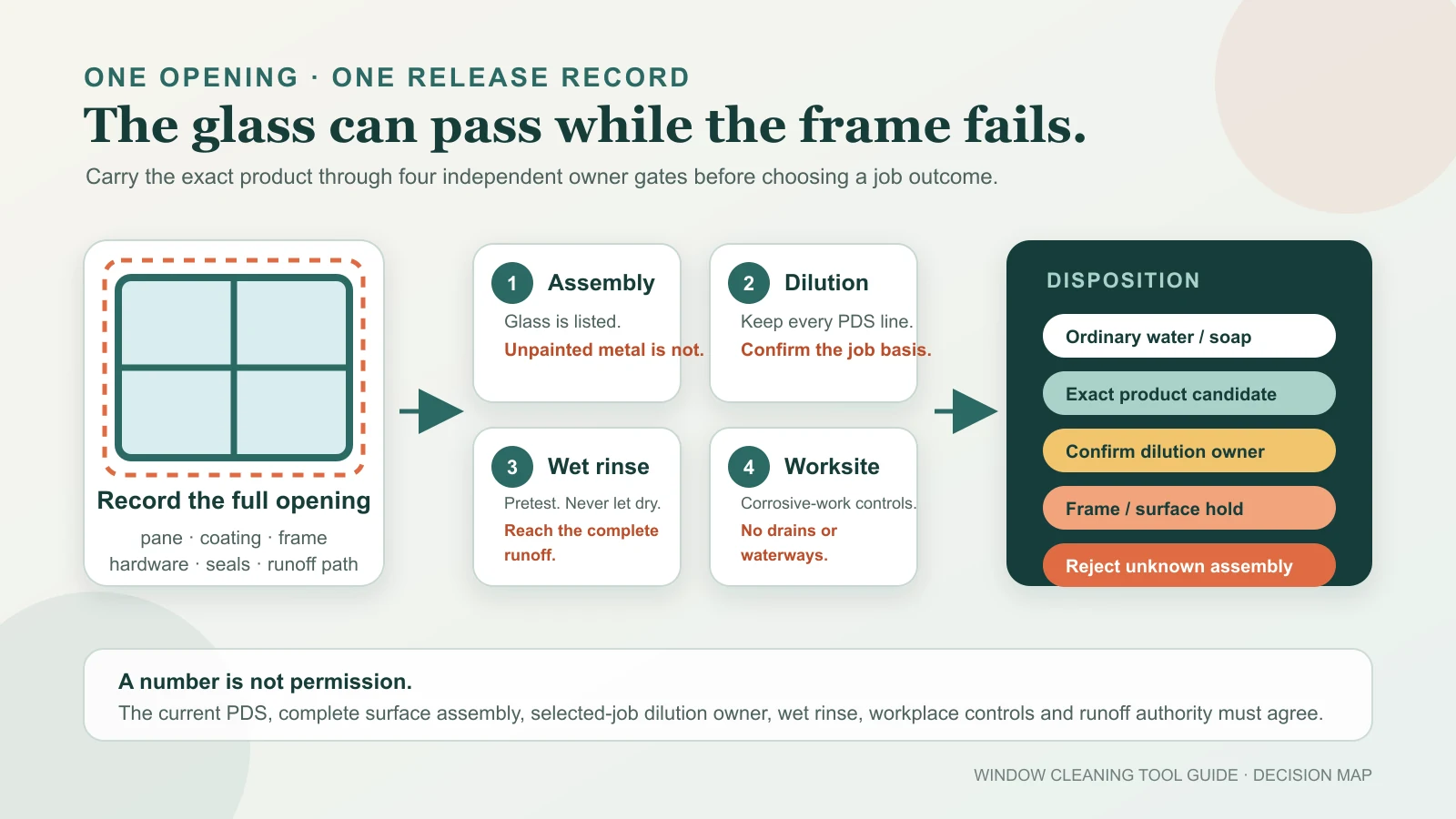
So “the product says glass” is only one completed field. Before Cleansol BC enters a job, the entire opening needs a material record, the manufacturer’s dilution sequence needs a confirmed interpretation, and the application must have a complete wet-rinse, corrosive-work and runoff route. If any of those owners is missing, the useful answer is a hold or a simpler cleaner—not a guessed recipe.
Treat one window opening as more than glass
Begin at the opening, not the bottle. Record what the solution can touch during application, dwell and rinsing. That includes indirect contact from drift and runoff, not just the area a brush or applicator is meant to reach.
| Opening field | Record before product selection | Why it changes the decision |
|---|---|---|
| Glass layer | Bare glass, known coating, film, tint, protection or unknown treatment | A general glass listing does not supply permission for an added layer |
| Frame | Material, paint or coating, finish condition and exposed edges | Unpainted metal is outside the PDS scope; polished aluminum carries a visible-finish warning |
| Hardware and seals | Material, finish, condition and whether they can be isolated | Small components may receive concentrated runoff or retain solution |
| Soil | What is present, how it was identified and whether ordinary cleaner has failed | The product name should not create a need for stronger chemistry |
| Conditions | Air and surface temperature, wind, shade, occupants and traffic | The PDS states a preferred temperature range and requires control of adjacent exposure |
| Pretest | Exact hidden area, complete proposed mix and method, dry-evaluated result | A wet surface can hide a finish change that appears after drying |
| Removal route | Application equipment, water source, rinse reach, drainage and final destination | The method is incomplete if the product can be applied but not fully removed |
The current Cleansol BC Product Data Sheet is precise enough to prevent a common shortcut. Its suitability list can support the glass row. Its unpainted-metal exclusion and polished-aluminum warning control separate rows. Neither row can be erased by choosing a weaker-looking mix.
This distinction matters on commercial openings with aluminum frames, metal fasteners, protective films or unknown restoration treatments. If the frame or hardware cannot be identified, the record is not “probably safe on glass.” It is “assembly identity incomplete.” That sends the opening to the surface owner, manufacturer or an ordinary-cleaner route before specialized alkaline chemistry is considered.
Let the ordinary cleaner win when it already can
Cleansol BC is not the starting point merely because its name appeared in the search. Start with the soil and the least complex owner-approved route that can close it.
If ordinary water or the documented bucket cleaner already removes the identified soil without introducing a restoration chemical, that is a complete outcome. The window-cleaning soap decision owns that branch. It keeps the cleaner, working water, surface, tools and expected result in one batch record. This page begins only when the ordinary route does not close the job and the named alkaline product has a defensible role.
The distinction is not a claim that mild always means safe or that strong always means effective. It is an ownership decision. Every additional chemical introduces its own exact label, surface scope, dilution, application, rinse, protective controls and disposal facts. If the job does not need those extra owners, adding them lowers clarity without adding decision value.
Do not substitute a nearby chemistry page for the product in hand. OneRestore has a separate restoration-chemistry boundary, with its own product documents and excluded glass conditions. It does not lend its ratios or permissions to Cleansol BC. The same separation applies in the other direction.
The dilution line needs an owner, not arithmetic
The PDS does not support pulling one attractive ratio out of a search result and turning it into a universal recipe.
Its dilution section first directs the user to add four parts water to one part Cleansol BC to make ready-to-use material. It then presents separate lines for difficult cleaning at 10:1, light cleaning at 20:1, and gutters or downspouts undiluted. Those statements all belong in the record. What the article must not do is silently decide whether every later line is measured from concentrate or from the prepared material when the selected job and current owner have not closed that basis.
That uncertainty is easy to hide with arithmetic. For example, multiplying two ratios may produce a clean number while answering a question the manufacturer never asked. A mathematically consistent conversion is not the same as an authorized use direction.
Send the manufacturer a question that preserves the document’s sequence:
For current Cleansol BC and this exact soil and surface assembly, does the stated job ratio use concentrate or the ready-to-use material made by adding four parts water to one part product? Which current label or instruction controls, and what complete application and rinse method belongs to that basis?
Keep the answer with the selected container, PDS revision, soil and opening record. Until that owner confirms the basis, the outcome is manufacturer dilution confirmation—not “use the weaker ratio” and not “start strong and adjust.”
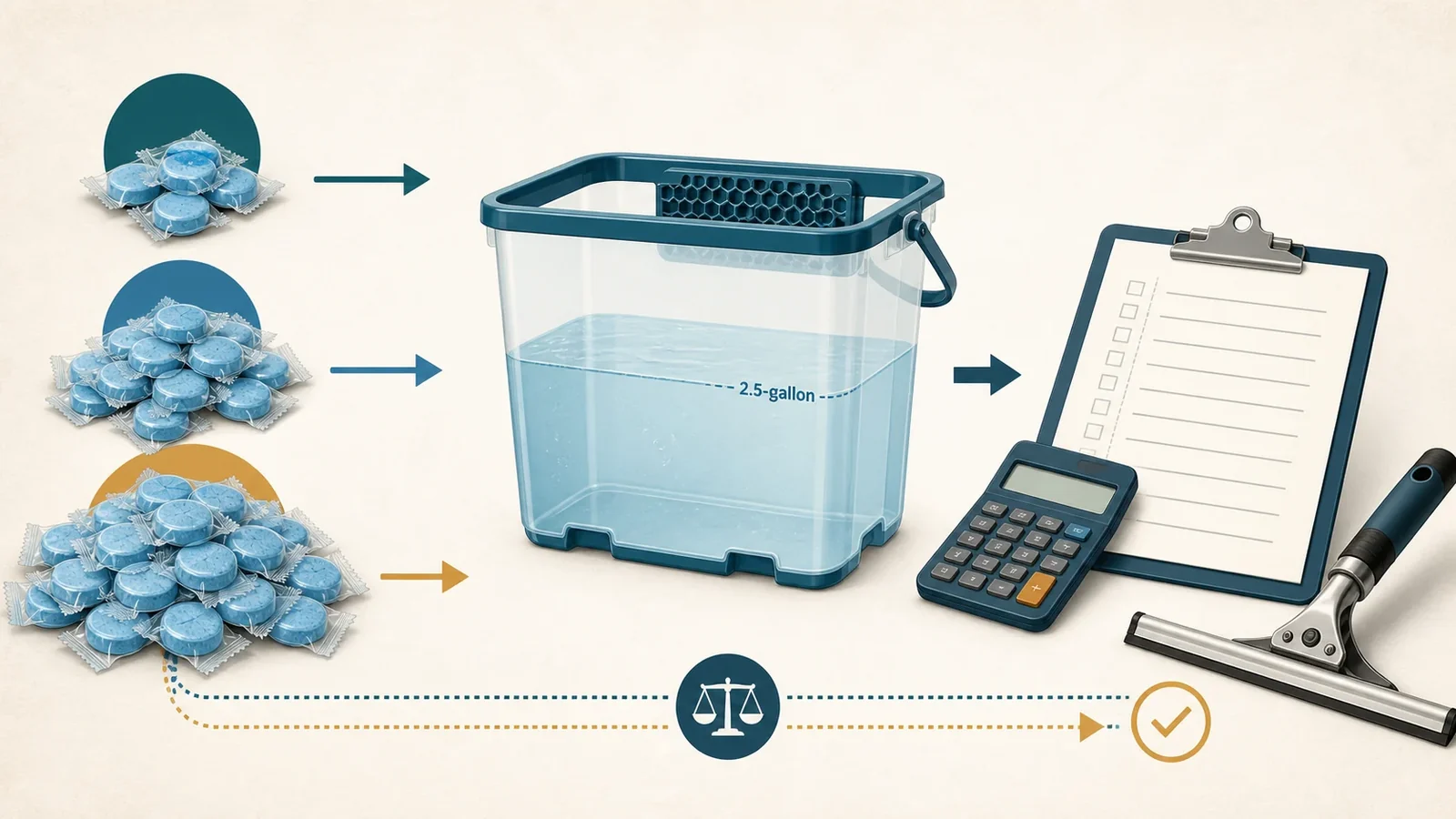
The record should also keep units and the actual working volume. But volume calculation comes after the owner identifies the correct basis. A calculator cannot repair an unresolved source term.
Application and rinsing are one operation
A product candidate is not released when the application step is possible. The removal step has to be possible under the same job conditions.
The current PDS says best results are obtained between 40°F and 90°F. It calls for pretesting and evaluating the test after it dries. Its published method uses two applications, three to five minutes apart, with no rinse between them; the product must not be allowed to dry. It then requires thorough rinsing and says not to use a zero-degree nozzle.
Those are connected constraints. A large sunlit opening can pass a small material check yet fail the route if the crew cannot keep the full work area wet through both applications and reach every frame, recess and lower surface with the complete rinse. Wind can change both dwell control and adjacent exposure. Cold or hot surfaces can take the job outside the owner’s stated best-results range even when the air temperature looks acceptable.
Write the application plan as one continuous line:
exact mix owner → exact application equipment → controllable work area → two timed applications → no-dry control → complete wet rinse → observed dry finish
If the line breaks at any point, reduce the work area, change the method under the responsible owner’s instruction or hold the chemical route. Do not solve a rinse-access problem by increasing pressure from article advice. The PDS itself says the surface manufacturer’s pressure recommendation controls, so the selected glass, frame and finish owners remain active.
The complete professional setup also matters. The professional window-cleaning tools guide owns the broader tool stack; this Cleansol BC record does not authorize a sprayer, nozzle, access method or protective setup simply because one appears convenient.
Hazard and runoff are separate yes-or-no decisions
Surface compatibility is not workplace authorization.
The current Cleansol BC Safety Data Sheet, version 3.1, identifies a professional-use mixture with pH 13.5 and 5-15% sodium hydroxide. It carries skin-corrosion and serious-eye-damage hazards. The SDS calls for appropriate ventilation, protective equipment and controls based on the workplace hazard assessment.
That means a public article should not select gloves, eyewear, clothing or respiratory protection for an unknown workplace. The responsible employer or site owner must use the current SDS, actual exposure route, ventilation, application equipment, duration and applicable requirements to make that selection. Occupants, other workers and traffic need their own exclusion or protection plan; “outdoor window” is not a complete exposure assessment.
Runoff is a different owner. The SDS says not to let the product enter drains, waterways or storm drains. Before application, the route needs a real answer for where the liquid will travel from the glass, across the frame and sill, down the façade and onto the ground. Covering a storm drain without an approved collection and disposal destination does not finish that question.
Also keep incompatibility facts attached to the exact product. The SDS identifies acids and certain metals as incompatible, while the PDS already excludes unpainted metal. Storage, mixing equipment, application hardware and the building assembly therefore belong in the same record. Do not blend another cleaner, additive or residue into the job unless all current owners explicitly close the mixture.
An exact-product identity matters here. The Sprayway glass-cleaner guide shows why similar category labels cannot carry formula facts between products. Cleansol BC keeps its own PDS, SDS, container and method from purchase review through disposal.
Give the opening one disposition
The first unresolved material, dilution, removal or site-authority question controls the result. Do not keep five possible answers in a project note and let the product drift onto the truck.
| Disposition | Evidence required | Next action |
|---|---|---|
| Ordinary water or soap route | Identified soil closes under the existing owner-approved cleaner and complete rinse | Keep the simpler batch record; do not introduce Cleansol BC |
| Exact Cleansol BC candidate | Current product and documents, known glass layer, accepted frame/hardware materials, passed dry-evaluated pretest, manufacturer-confirmed dilution basis, complete wet rinse, workplace controls and lawful runoff route | Preserve one exact job line for responsible owner review before use or purchase |
| Manufacturer dilution confirmation | Product and assembly are identifiable, but the current ratio basis or selected-job direction is unresolved | Send the precise sequence question and hold mixing and purchase assumptions |
| Frame or surface hold | Coating, film, treatment, finish, seal, hardware or adjacent surface permission is missing | Obtain the relevant surface owner’s answer or return to an accepted ordinary-cleaner route |
| Reject unpainted metal or unknown assembly | Unpainted metal is exposed, or the opening cannot be identified well enough to apply the current scope | Remove the product from this opening; do not try to cure an exclusion with dilution |
A useful final job line is compact: [exact product and document revisions] / [pane and exposed layer] / [frame, hardware and seals] / [soil and ordinary-route result] / [temperature and dry pretest] / [confirmed dilution basis] / [application and full rinse] / [PPE, ventilation, occupants and runoff owner] / [one disposition].
If another person cannot audit every field before the product enters the route, the opening is not an exact Cleansol BC candidate yet.