Before you remove silicone from glass, answer a less obvious question: is the silicone on the window, or is it still doing a job at the edge? A thumb-sized smear in the field of a pane may be cleanup residue. A continuous bead between glass and frame may be part of a glazing or weather joint. Cutting the second object is not window cleaning.
Appearance cannot settle that question. Record the mark, the pane and every material the proposed remover could touch. If the line is continuous, enters a frame or gasket, or has no documented owner, leave it in place and send the record to the glazing, window or sealant contractor.
This page covers that decision inside the broader professional window-cleaning equipment plan. It does not teach joint repair or resealing.
A continuous line is a building component until someone identifies it
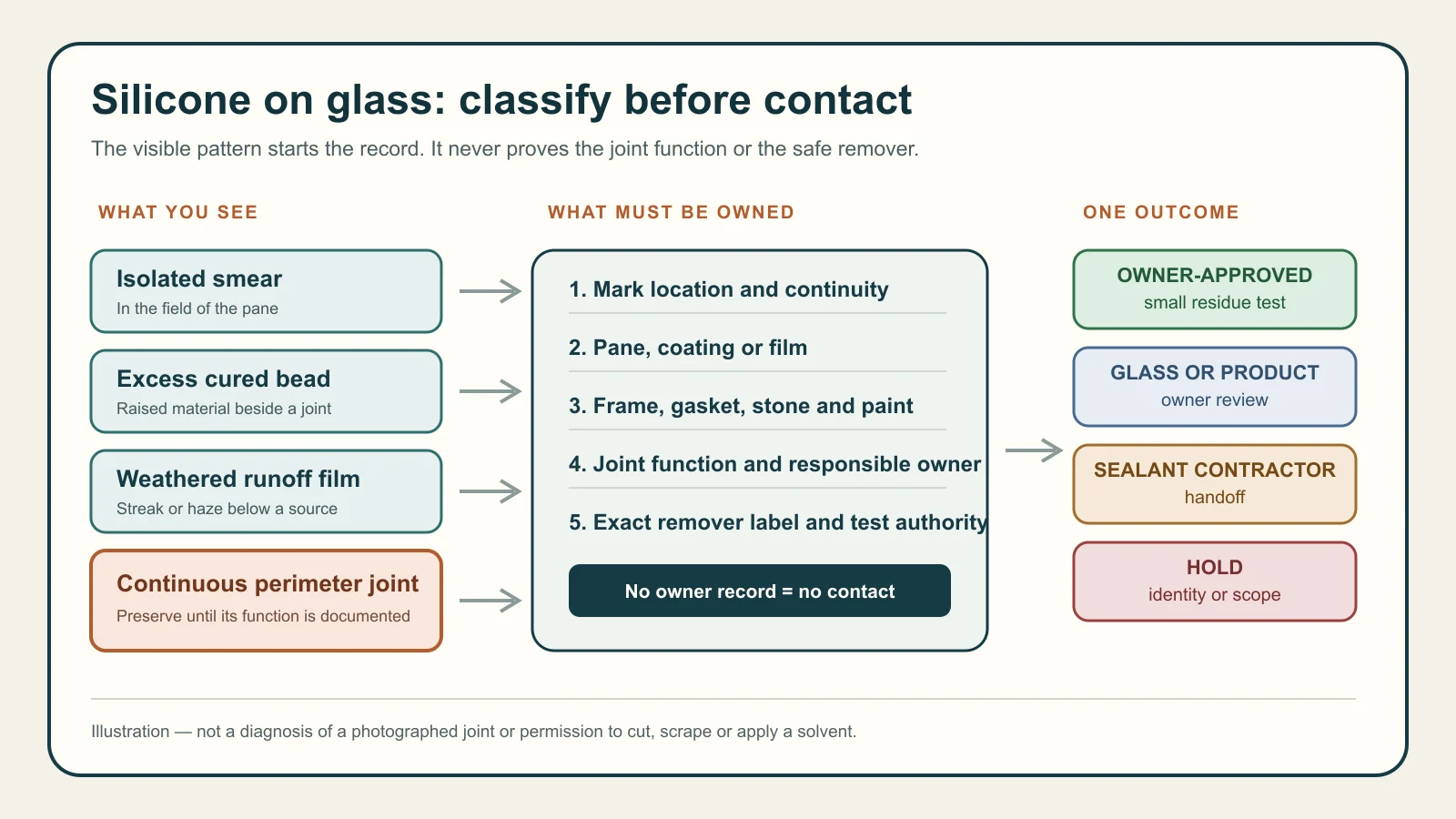
The same translucent material can appear as a smear, a raised ribbon, a weathered streak or a deliberate perimeter joint. Those shapes start different questions.
| Visible pattern | First question | What the pattern does not prove | Current owner |
|---|---|---|---|
| Isolated smear in the field of the pane | Was this left during installation or later work? | That it is silicone, cured or removable with a chosen product | Glass and product record |
| Raised excess beside a joint | Is the raised material separate from the line that seals the assembly? | That cutting the excess will leave the joint intact | Sealant or glazing owner |
| Film or streak below a joint | Is this runoff residue rather than remaining bulk sealant? | The chemical identity of the deposit or the correct remover | Glass owner plus material supplier |
| Continuous line at glass, frame or gasket | What function does the joint serve? | That it is failed, cosmetic or inside the cleaner’s scope | Window, glazing or sealant contractor |
For one named product, DAP’s MONO 100% Silicone bulletin distinguishes excess uncured material from cured sealant: it directs mineral-spirit cleanup for uncured excess and says cured excess must be cut or scraped. It also requires old caulk to be removed before resealing. That is useful evidence that cure state and job scope change the work; it is not a method for every silicone product or installed window.
A smear and weathered runoff are not the same record
An excess bead is material with edges and thickness. A runoff film can be a thin, weathered deposit that travelled from another building material. Treating both as “old silicone” silently invents a product identity.
Vitro’s TD-107 on residue on glass says sealants need not touch the pane directly to produce residue: material from expansion joints, parapets and weather seals can reach glass with gravity or rain. It also warns that a long residence time can make residue costly to remove. That points the investigation upstream. If the glass is cleaned but the source remains, the next rain can recreate the mark.
Vitro’s severe-residue procedures are explicitly for evaluation by building owners or maintenance supervisors and are limited to stated surface configurations. They are not generic permission for exposed low-e coatings, aftermarket film or a different manufacturer’s product. Before escalating beyond an ordinary wash, identify the glass make-up and exposed surface. If that record is missing, the missing record—not a stronger chemical—is the next task.
The pane-identification guide can help organize marks and product records, but a tempered stamp still does not reveal the exposed coating or approve a solvent, pad or blade.
The pane and its neighbors get veto power
“Safe for glass” is too small a promise for an installed window. A liquid placed on the pane can run into a seal, painted frame, gasket, stone sill or finished wall. A tool can leave the pane and catch an edge. The purchase decision therefore needs an exposure envelope, not a single substrate.
| Contact zone | Fact to close | Why it changes the cart |
|---|---|---|
| Pane face | Manufacturer/product, exposed coating or film, existing damage | Decides whether the glass owner admits the proposed contact |
| Perimeter joint | Purpose, extent and responsible contractor | Separates residue cleanup from seal removal or repair |
| Frame and finish | Aluminum, vinyl, wood, paint or other declared finish | A glass-compatible product may still be incompatible here |
| Gasket and seal | Exact assembly information and product restrictions | Limits runoff, dwell and wiping products |
| Sill, tile or stone | Material and current care instructions | Solvents and residues can cross onto a different surface |
If the mark arrived during construction, keep this pane-level decision inside the post-construction window-cleaning acceptance record. That page owns scope, baseline condition and responsibility across the job; this one owns only the silicone mark.
Build the job record before the shopping list
Do not begin with “razor or remover?” Begin with one row that another person can audit. A photo is useful, but it needs labels.
| Field | Record this | If it is missing |
|---|---|---|
| Mark | Exact location, continuity, width, raised bead versus thin film | Do not name the material from appearance |
| Installation | Window, door, shower or other assembly; interior or exterior face | Obtain the product or project record |
| Joint | Does the material join two components or continue into a frame? | Preserve it and hand off |
| Pane | Maker/product, lite, exposed surface, coating or film, visible damage | Ask the glass owner before advanced contact |
| Neighbors | Frame, gasket, paint, stone, tile and sealant inside the exposure area | Exclude the product or narrow the test envelope |
| Product | Exact remover name, container revision, directions and SDS | Do not substitute a category claim |
| Test | Named hidden area, evaluator and acceptance condition | No expansion beyond ordinary owner-approved cleaning |
| Closeout | Dry-light result, remaining mark, new damage and source correction | Do not call the pane complete |
This card should return one of four routes: an owner-approved small residue test, glass/product-owner review, sealant-contractor handoff or a hold for identity. It does not output a universal solvent, dwell time, scraper angle or heating step.
If a blade remains a candidate after the pane owner answers, move that question to the window scraper decision. That page keeps surface authorization, holder, blade and protected storage together. Do not borrow its blade discussion as blanket permission here.
A remover label cannot answer an unidentified job
A product page can identify what is for sale. Only the current label and safety document can own its directions, ventilation, protective equipment, dwell, prohibited materials and cleanup. The inspected J. Racenstein Silicone & Adhesive Remover page confirms that a specialist commercial product path exists, but a seller title does not identify the silicone on the pane or authorize every material around it.
The same restraint applies to familiar household chemicals. “Alcohol,” “mineral spirits” and “silicone remover” are categories, not completed purchase records. Concentration, formulation, flammability, ventilation, disposal, coating compatibility and adjacent finishes can differ. Select the exact product only after its current label addresses the recorded job, and keep the trial inside the area and acceptance condition authorized by the responsible owner.
The current J. Racenstein specialist guide names scrapers, alcohol/remover products, gloves, eye protection and ventilation. Use that as evidence of the questions buyers encounter, not as a replacement for the pane maker, sealant owner or exact product label.
Sticker glue and silicone should not share a guessed chemistry. If the material is pressure-sensitive label adhesive rather than silicone, route it to the sticker and adhesive-removal page instead.
Finish with one of four owned outcomes
Write the result as a sentence that names both the evidence and the next owner.
- Owner-approved residue test: “The mark is isolated surface residue; pane, coating and neighboring materials are identified; the exact product label admits them; the named owner approved this small test area.” Record the dry result before considering a larger area.
- Preserve and hand off the seal: “The material is a continuous joint, enters the frame or gasket, or may serve a glazing or weather function.” Leave it intact and send the record to the window, glazing or sealant contractor.
- Glass or product-owner review: “The mark appears separate from the joint, but the exposed coating, film, product identity or adjacent finish is unresolved.” Ask the relevant manufacturer or project owner one precise question.
- Hold the job: “The material, pane or authority cannot be established, or the proposed product excludes part of the exposure envelope.” Stop at the ordinary owner-approved cleaning scope.
That is how silicone removal stays a controlled glass decision instead of a sequence copied from a different pane. The useful purchase is not the strongest remover or sharpest tool. It is the narrowest product and method that the exact window, surrounding materials and responsible owner can support.