Two current instructions can point in opposite directions. Loctite’s US guide says to soften super glue on glass with acetone and lift the softened glue with a razor. Andersen’s care document for its windows and doors says to avoid solvents and razor blades. Both can be accurate because they own different objects.
That is the first answer to “how to remove super glue from glass”: do not choose a liquid or tool from the word glass. Confirm that the mark is expendable cyanoacrylate residue, identify the exact object and map everything the proposed method could touch. The method proceeds only when its product instructions and the object maker’s care instructions agree.
This is a residue-admission decision inside the broader professional window-cleaning equipment plan. It is not a repair method for bonded glass or a universal acetone-and-blade recipe.
Two correct instructions can still produce the wrong window decision
Loctite’s current US glass page is written around super-glue residue on items such as glassware. It tells the reader to apply acetone to a cloth, let the adhesive soften and work a razor under the softened edge without forcing a hard area.
Andersen starts somewhere else: the product ID on the unit. Its current care document says that label identifies details such as product series, size, color and glass type. For cleaning Andersen windows and doors, it recommends a clean cloth with mild soap and water and says to avoid razor blades, abrasive cleaners and solvents.
The documents are not interchangeable votes about all glass. One comes from an adhesive maker describing a glass cleanup route. The other comes from a window maker describing care of its complete installed product. If the pane belongs to an Andersen unit, the second instruction does not disappear because a generic glass method sounds effective. If the object is not an Andersen product, its exact maker must supply the corresponding care rule.
The word glass hides three different objects
Before naming the remover, write one object line.
| What is in front of you? | Evidence that matters | Governing instruction | Result before shopping |
|---|---|---|---|
| Loose glass object with known product and finish | Object maker, glass or coating record and intended use | Object care plus exact remover directions | Compare a method only inside both documents |
| Installed window or door unit | Unit label, series, glass type, exposed coating or film, frame and gasket | Current window or door maker care | Reject any contact the unit owner prohibits |
| Adhesive that joins two parts or enters a repair | Repair record, joint purpose and responsible installer | Assembly or repair owner | Preserve it; residue cleanup is not bond removal |
| Unknown clear or white mark | Material identity, location, continuity and project history | Not established | Keep the chemistry and blade lines blank |
A clear hard spot is not a laboratory identification. It may be cyanoacrylate, but it may also be another adhesive, a coating defect or part of a deliberate bond. Sticker and tape residue belongs in the sticker-adhesive decision; silicone residue or a continuous seal belongs in the silicone decision. Do not transfer a super-glue product direction to either material.
The pane record also stays separate. A tempered stamp can help identify heat treatment, but it does not reveal every exposed coating or film and does not approve a solvent or blade. Use the pane-identification guide to organize that evidence without turning identity into method permission.
A method includes everything it can touch
“Use a small amount” is not a contact boundary. A wet cloth can touch the pane, cross a coating edge, wick into a gasket or drip onto a painted sill. A gel may stay where placed better than a liquid, yet its dwell keeps that contact active for longer. A tool can leave the residue and catch the glass surface.
Trace the exact spot, the smallest treatment area, the exposed pane surface, every coating or film edge, frame, glazing bead, gasket, sealant, paint, wood, stone or fabric in the drip path, the absorbent material that will carry dissolved adhesive and the place where used material or rinse water will go. Anything on that path can reject the proposal.
The current Loctite Glue Remover technical data sheet, for example, says not to use that exact gel on painted or varnished surfaces and warns that some hard plastics such as ABS are unsuitable. A centered glue spot on glass can therefore become a frame-finish problem as soon as the application footprint reaches the edge.
Acetone and Glue Remover are different work orders
Acetone is a chemical name, not a completed purchase record. Nail-polish remover and hardware-store acetone can have different formulations and labels. Loctite Glue Remover is another product entirely: the current US page identifies a clear 5 g gel, IDH 3076845, and its September 2025 TDS identifies a propylene-carbonate base.
| Record field | Acetone route in Loctite’s glass guide | Current Loctite Glue Remover gel |
|---|---|---|
| Exact product owner | The selected acetone product and its own label and SDS are still required | Loctite IDH 3076845, clear 5 g gel |
| Published use direction | Soften glue on a cloth-applied contact, then address the softened edge | Cover the residue, place absorbent tissue over it, leave several hours or preferably overnight, then wipe, rinse and dry |
| Named material warning | The guide notes acetone can stain some fabrics and other materials | TDS excludes painted or varnished surfaces and some hard plastics such as ABS; hidden-area test required |
| Work controls | Belong to the exact acetone product and workplace | Current TDS and US SDS call for ventilation and product-specific exposure controls; the workplace selects protection |
| What it cannot decide | Window, coating, frame, gasket, bond purpose or blade permission | The same installed-unit and adjacent-material questions remain open |
This is why “buy a super-glue remover” is too vague. Record the exact container, current directions, TDS and SDS before deciding whether its dwell, runoff and cleanup can be contained on the named window. The Loctite gel’s current documents support a product candidate; they do not overrule a window maker that prohibits solvents.
A razor needs its own permission
Softening the adhesive and admitting a blade are two different decisions. Loctite’s glass guide combines them in one sequence. Andersen’s current unit care rejects both for its products. Another glass owner may publish a different rule, but that rule must be found for the exact pane rather than inferred from a generic statement about plain glass.
If a blade remains a candidate after the unit owner is identified, move that question to the window-scraper decision. It keeps glass authorization, holder, blade and protected storage together. A solvent label cannot grant surface permission, and a tempered mark cannot grant it either.
Do not escalate because the first contact leaves a shadow. The mark may be unresolved adhesive, residue carried by the cloth, altered coating, existing damage or something behind the exposed surface. A dry inspection can record what remains; it cannot convert an unknown mark into permission for more pressure or a sharper edge.
Release one method only when both instructions sign the same line
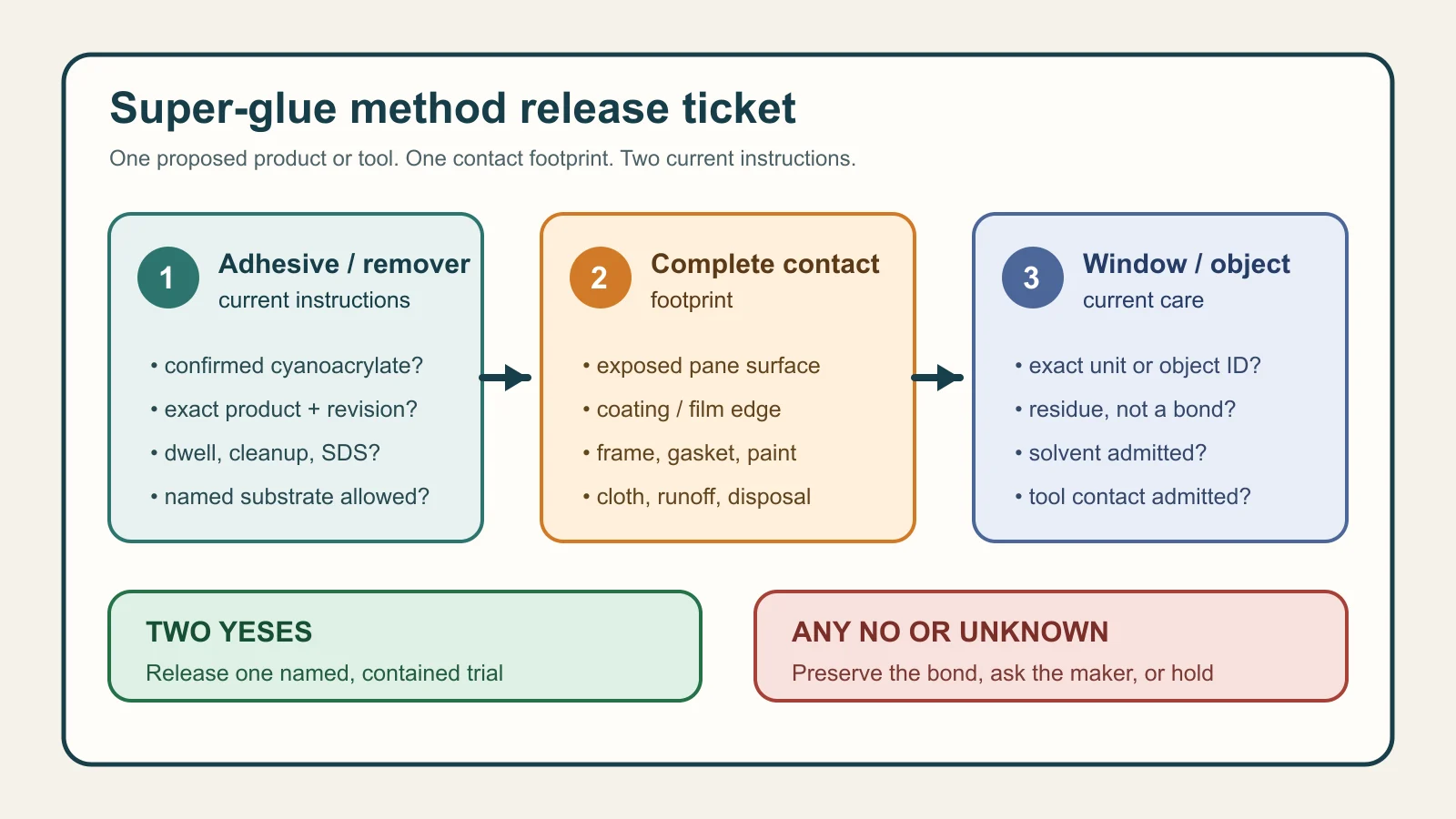
The useful asset is a short release ticket. Complete it for one proposed method, not for “glue removers” as a category.
| Ticket field | Adhesive or remover instruction | Window or object instruction | Entry needed before release |
|---|---|---|---|
| Material | Product or repair record supports cured cyanoacrylate residue | Object record shows the material is not a required bond | Both describe expendable residue |
| Exact object | Product directions name glass or the exact substrate | Unit or product ID and exposed surface are known | Same surface appears in both records |
| Proposed product | Exact name, container or revision, directions and SDS | Care document does not prohibit the product class | One product, not “acetone” or “debonder” alone |
| Contact footprint | Application, dwell, absorbent material, rinse and disposal path are defined | Coating, film, frame, gasket, paint and nearby finishes admit that path | No unapproved material inside the footprint |
| Tool | Product direction states whether a tool is part of its method | Glass owner independently permits that contact | Product and surface approvals stay separate |
| Trial | Current direction allows the named use | Responsible owner names a small inconspicuous area and acceptance condition | Area and evaluator are written down |
| Closeout | Product cleanup direction is followed | Dry result is inspected under the agreed condition | Remaining mark and any change are recorded |
| Decision | Product-side answer is yes | Object-side answer is yes | Only two yeses release the named trial |
A released line can read: “Confirmed cured cyanoacrylate residue on the identified exposed surface; the exact remover document and the current window-care document admit the same contained trial area; frame, gasket, paint and film are outside the footprint.”
If that sentence cannot be completed, write the missing decision instead. The unit maker prohibits the solvent. The material may be a bond. The coating is unknown. The product is only a category name. Each is a usable reason to ask the responsible maker or preserve the assembly.
“Acetone works on glass” is not the finished answer. The finished answer names the residue, the exact window and the exact product on one line. If either current instruction says no—or says nothing—that line stays unsigned.