Put a tape measure on the glass before opening another squeegee product grid. The first useful number is not 12, 14 or 18 inches on a product card. It is the smallest clear span your assembled squeegee has to occupy on the windows you expect to clean repeatedly.
That measurement removes impossible sizes. A second record finishes the purchase: the exact handle, channel, rubber and replacement family supplied by the selected variant. When either the pane fit or the component path is vague, the product is not ready for the cart yet.
This page handles one part of a broader professional window-cleaning tool setup. It assumes a traditional squeegee belongs in the job. The task here is to select one complete, serviceable assembly—not to rebuild the whole kit or teach a cleaning technique.
The narrowest recurring pane gets the first vote
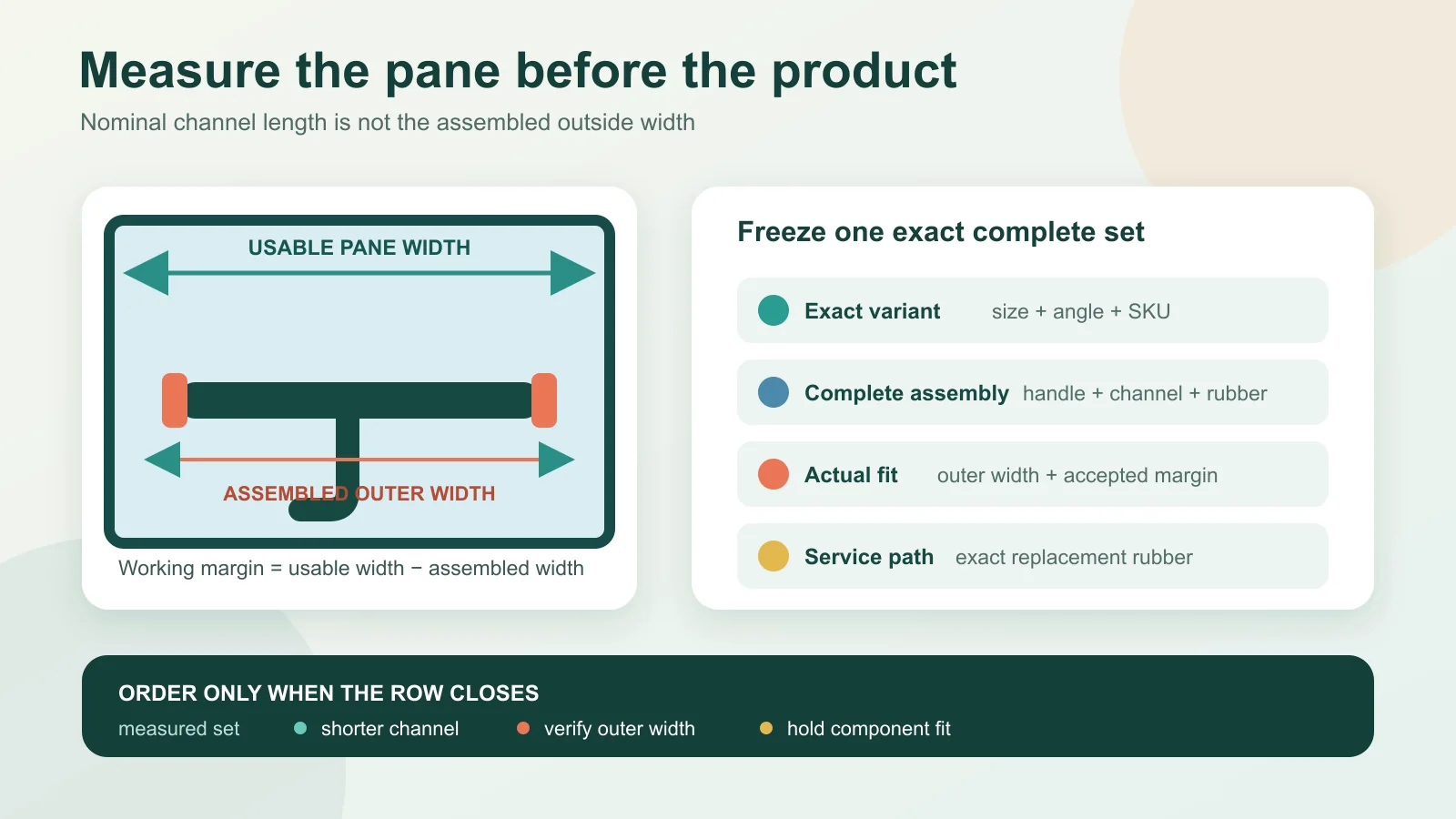
Do not measure the outside of the frame. Measure the clear glass span where the complete channel has to sit for the method you intend to use. A sash stop, handle, deep edge or divider can reduce the usable span even when the window looks wide from across the room.
Start with recurring work, not the single smallest decorative pane you can find. Group the windows you actually expect to see: for example, narrow divided panes, ordinary residential panes and larger storefront glass. For each group, record the smallest usable span. The first squeegee should serve the most important recurring group without being physically excluded by its narrowest member.
Use one unit throughout the row. If the pane is measured in inches, convert any centimeter product size before subtracting. Keep the original manufacturer unit beside the converted value so the ordered variant can still be checked against its product page.
This process does not produce a universal “best size.” It gives your first channel a real job. A 14-inch channel may be a sensible candidate for one route and unusable on another. The pane—not a beginner list—owns that difference.
A 14-inch label is not a 14-inch fit
Manufacturers usually organize variants by nominal channel length. The assembled tool may also have end clips, angled tips or other hardware at the channel ends. If the fit is close, the nominal number cannot stand in for the actual outside width of that complete assembly.
Keep two fields:
- Nominal channel length: the size printed in the variant selector.
- Assembled outer width: the end-to-end width of the selected channel with its real clips or tips installed.
The current Unger, Ettore and Sörbo pages used below list nominal sizes, but the captured pages do not publish an assembled outside width for every exact variant. That missing value is not a defect score. It is a question to send to the seller or a measurement to take from the exact assembled product before assigning it to a close-fitting pane.
Once both dimensions are known, calculate:
Total working margin = usable pane width − assembled outer width
Suppose a hypothetical pane has 14.50 inches of usable glass and the exact assembled head measures 14.25 inches. The total margin is 0.25 inch. That arithmetic only proves the head is narrower than the measured span. It does not prove that the margin is comfortable for your hand position, preferred method or frame geometry. There is no honest universal minimum to insert here.
If assembled width is unknown, do not subtract the nominal label and call the result clearance. Ask for the end-to-end measurement of the exact size and end-clip configuration in your cart.
Put the pane and the exact assembly on one line
Create a row for each recurring pane group. Do not create a row for every product you like; products enter only after the pane constraint exists.
| Recurring pane group | Smallest usable span | Obstruction that changes the span | Exact complete variant | Nominal channel | Assembled outer width | Total working margin | Components and replacement path | Decision |
|---|---|---|---|---|---|---|---|---|
| Primary route group | Measure the clear span for the intended pull | Record frame, handle, divider or deep edge | Brand, family, size, angle and exact SKU | Copy the listed value and unit | Obtain exact end-to-end value | Usable span minus assembled width | Handle + channel + rubber; exact replacement rubber | Measured set, shorter channel, verify width or hold fit |
| Second recurring group | Measure independently | Record only what changes fit | Leave blank until the first assembly fails this group for a measured reason | Candidate only | Required if fit is close | Calculate in the same unit | Reuse only with documented component fit | Keep first set or justify second channel |
Read the row from left to right. If the assembled width is equal to or greater than the usable span, choose a shorter channel. If the product lists only nominal length and the result would be close, verify the assembled width. If the handle, channel or replacement rubber belongs to an unproven component combination, hold the fit. Mark a measured set only when the exact variant is narrower than the pane by a margin you accept and the complete component path is documented.
“Complete” has a narrow meaning. WindowCleaner.com’s squeegee preparation chapter and Sörbo’s current manufacturer guide both use it for a handle, channel and rubber supplied as an assembly. It does not automatically include spare rubber, a different channel size, a pole adapter or proof that a mixed-brand component fits.
Keep a product URL and observation date in the row. Variant selectors and component families can change. The row is more useful than a screenshot because it preserves the exact facts that made the order acceptable.
Current complete squeegees close different fields
These three manufacturer pages show how the same “complete squeegee” category can leave different questions for the buyer. They are examples for the fit card, not a ranking.
| Current product family | What the manufacturer page closes | What must still be copied or verified |
|---|---|---|
| Unger ErgoTec Ninja Window Squeegee | Complete with an ErgoTec Ninja handle, NINJA T6 aluminum channel and professional soft rubber. The current comparison lists 30, 35 and 45 cm complete sizes, 30° or 40° handle variants, 180° swivel, TriLoc channel retention, SmartClips and Unger Locking Cone pole fit. | Copy the exact size, angle and SKU from the cart. Obtain assembled outside width when the pane is close. Keep its NINJA channel/rubber and Locking Cone statements within the Unger family rather than assuming another component or pole fits. |
| Ettore Pro Series Brass Window Squeegee | The current US page describes a solid-brass complete family with interchangeable channels from 6 to 18 inches, a vulcanized Master Rubber blade, a replaceable-rubber path and Ettore REA-C-H pole integration. | Product #10006 identifies the captured family page, not necessarily every size-specific cart variant. Record the exact ordered size identifier and assembled outside width. The page does not close every handle-geometry field used by other product families. |
| Sörbo Complete Swivel Quicksilver Squeegee | The current US selector offers nominal sizes from 5 to 36 inches. The page declares a swivel fast-release handle, widebody Quicksilver channel and 40° angled channel tips; Sörbo’s family guide says its complete assemblies include rubber. | Copy the exact size SKU rather than the series name. Verify assembled outside width, exact replacement compound and any intended pole connection; the captured product page does not close those fields for this purchase. |
Material names do not settle the fit card. Brass, stainless steel, standard aluminum and widebody designs may change weight and construction, but this page has no controlled field test that turns material into a winner. The first hard filter remains the measured pane. The second is whether the exact assembly can be ordered and maintained without inventing a component match.
The same boundary applies to fixed, swivel and angled handles. A manufacturer can state the geometry and the compatible channel family. Your preferred method and the actual window decide whether that geometry is useful. Do not convert a feature list into a performance promise.
The second channel needs a second pane group
A common buying guide suggests carrying several sizes. That may become sensible, but it is not the first decision. Add another channel only when another recurring pane group creates a measured problem the first accepted assembly cannot solve.
Imagine a route with narrow divided panes and a separate group of wide storefront panes. If the first complete assembly fits the narrow group and remains acceptable for the storefront group, a second size is optional. If the storefront group creates a real owner-time problem and a larger exact assembly fits its panes, the second channel now has a named job. Conversely, if the storefront choice cannot enter the narrow group, it cannot replace the first assembly.
Keep the examples hypothetical until your own window record supplies the dimensions. Do not buy a 6-, 12-, 14- and 18-inch sequence simply because those options exist. Variant breadth is inventory, not a route requirement.
If a bundle already contains a squeegee, run the exact model through this row before calling that function closed in the starter-kit contents audit. A listed “squeegee” without an exact size or service path is still an unresolved variant, even though the box has the right category label.
Buy the replacement path with the first set
The order record should survive the first rubber change. Save the exact complete variant, compatible channel family, supplied rubber description, replacement rubber family and any clip or lock named by the manufacturer. “Replacement rubber available” is useful only when you can connect the replacement to the exact channel in your row.
Pole use is a separate interface question. Unger declares Locking Cone fit for the Ninja family, while Ettore declares REA-C-H integration for its brass family. Those statements do not prove cross-brand fit. If your measured squeegee will go on a pole, close the exact head-to-tip combination with the traditional extension-pole connection record instead of adding “pole compatible” to the row from a category assumption.
Finish the row with one plain decision:
- Order the measured set when the exact variant, complete components, assembled width, accepted margin and replacement family are all closed.
- Choose a shorter channel when the exact assembled width does not fit the measured pane.
- Verify the outer width when only the nominal size is published and the remaining margin could change the decision.
- Hold the component fit when the selected handle, channel, rubber, size SKU or pole connection depends on an undocumented combination.
The first useful purchase is not the brand with the longest feature list. It is one exact assembly that fits the panes you actually expect, arrives as a complete set and can be returned to service with a named replacement. A second channel earns its place only when a second measured pane group gives it work.