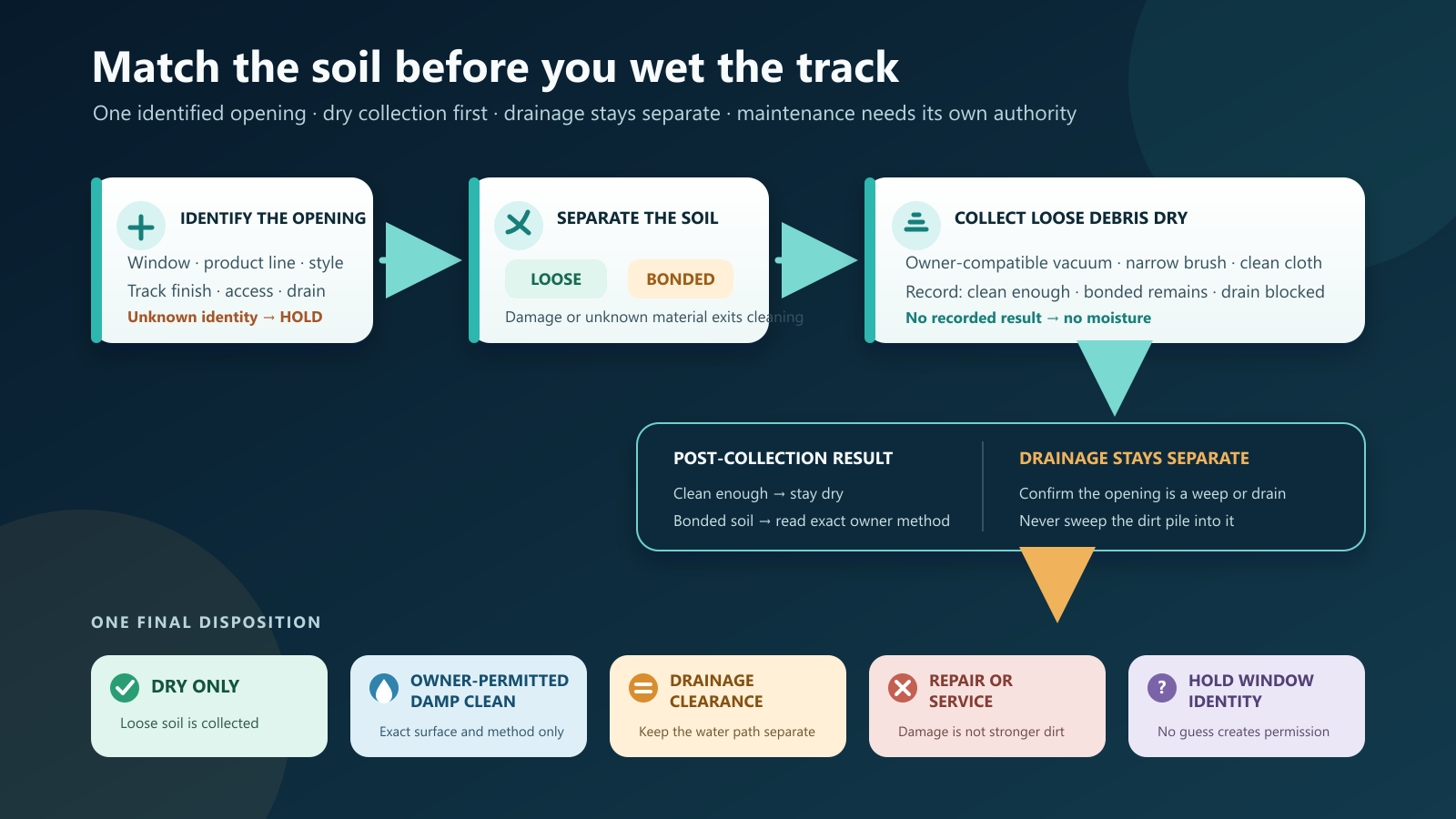
A package of #0000 steel wool can say it cleans glass. The window paperwork can say never use abrasives or metallic tools. Both statements can be accurate, because they belong to different products. The pad maker describes the pad; the window or glass maker controls the exposed surface.
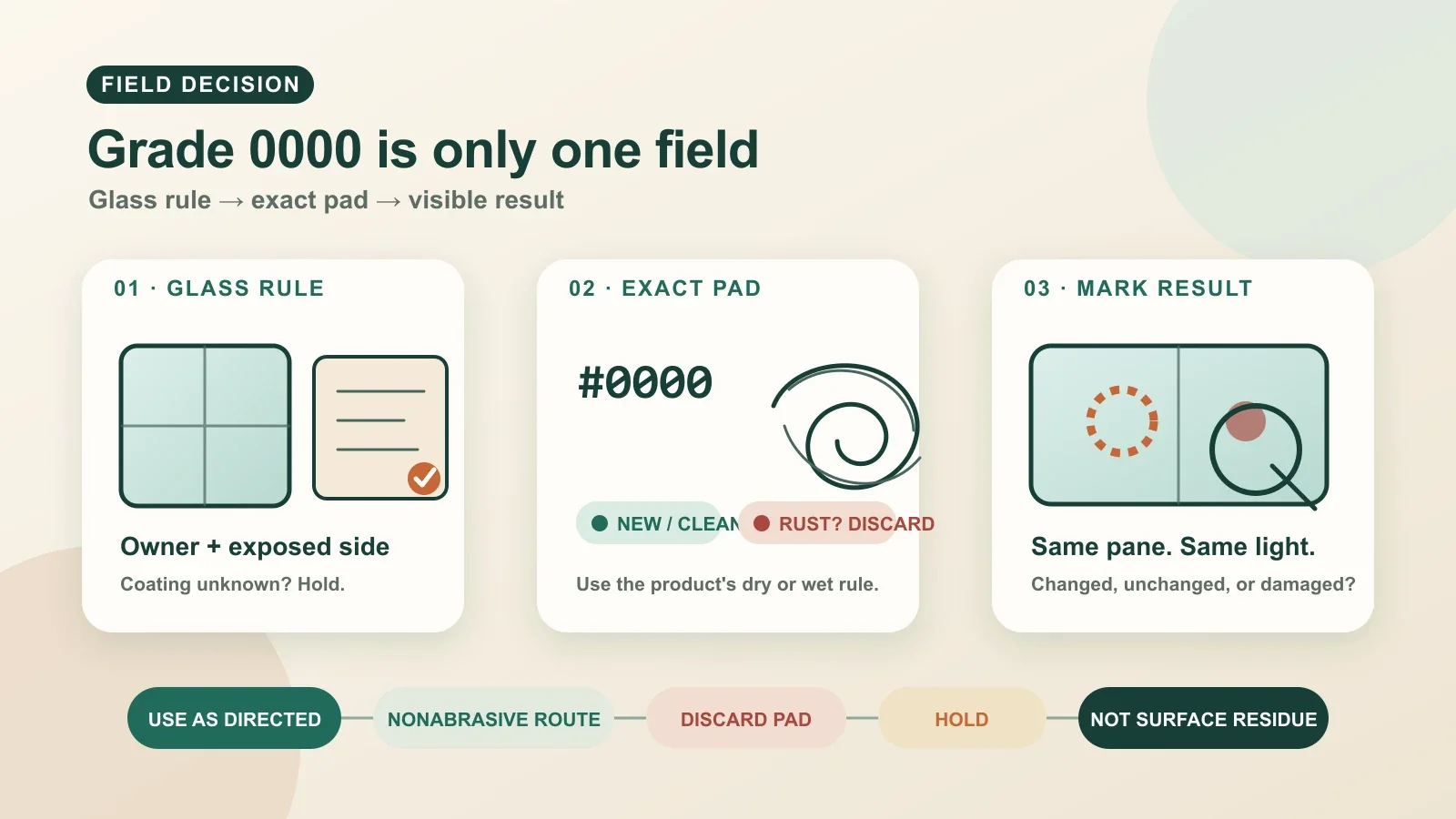
That distinction is the answer to the scratch question. The number 0000 does not make steel wool safe for every pane. Use it only when the exact glass instructions permit the method, the exact steel-wool product supplies a compatible dry or wet direction, and the piece is new, clean and free of rust. An unknown coating, old pad, trapped grit or mark inside the glass unit ends the route.
This is a small specialty item within a professional window-cleaning tool setup, not a substitute for ordinary washing. Its job starts only after a permitted mild clean has left a surface contaminant behind.
“0000” identifies the grade, not the glass
Steel wool grades are easy to misread on a busy shelf. 0000, 000, 00 and 0 are different products. A mixed pack that contains a #0000 pad beside coarser pads also creates an identification problem once the pieces are loose. Keep the grade attached to the package or exact product record.
Red Devil’s current manufacturer catalog lists SKU 0320 as an eight-pack of Super Fine #0000 and SKU 0310 as a separate 16-pack. Its #0000 product page says that the pad can clean windows and glass without water or cleaners. Liberon’s product guide also identifies grade 0000 as Ultrafine, but directs the user to combine it with soapy water for glass. Those directions are not interchangeable techniques; each belongs to the named product.
| What the package or source proves | What you may record | What is still open |
|---|---|---|
Exact product says 0000 or #0000 |
Grade is closed for that piece | Glass permission, coating, mark and pad condition |
| Red Devil SKU 0320 | Super Fine #0000, eight-pack, declared dry glass use | Whether the window owner permits that dry method |
| Liberon Grade 0000 | Ultrafine, declared soapy-water glass use | Whether the window owner permits that wet method |
| A loose silver pad with no retained label | Nothing reliable about its grade or product method | Hold it out of the glass kit |
The purchase decision is therefore exact rather than generic: named grade, named product and retained direction. Pack size, a fine-looking texture or a seller’s for glass category cannot close the other fields.
The window instruction outranks the pad
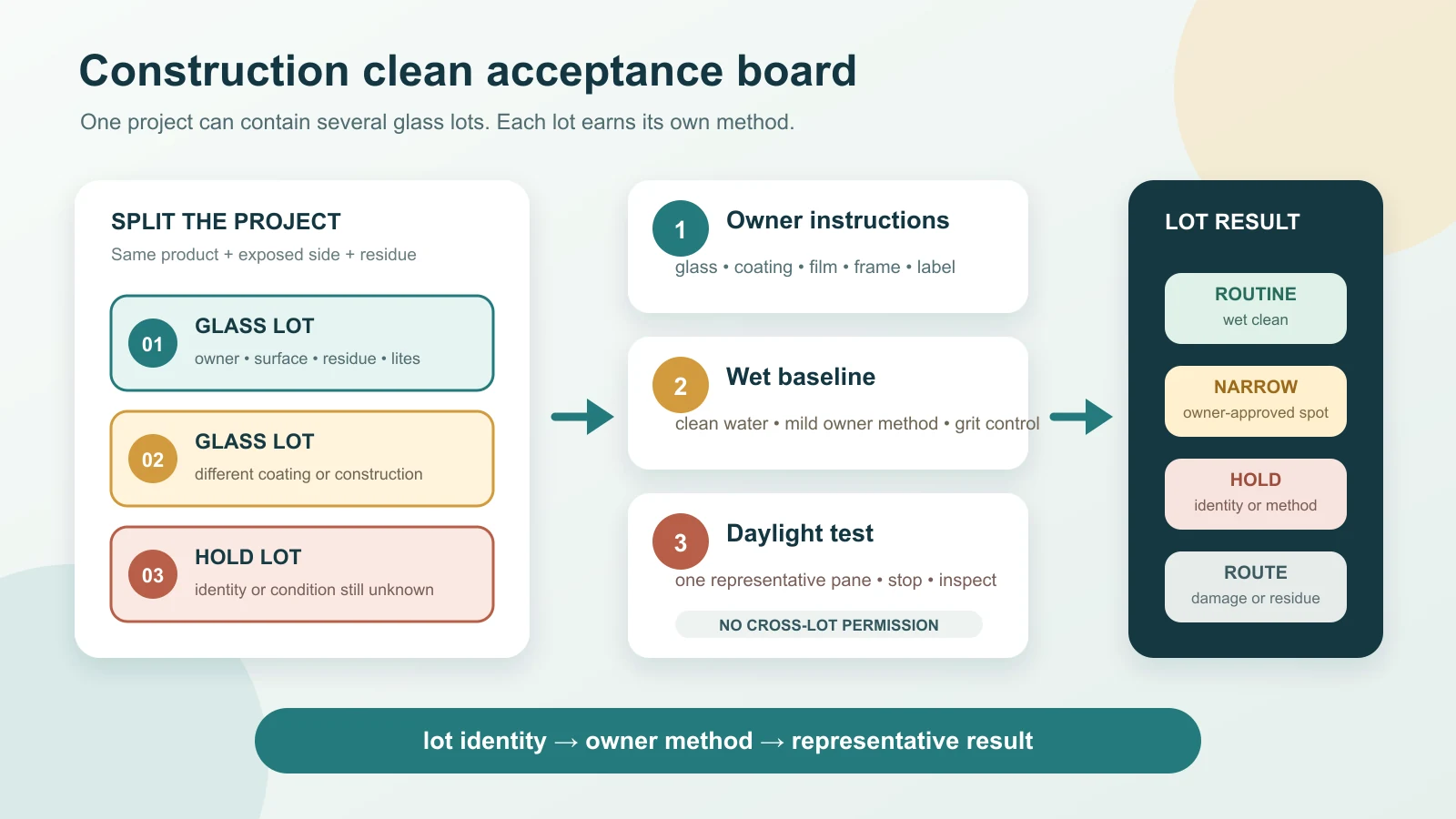
An exposed glass surface may be ordinary float glass, heat-treated glass, an anti-reflective coating, another architectural coating or an applied film. Appearance alone does not identify the cleaning side. Read the window or glass maker’s current care document before using a metal-fiber pad.
Guardian Clarity is a useful hard stop. Its maintenance guide says to avoid sharp and hard tools, metallic parts and abrasive particles on the exposed anti-reflective coating. It directs cleaners toward a nonabrasive paper or soft cotton cloth and says not to use a scraper or razor. A #0000 product claim does not create an exception.
Vitro’s current TD-142 glass-cleaning bulletin also says not to use harsh cleaners or abrasives and not to use metal scrapers or tools for stubborn material. Its normal route uses clean, grit-free cloths with enough wash solution to float loose debris away. If the pane is governed by that document, follow it instead of importing a steel-wool method from another source.
The opposite example is deliberately narrow. Viwinco publishes a procedure for suction-cup marks on its glass: wash away loose dirt, lubricate with glass cleaner or soapy water, gently work a #0000 pad over the mark while keeping the surface wet, then wipe and rinse. That is permission for the named mark under the named bulletin—not a general rule for every window.
| Exact surface record | Steel-wool disposition | Reason |
|---|---|---|
| Guardian Clarity coating is exposed | Use the documented nonabrasive method | Its current guide excludes hard tools, metallic parts and abrasive particles |
| Named Vitro glass follows TD-142 | Use the documented nonabrasive method | The current bulletin excludes abrasives and metal tools |
| Viwinco unit with the suction-cup mark covered by its bulletin | A new #0000 pad may enter the specified wet procedure | The window maker supplies the mark-specific method |
| Coating, film, glass owner or cleaning side is unknown | Hold for the glass owner | A wool maker cannot identify or authorize the exposed surface |
| Exact glass instructions permit #0000 and the exact pad method agrees | Proceed only to one controlled area | Both document owners now point to the same method |
This two-document rule is intentionally conservative. It prevents a valid product direction from being used on the wrong pane, while preserving a named window-maker procedure when one actually exists.
A clean pad can change state during one job
The pad’s condition is part of the method. Loose sand or construction grit caught in fine fibers can travel across the glass even when the wool itself is the correct grade. Wash loose debris away using the surface owner’s permitted method before a pad comes near the mark.
Water creates another state change. The IWCA architectural-glass guide explains that wet carbon-steel wool begins oxidizing immediately and can become heavily rusted within hours. Iron oxide is capable of leaving fine swirl scratches. That does not mean every documented wet #0000 procedure is wrong; it means a wet piece cannot be treated as the same clean pad later in the route.
If the exact documents call for a wet method, cut a fresh piece for that session, keep it away from porous sills and seals, complete the required rinse, and retire it when the task ends. Any orange or brown discoloration, stale dampness, embedded debris or unknown previous use is enough to discard the piece before it reaches glass.
Liberon’s own handling note adds a practical distinction: cut steel wool to size with scissors or shears rather than tearing it, and protect your hands with gloves. That instruction belongs to Liberon wool, but the record it prompts is useful for any exact product: how was the piece separated, where was it stored, and is its condition still known?
Not every mark lives on the exposed surface
Abrasion only acts on material it can reach. Before choosing a pad, view the dry mark from both sides of the pane and from an angle. Then use the glass owner’s mild cleaning route on a small area. The purpose is not to diagnose a window remotely; it is to prevent more force from being applied to the wrong problem.
| What changes during observation | Working disposition | Next move |
|---|---|---|
| A film changes when wetted or partly lifts with the permitted soft clean | Reachable surface residue remains plausible | Identify the residue and check whether the exact owner permits #0000 |
| The mark appears fixed between two panes or cannot be reached from either exposed side | Mark is not exposed surface residue | Record the unit and refer the condition to the window owner or service path |
| Fine lines, haze or color change are already visible in raking light | Existing damage or coating change is possible | Photograph and stop; do not use abrasion as a diagnostic test |
| A crusted mineral edge remains after ordinary washing | Deposit or etching is possible | Move to a source-specific stain assessment; do not invent a stronger mix or add pressure |
| The source of a sharp particle is unknown | Scratch risk is unresolved | Remove loose debris without dragging it and hold the abrasive route |
This page does not turn #0000 into a hard-water treatment. A surface deposit, chemical alteration and etched glass can look similar from a standing position but require different decisions. When the mark is not clearly a permitted surface residue, an empty steel-wool field is the correct record.
Make the trial a comparison, not a promise
Once the glass owner and exact product direction agree, preserve a before state. Photograph the mark, note the pane or unit, exposed side, light direction and viewing angle. That gives the after inspection something real to compare with.
First remove loose grit with the documented mild wash. Inspect an unused piece under good light and confirm the retained package says grade 0000. Follow the product-specific dry or wet direction exactly; do not average Red Devil, Liberon and Viwinco into a homemade method. Work only a small area with low pressure. If the procedure specifies lubrication, keep that area supplied as directed rather than letting a dirty slurry dry against the glass.
Clean or rinse the test area according to the glass instruction, allow the optical result to become visible, and return to the same angle. New fine lines, haze, color transfer, coating disturbance or residue at the frame edge is a stop. No visible change is also a result: it may mean the mark is not removable surface material, not that the pad needs more pressure.
The job record needs only five entries:
- exact pane/unit and exposed-surface instruction;
- exact grade-0000 product and its dry or wet direction;
- pad state before contact;
- mark and small-area location;
- after-cleaning result under the same useful light.
Do not carry a pass from one unit to the next. Two adjacent panes can have different exposed surfaces, replacements or films even when the elevation looks uniform.
A complete decision may contain no steel wool
There are five useful endings. USE_NEW_0000_AS_DIRECTED means both documents align and the same-pane comparison passed. USE_NONABRASIVE_OWNER_METHOD means the glass guide already chose a softer route. DISCARD_OXIDIZED_PAD removes a changed tool from the kit. HOLD_FOR_GLASS_OWNER keeps an unidentified surface out of the experiment. MARK_IS_NOT_SURFACE_RESIDUE sends the condition to the correct window or damage path.
If the permitted task actually needs a blade and holder, use the separate window-scraper decision before buying components. If the contaminant is a label or adhesive, the sticker-removal route owns the protected-label and solvent questions. Finish a permitted cleanup with a cloth whose exact role and care remain known rather than a rag carrying old grit.
The steel-wool line on a job card is allowed to stay blank. That is not an incomplete kit; it is proof that the pane, product and mark made the decision before the pad did.