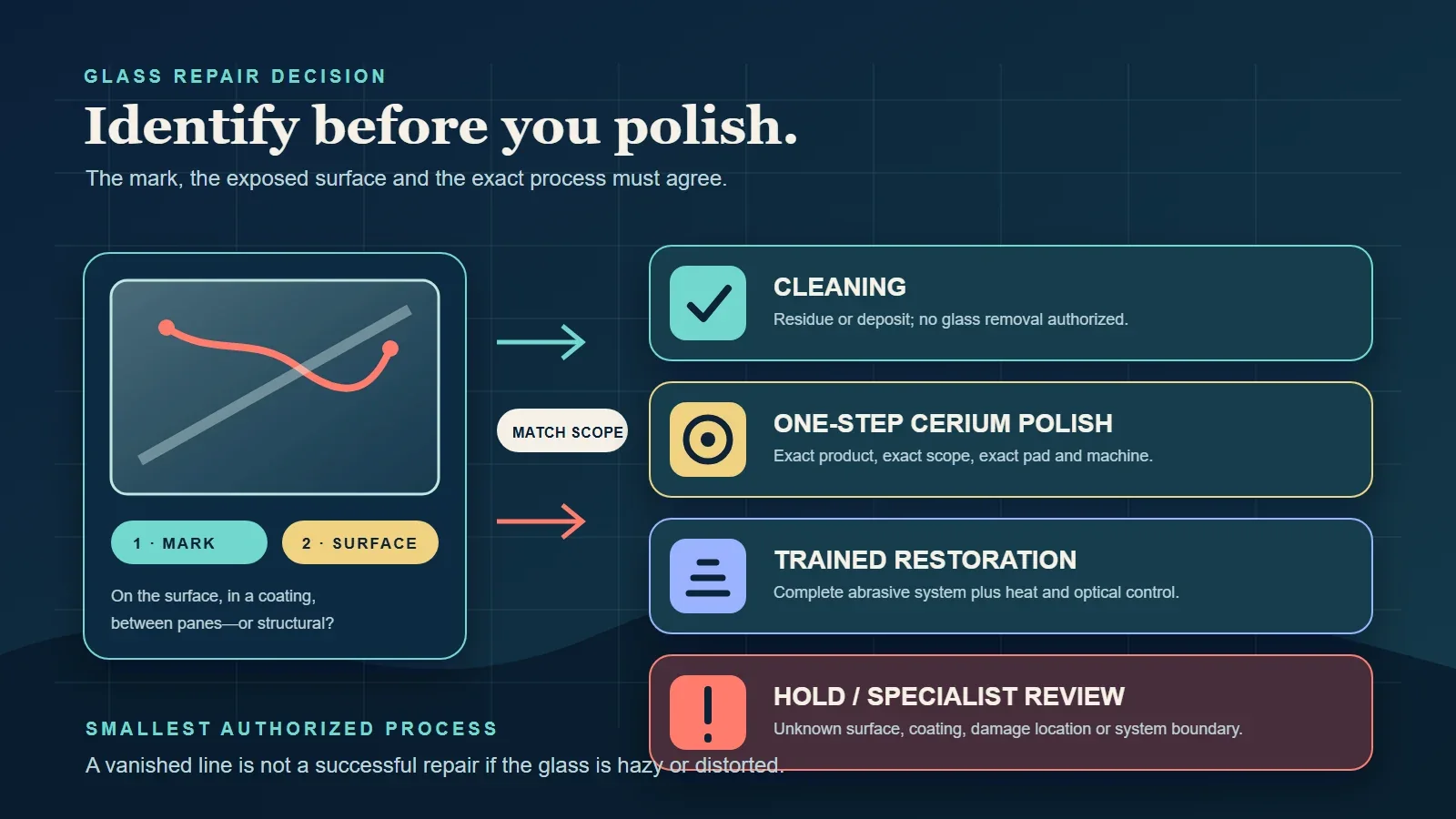
Cerium oxide glass polish can be the finishing product a light, exposed-surface defect needs. It can also be the wrong purchase for residue that only needs cleaning, a coating that should not be abraded, a scratch that requires a complete trained restoration system, or damage that is not on the accessible surface at all.
The useful buying order is mark location → glass and exposed surface → exact product or system scope → required tools and competence → optical acceptance. If one of those links is missing, a low-priced jar does not make the job ready.
Polishing is a specialist branch of a larger professional window-cleaning tool setup. It should enter the kit only after the surface and process are known, not as a general-purpose fix.
The mark may not be a polishing job
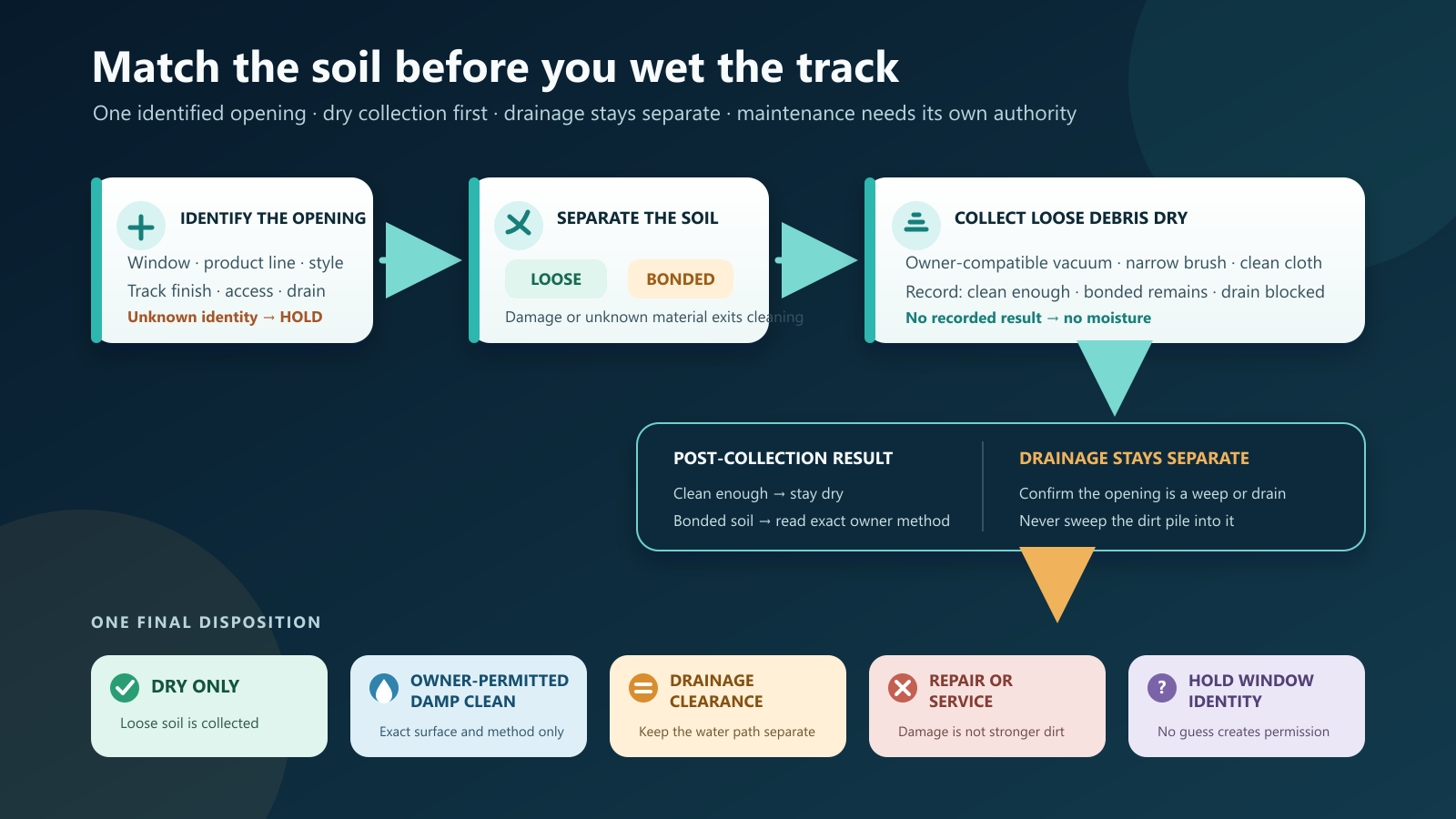
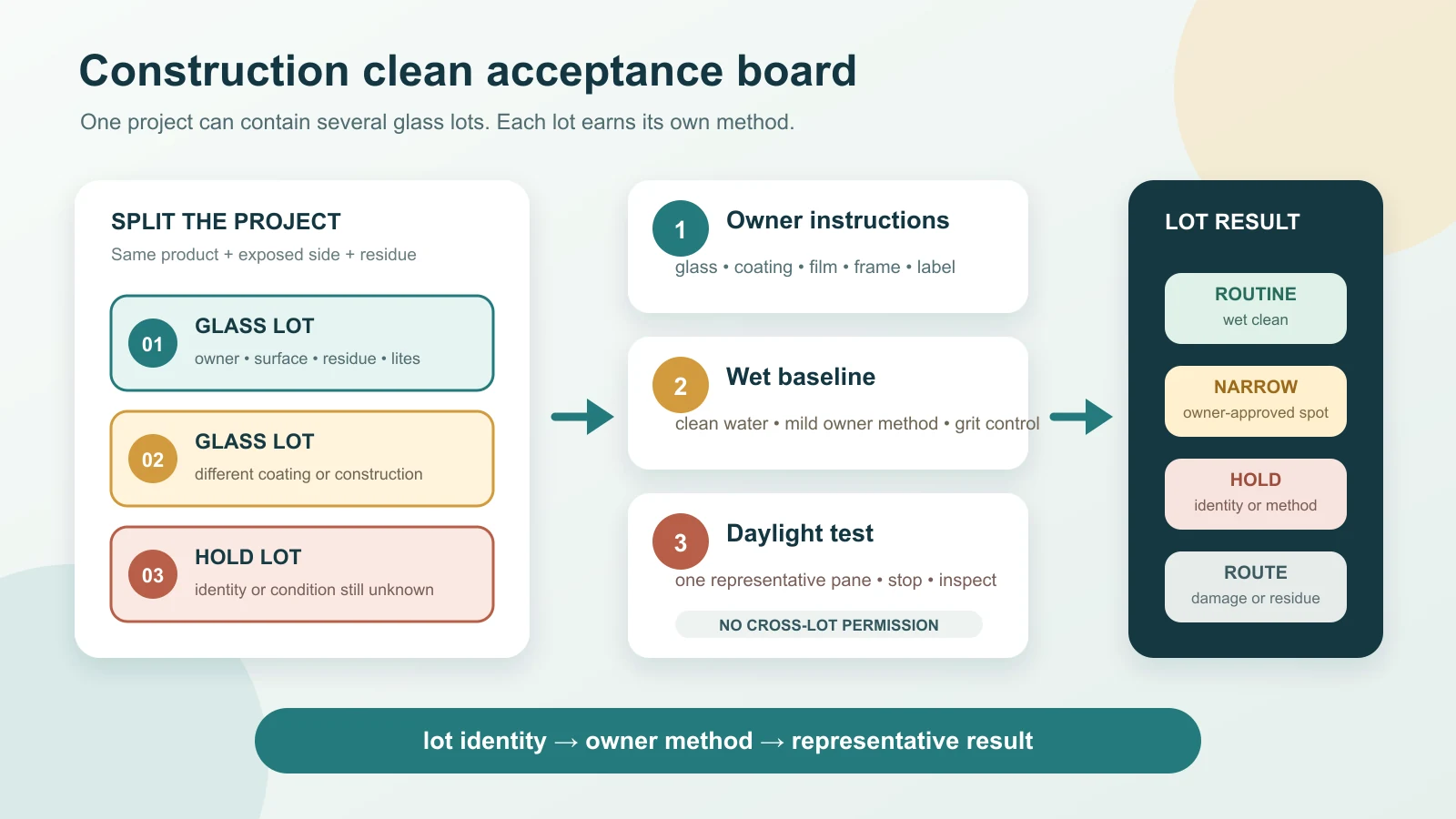
Start with provenance, not a universal scratch-depth test. Record the window or glass supplier, construction, coating or treatment, which surface is exposed, and where the mark appears as the viewing angle changes. The glass owner’s current care document decides what may touch that surface.
A mark that responds to the documented nonabrasive cleaning method belongs in cleaning, not restoration. Adhesive has its own glass-safe sticker and residue decision. A blade has its own surface-authorization and scraper-fit decision, while grade 0000 has a separate glass-owner and pad-state boundary. None of those tools authorizes polishing.
A line that appears between panes, a coating change, a chip, a crack or edge damage is not converted into a polishing job by the presence of cerium oxide. Avoid the familiar “if your fingernail catches, do X” shortcut. It does not identify a coating, show where the damage sits or prove that an exact system can remove material without unacceptable distortion.
| What is known | First process class | What still has to authorize it |
|---|---|---|
| Surface residue or deposit responds to the documented cleaning method | Cleaning | Exact glass-owner method and cleaner compatibility |
| Fine exposed-surface defect falls inside a named product’s current scope | Exact one-step polish | Glazing permission, product label, user scope, pad and machine |
| Damage requires controlled abrasive progression | Multi-step restoration | Complete system, training, heat and distortion controls |
| Coating, texture, damage location or glass identity is unknown | No polishing purchase yet | Glass owner or trained specialist evaluation |
A compound and a restoration system are different purchases
The exact label matters. The current US safety data sheet for 3M Glass Polishing Compound PN60150 identifies an industrial/occupational product that is not for consumer sale or use. A regional 3M product page describes that exact water-based cerium product for fine scratches and water spots with its matching polishing pad and rotary or dual-action equipment. That supports a narrow, named one-step product in the page’s stated region; it is not a recipe for an unidentified powder or proof of US retail availability.
The current GlassRenu Professional Grade System is different in kind: a three-step dry-grinding system that requires a handheld grinder and system abrasives. Its current kit listing also says the most aggressive red disks are not included. GlasWeld’s scratch-removal range likewise separates one-step polishing from a multi-step micro-abrasive process for medium and heavy scratches.
| Process offered | Evidence required | What the product name does not include |
|---|---|---|
| Cleaning product | Glass-owner cleaning permission and exact contaminant/product fit | Permission to abrade or remove glass |
| One-step cerium compound | Exact product scope, user class, pad, machine and glazing permission | Abrasive progression for damage outside that scope |
| Multi-step scratch-removal system | Damage classification, complete disks/tools, training and optical controls | A guarantee that the pane will remain distortion-free |
The shopping question is not “which cerium has the best rating?” It is “which process class is documented for this glass and damage, and is the entire process available?”
Some glass ends the comparison early
An exact polishing-system page cannot overrule the glazing owner. Vitro’s coated-glass guidance warns that anything able to scratch glass can scratch the coating and says not to use sharp objects on the coated surface. Its field-cleaning materials guide also treats abrasive cleaners and damaging chemicals as material and warranty risks.
GlasWeld’s current scratch-removal page does not recommend its process for textured or coated glass. That exclusion belongs to the named GlasWeld system, while Vitro’s rule belongs to glazing in its document scope. Together they show why neither “glass-safe” nor “cerium oxide” authorizes an unknown window.
If the glass or exposed side cannot be identified, stop comparing compounds. If the owner permits only nonabrasive cleaning, the appropriate result is cleaning or specialist review—not a gentler guess at polishing.
Use a repair-system gate before pricing the kit
| Gate | Close this evidence | Decision if it remains open |
|---|---|---|
| 1. Glazing | Supplier, construction, treatment, exposed side and current care document | Hold for the glass owner |
| 2. Mark | Surface residue, exposed-surface defect, coating change, between-pane mark, crack, chip or edge damage | Do not choose a polishing process |
| 3. Exact process | Named product/system, current version and declared damage scope | Reject the generic powder or kit comparison |
| 4. Complete system | Machine, pad/disks, all required grades, fluids and replacement consumables | Price and source the complete path before starting |
| 5. Competence and control | Declared user scope, training, heat control, edge protection and work-area method | Use a trained specialist or stop |
| 6. Acceptance | Inspection for haze, coating change and optical distortion from relevant viewing positions | A vanished line is not a completed repair |
The gate deliberately has no universal RPM, mixing ratio, dwell time or scratch-depth cutoff. Those numbers belong to the exact current product or system and the operator responsible for applying it.
Price the process that has to succeed
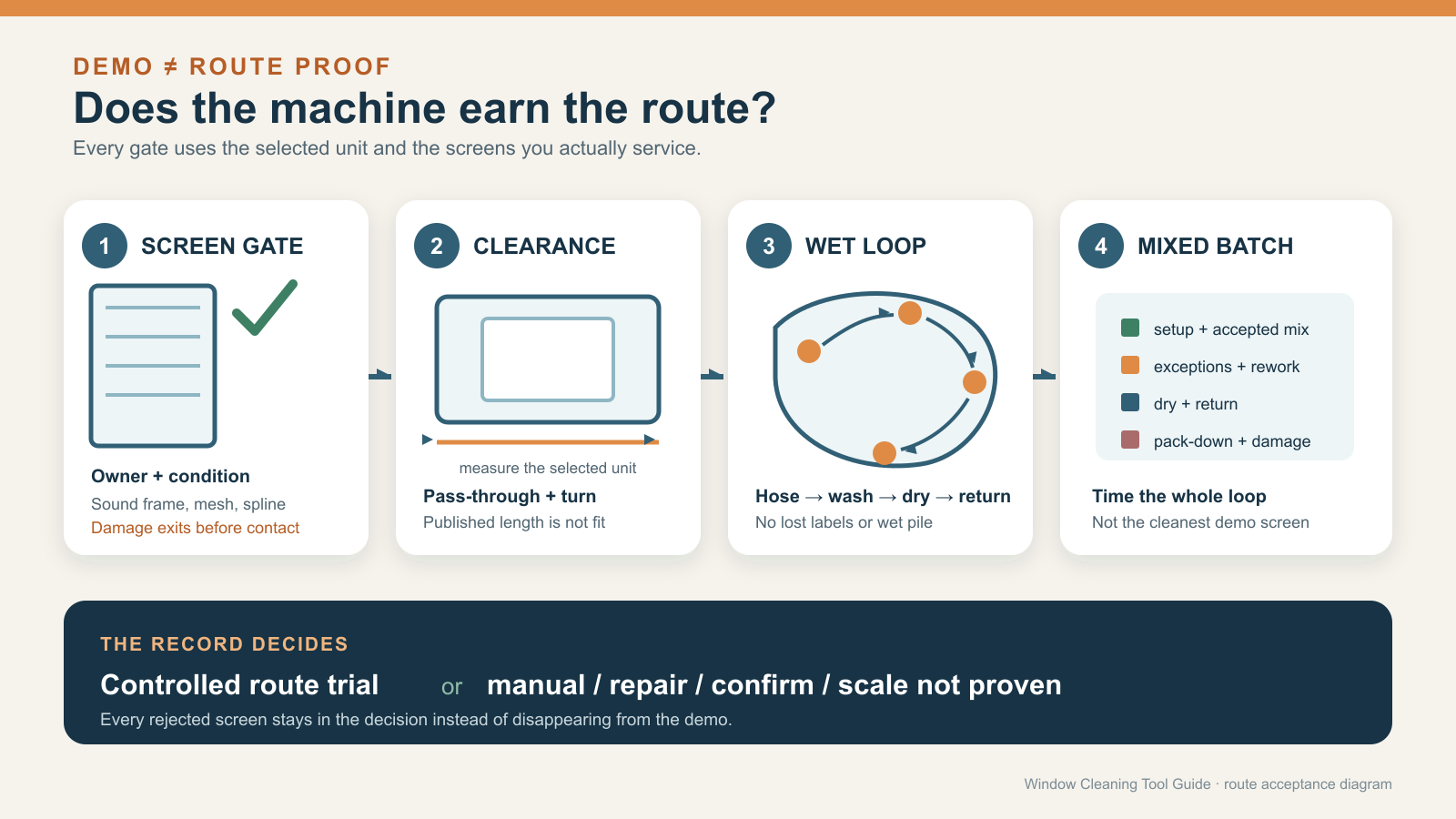
The purchase cost includes more than compound. Close the exact machine and pad or disk, every abrasive grade the selected path requires, system fluid or coolant, edge and adjacent-material protection, inspection conditions, consumable replacement, training and the area needed to blend the repair. If a kit omits the component required for the identified damage, its box price is not the job price.
Optical acceptance deserves its own line. GlassRenu explains in its scratch-removal distortion reference that uneven material removal can introduce distortion. GlasWeld warns that its multi-step abrasive disks can cause minor distortion, and its training path progresses from one-step competence to multi-step restoration.
| Result | What makes it supportable |
|---|---|
| Keep this as cleaning | The mark and glass owner point to a documented nonabrasive method |
| Use the exact one-step product | Glazing, defect, label, user scope, machine and pad all match |
| Use trained multi-step restoration | The complete named system, competence and distortion controls are in place |
| Hold for owner evidence | Surface identity or permission is missing |
| Request specialist or replacement review | Damage location, coating, crack/chip/edge condition or optical risk leaves the documented polish scope |
Compare the finished area with adjacent glass from the viewing positions that matter for the building. If the exact system does not give a supportable way to control and judge heat and optical change, the prudent purchase is trained specialist evaluation—or replacement—not a larger container of polish.
The smallest authorized process is the right result. Sometimes that is a named one-step compound. Sometimes it is a complete trained restoration system. Often, closing the glass identity and mark location shows that polishing should never begin.