A garden-hose fitting proves that two threaded faces can meet. It does not prove that a pump belongs in that part of the system, will deliver the required flow at pressure, or can operate without exceeding a filter housing, hose, reel or valve.
For a tap-fed RO/DI cart, the current XERO and Tucker 110V booster instructions place the pump between the water source and the purification-system inlet. A tank that already holds water creates a different delivery-pump job. A whole-building pressure problem is different again. Choose the branch first; compare pumps only inside that branch.
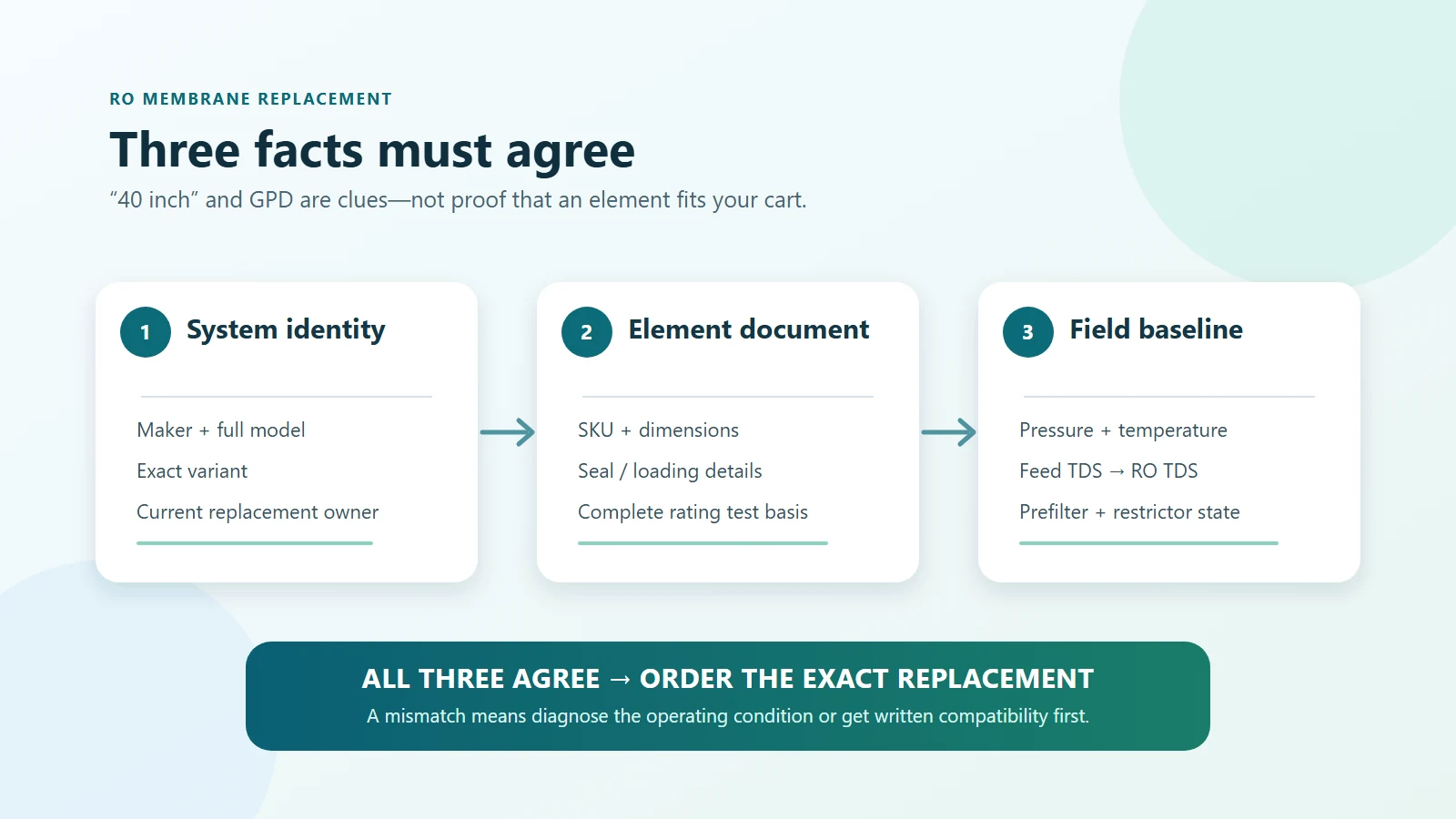
If the branch is tap-fed boosting, record measured inlet pressure and flow, the purifier’s required operating point, the exact pump’s curve or declared conditions, the lowest downstream pressure limit, ports, control behavior, power protection and dry-run instructions. Missing one of those fields is a reason to hold the model—not a reason to buy more horsepower.
Put the pump on the correct side of the purifier
Draw the water path with arrows before opening a product page. The source and destination identify the pump duty.
| Starting arrangement | Pump job | Evidence needed before shopping | Route when it does not match |
|---|---|---|---|
| Pressurized tap feeding a named RO/DI system | Raise or stabilize feed into that purifier | Tap pressure and flow in the intended setup; purifier input requirements; permitted combined pressure; exact boost-pump documentation | Correct a restriction first or evaluate a documented tap-fed booster |
| Storage tank feeding a hose reel and pole | Move stored water through the delivery path | Tank outlet and venting; suction conditions; required brush-end flow and pressure; delivery-pump curve, controller and power | Select a documented delivery pump, not a tap booster by label |
| Property-wide low pressure or a permanent mains connection | Change building water service | Local water authority, property owner and qualified plumbing design | Refer the work outside this equipment-page scope |
| Acceptable source but unexpectedly weak output | Find the failed restriction | Valve position, kinked or undersized hose, clogged stage, fouled prefilter, wrong bypass setting or undocumented adapter | Correct the proved restriction before adding a pump |
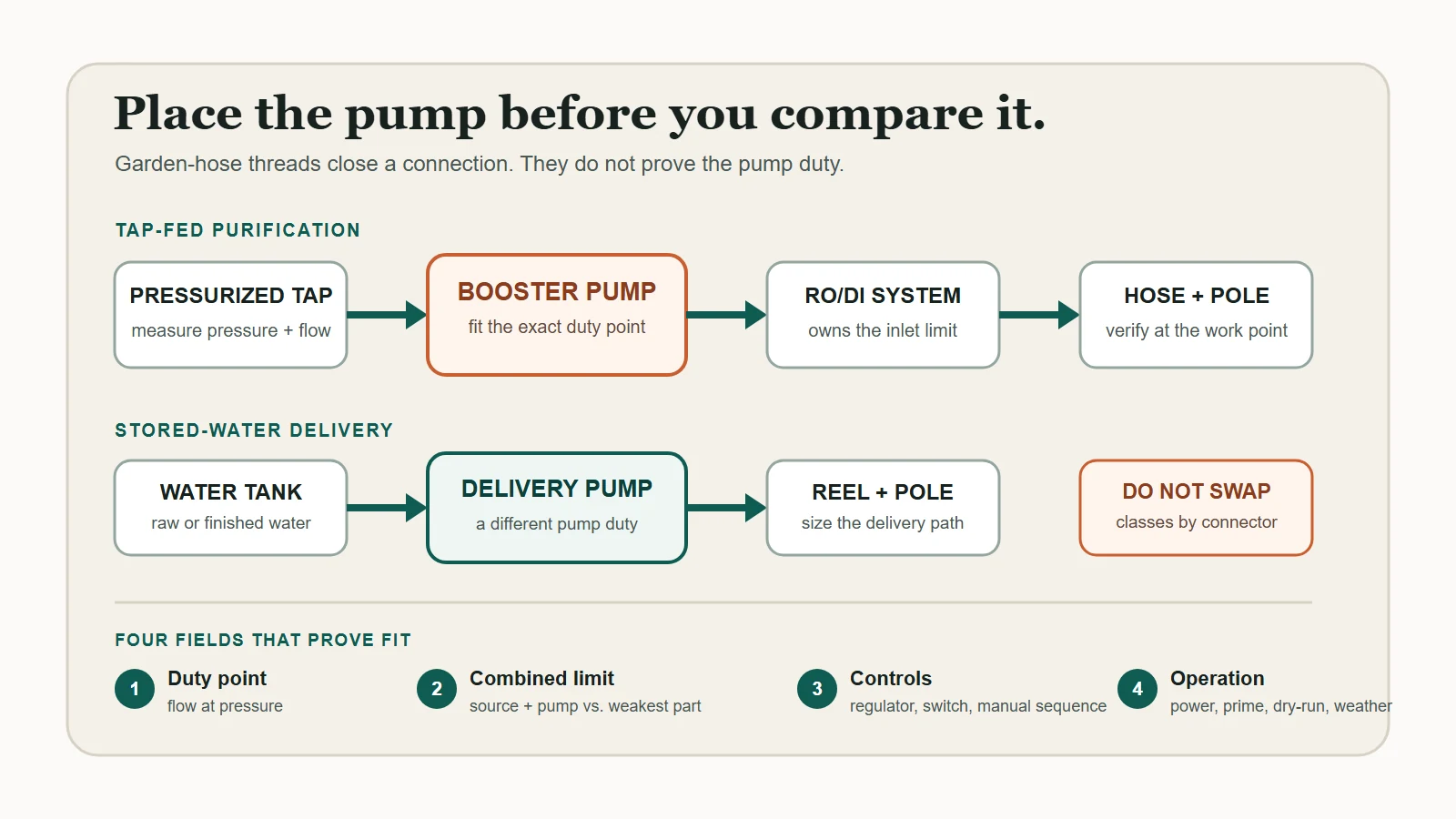
XERO’s current 110V Booster Pump page says its exact pump goes between the tap and the purification system and should never be placed after the purifier. Tucker gives the same source-to-pump-to-purifier order for its current 110V system. Those are model instructions, not a universal diagram for every pump sold with garden-hose threads.
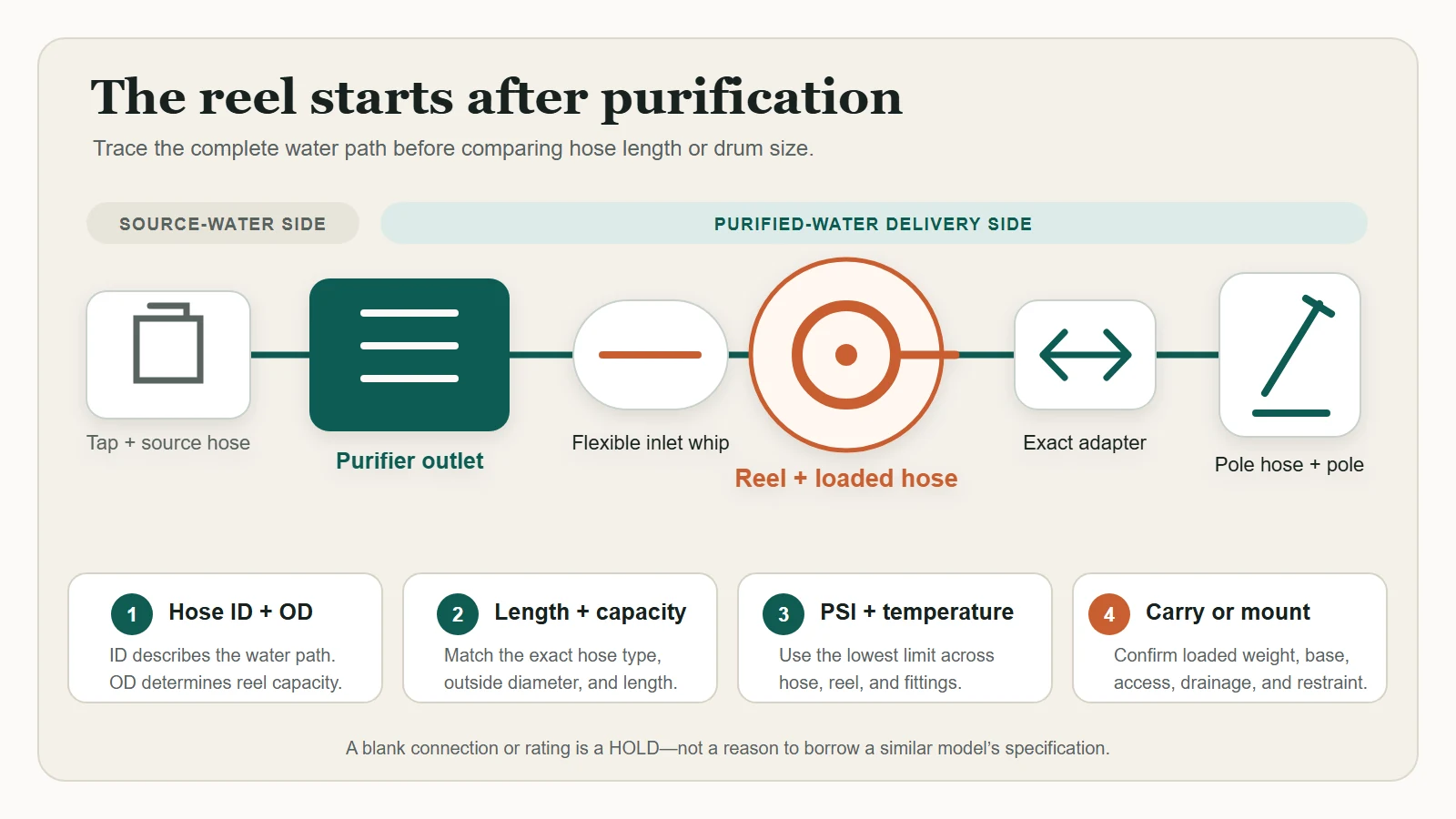
This page begins after the complete water-fed pole system has been chosen. If DI versus RO/DI, required output or hose route is still open, close that system decision first. If a storage tank is the source, keep its load, support, vent and outlet record separate from the pump selection.
Horsepower is not the operating point
A pump does not deliver one fixed pressure and one fixed flow everywhere. Grundfos describes a pump curve as the relationship between flow and pressure differential or head; the actual duty point is found where pump performance meets the system’s characteristics. That is why a 1/2-hp label, a shutoff-pressure headline or an open-flow maximum cannot establish water-fed-system output on its own.
Record the source at the arrangement you will actually use: same faucet, supply hose, valves and intended time of day. Pressure without flow is incomplete; flow without pressure is incomplete. Then obtain the named purifier’s required input condition and pressure ceiling, plus the requirements of any housing, gauge, hose, reel, fitting and valve that will see boosted water.
The combined-pressure question matters. Grundfos notes that a pressurized source and a booster can create a total above a component’s material limit. Do not simply add a seller’s headline boost to a single convenient faucet reading and call the system approved. Source pressure can vary, and a pump’s contribution changes with flow. Use the exact curve or a written model-specific operating point, then compare the worst permitted condition with the lowest documented ceiling in the route.
Some brands publish a target for their own systems. XERO, for example, describes 70 psi as ideal for its XERO Pure family on its current water-fed accessories page. That number belongs to those named systems. It is not a universal prescription for every RO membrane, DI vessel or hose layout.
Current product pages close different fields
The three current products below all appear relevant to a hose-fed route, but their published contracts are not interchangeable. This is a specification comparison, not a performance ranking.
| Exact current product | What the page declares | Control and operation facts | Fields still to obtain for your route |
|---|---|---|---|
| XERO 110V Booster Pump SKU 209-25-61-XP |
1/2 hp; female garden-hose inlet; male garden-hose outlet; up to 120 psi; GFCI on a 15-ft cord | No pressure switch; water must be flowing while the pump is on; clear non-salt water only; keep the non-submersible motor dry and protected from weather; never run dry | Pump curve or written output at your inlet condition; every downstream ceiling; acceptable control sequence for your valve and work pattern |
| Tucker Booster Pump System 110V SKU 12025-v2 |
110 psi; “multiple gallons per minute”; female garden-hose inlet; male outlet; 37.6 lb; 19 x 19 x 19 in | On/off switch, regulator and GFCI plug are listed | Exact flow at your required pressure; pressure-switch behavior; duty, priming and weather instructions; current compatibility confirmation |
| J. Racenstein Pump 110V Boost Water Pressure add 40psi SKU 150-0602 |
Seller declares a 40-psi addition; 1/2-hp thermally protected motor; cast-iron housing; thermoplastic impeller with steel shaft; two male garden-hose fittings | Captured page describes inline boost and separate transfer-pump uses | Required female adapter or exact inlet assembly; curve; regulator or switch behavior; GFCI and weather protection; downstream ceilings; model-specific operating manual |
Two lessons are immediate. First, an exact-model page can close some fields while leaving a purchase-critical field unknown. Tucker’s “multiple gallons per minute” is not an exact point for your route. XERO’s up-to-120-psi answer is not a flow curve. J. Racenstein’s two male fittings do not produce a complete inline connection by themselves.
Second, similar horsepower does not create similar control. XERO expressly says its named pump has no pressure switch and needs water flowing whenever it is on. Tucker lists a regulator but the captured product page does not state the pressure-switch behavior. The J. Racenstein product page leaves both fields open. Record unknown where the exact source is silent, then ask the manufacturer or seller to close it in writing.
Use the separate garden-hose quick-connect record to identify thread standard, gender, seal and both mating halves. A connector can solve a documented interface; it cannot correct an unsuitable pump duty or raise a downstream pressure rating.
The shutoff decision belongs in the pump record
At the brush, an operator may close a valve while the pump still has power. What happens next depends on the exact pump and control system. A pressure switch, bypass, regulator and manual on/off switch perform different jobs. Do not infer one from another.
For the current XERO model, the public answer is unusually clear: there is no pressure switch, and the pump should be on only while water is flowing. That makes the operator’s start/stop sequence part of product fit. A route that expects the pump to stop automatically when the brush valve closes has not matched that documented behavior.
A regulator can set or limit an operating pressure within its documented range; its presence does not prove automatic shutoff, dry-run protection or a permitted blocked-outlet condition. Ask for the exact sequence covering source-on, prime, pump-on, brush-valve closure, pump-off and source-off. Ask what happens during a blocked outlet and what protection is built in. If the answer is not in the current manual or written support for the exact model, keep it unknown.
Electrical and water boundaries are equally specific. XERO instructs users to keep its non-submersible motor, cord and plugs dry, retain the grounding prong, use GFCI protection, avoid a damaged cord and never run the pump dry. Those instructions govern that exact product. They are not proof that another 110V pump has the same protection.
The Tucker 4060 kit record illustrates why this matters. Its current kit page ties stated output points to specific pressure and temperature conditions and names a booster at the higher point. The kit decision still has to close the booster, power, waste-water and brush-end route rather than treating the accessory name as guaranteed field output.
Complete one pump-fit record
Keep measurements and manufacturer facts on the same sheet without letting either replace the other.
| Field | Record for the exact route | Evidence that closes it | Hold when |
|---|---|---|---|
| Source mode | Pressurized tap, raw-water tank, finished-water tank or other named source | Route diagram and source record | “Garden hose” is the only source description |
| Pump position | Before purifier, after tank or another documented position | Exact pump and system instructions | Position is copied from another model |
| Inlet condition | Pressure and flow, with faucet, hose, valve and time noted | Measurement from the intended arrangement | Only a static gauge or bucket-flow number is available |
| Required duty point | Flow at pressure required by the exact purifier or delivery path | Current system manual, curve or written manufacturer confirmation | A universal PSI target is being substituted |
| Exact pump performance | Model-specific Q/H curve or declared point at stated conditions | Current datasheet, manual or support answer | Only horsepower, shutoff PSI or open flow is known |
| Combined-pressure ceiling | Highest source condition plus pump behavior compared with every downstream limit | Pump/system documents and the lowest component rating | Any housing, hose, reel, fitting, gauge or valve limit is unknown |
| Connection faces | Inlet/outlet thread, gender, seal and required adapters | Exact product specs and paired fitting record | A photo or nominal size is the only evidence |
| Control | Regulator, pressure switch, bypass, manual switch and valve-closure sequence | Exact manual or written model support | Regulator is being treated as automatic shutoff |
| Power and environment | Voltage, circuit, GFCI, grounding, cord, weather and placement | Exact instructions plus available site power | Water protection or the electrical route is assumed |
| Prime and dry-run rule | Start sequence, permitted fluid, prime requirement and dry-run boundary | Exact operating manual | The route can uncover the inlet or stop flow without a documented response |
| Demand proof | Number of poles, longest hose path and brush-end output check | Defined commissioning test for the chosen equipment | Seller output is accepted without the planned route |
The sheet is complete only when all rows refer to the same pump, purifier and hose path. A number from a different pump family or a different purification cart reopens the row.
Let the first failed field choose the route
| Result | Use it when | Next move |
|---|---|---|
| Evaluate the exact tap booster | The route is tap → booster → named purifier, and duty point, limits, ports, controls, power and instructions are closed | Commission only by the exact system and pump instructions, then verify output at the intended work point |
| Correct the restriction first | Source is adequate but a documented valve, hose, fitting or filtration restriction explains the loss | Repair the first failed handoff and measure again before buying a pump |
| Select a documented delivery pump | Water starts in a storage tank or finished-water reservoir | Size the delivery duty from the tank outlet to the brush; do not reuse a tap-booster decision by name |
| Refer building or mains work | The proposal changes property plumbing or directly boosts a regulated water main | Stop the equipment comparison and use the property owner, local authority and qualified trade |
| Hold the exact pump | A curve, combined ceiling, control behavior, port, power path or operating rule can still change the answer | Obtain the missing exact-model evidence or reject the candidate |
The shortest safe purchase record is not “1/2 hp, garden-hose ready.” It is “this exact pump, in this position, meets this measured duty point, remains below every downstream limit and has a control sequence the route can actually follow.”