A dash does real work in a Gemtor harness listing. In 972-2, 972 identifies the harness family; -2 identifies Gemtor’s current Universal size code. Neither part says that this is the right harness for every worker or every window-cleaning system.
Before 972-2 becomes an order, match the complete label, the D-rings and their approved roles, the buckle and belt variant, the applicable standard, the worker’s total load and the current instructions to a system the employer has already approved. If the work method or complete system is still unsettled, return first to the roof-harness system decision. A brand model cannot design that system for you.
This is a model-selection guide, not a wearing or rigging guide. It deliberately stops before donning, connecting, anchoring or using the equipment.
Read 972-2 from right to left
Shopping pages tend to present 972-2 as one product name. For purchasing, it is safer to split it into fields and then add the facts that the short name leaves out.
| Part of the record | What the current Gemtor source establishes | What it does not establish |
|---|---|---|
972 |
One named harness family and feature set | The selected size, exact regional label or approved system role |
Optional H after the family number |
A distinct variant with waist-belt D-rings in the current 972/872 family listing | Permission to use those rings for a particular job or system |
-2 |
Gemtor’s current Universal ordering-size code | Fit for this worker, load capacity or universal application |
-4 / -9 |
Current XL / 2XL ordering-size codes | A substitute for the current size chart and worker fit process |
| Exact sewn label | Model, markings, standard/capacity information and the identity that travels with the equipment | Approval of a mixed or incomplete system |
| Employer’s system record | The intended method and the role of each component and connection point | A change to the manufacturer’s model or label |
The current Gemtor harness-family page supplies the -2, -4 and -9 mapping. That mapping is useful, but “Universal” is still the name of one size band. It is not a performance claim about every body, task, connector or jurisdiction.
Four order lines can look like one harness family
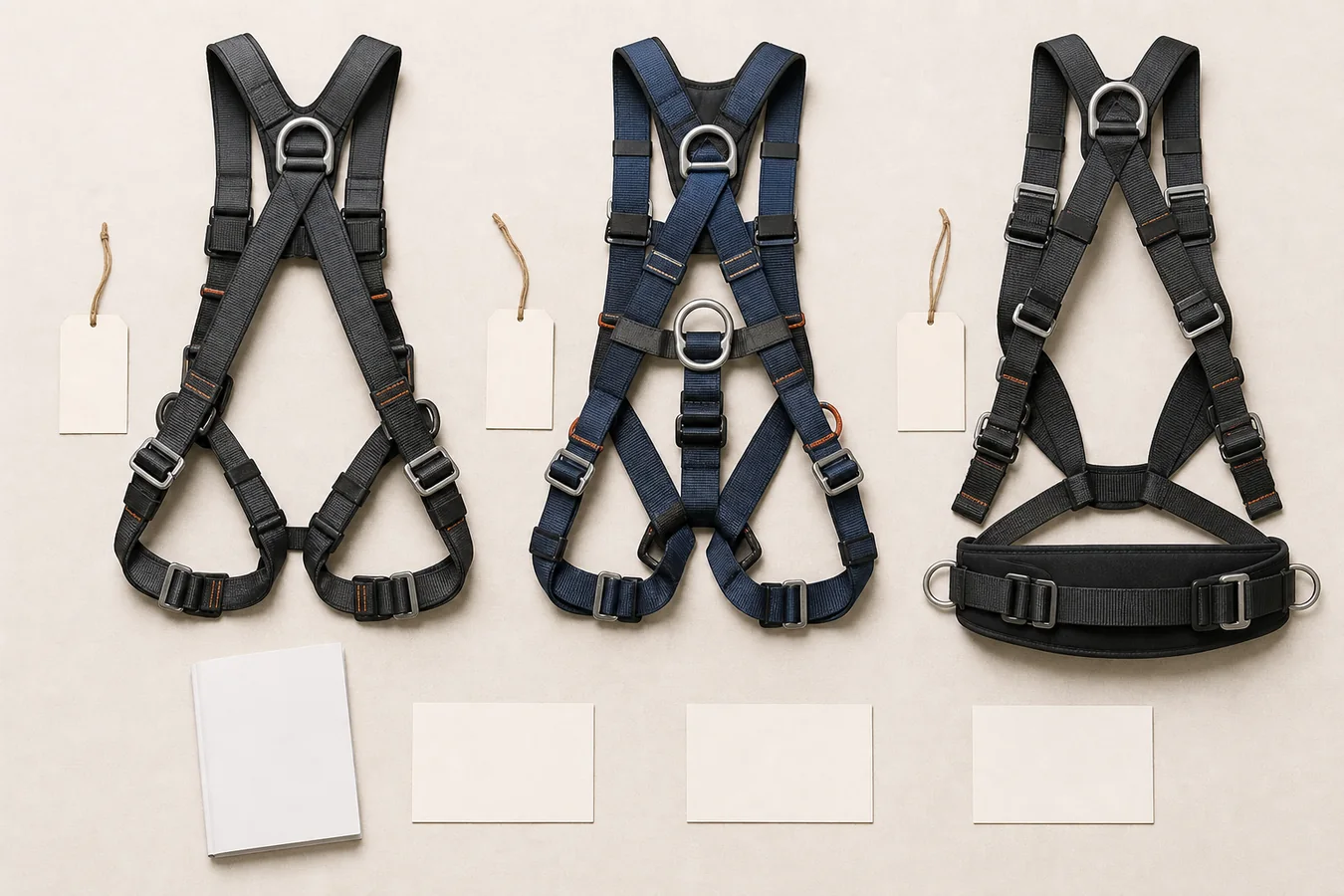
Gemtor’s current family page lists four closely related order lines. Read them as separate products, not a base harness with details the seller can fill in later.
| Current family line | Leg-buckle distinction | Hip-D-ring distinction | Purchase consequence |
|---|---|---|---|
972 |
Quick-connect buckle leg straps | No H-designated waist-belt D-rings in the listed name | Preserve the complete 972 model and selected suffix |
972H |
Quick-connect buckle leg straps | Waist-belt D-rings | Do not shorten the order back to 972 |
872 |
Tongue-buckle leg straps | No H-designated waist-belt D-rings in the listed name | Do not borrow 972 buckle wording |
872H |
Tongue-buckle leg straps | Waist-belt D-rings | Preserve both 872 and H before adding the size suffix |
The current Gemtor harness flyer describes the 972 construction-style family with padded features, a front D-ring and a removable waist/tool belt. Those are manufacturer feature facts. They still do not tell an employer what work method to use, what a connection point does in a designed system or whether another family would be appropriate.
This is why “972 universal harness” is not an orderable conclusion. It omits at least the exact suffix, label, standard/region and approved roles. “972H-2” and “972-2” are not editorial variations. The H changes the manufacturer’s listed configuration; the suffix changes the size code.
The same discipline applies when a seller’s photo looks similar to another listing. Webbing color, padding and visible hardware are identification leads, not identity proof. Ask for the exact current product label and manufacturer model string before comparing features or accepting a substitution.
A D-ring cannot choose the job for you
More attachment points can look like more capability. That is the wrong direction for this purchase. The approved work method creates component roles; the rings do not create the method.
For covered general-industry work, OSHA 1910.140 defines a personal fall-arrest system as a body harness, anchorage and connector. Depending on the system, connector components may include a lanyard, deceleration device or lifeline. The harness is therefore one component even when its product page contains several rings and many compliance bullets.
| Question raised by a product page | Correct owner before purchase | What the Gemtor listing may contribute |
|---|---|---|
| Is this personal fall arrest, restraint, positioning or rope access? | Employer and the responsible qualified or competent system owner | Exact manufacturer-declared harness features and instructions |
| Which anchorage and connector chain belong to it? | The complete job-specific system, with the roof-anchor record kept separate | Exact harness label and compatibility information requested by that owner |
| What does a front, dorsal or hip ring do here? | Current manufacturer instructions plus the approved system design | The presence of the exact ring on the exact model |
| Does the selected rope grab and lifeline belong in the system? | The independent rope-grab and lifeline match | Harness interfaces only after compatibility is documented |
| Is the worker ready to use the equipment? | Employer training, fit, inspection and rescue process | No seller feature can answer this by itself |
Do not convert this into a diagram of where to connect. The answer must come from the current illustrated instructions and the person responsible for the complete system. A front ring on one model does not authorize a function copied from another model, another standard or another employer’s plan.
Covered rope descent makes the separation especially important. OSHA 1910.27 requires a separate independent personal fall-arrest system for covered rope-descent work. A harness feature list cannot collapse the working descent system and the independent protection system into one commercial bundle.
The capacity belongs to the exact label
“Universal” is a size code, not a load rating. Gemtor’s current full-body-harness instruction guide gives different capacity ranges for different standards and tells the reader to use the harness label for specific information.
The guide states an ANSI Z359.11 range of 130 to 310 pounds and, where applicable, a CSA Z259.10 range of 120 to 352 pounds. Those figures include clothing and tools. It also says all components in the system must be rated appropriately for the application.
That creates three separate numbers in the purchase record:
- The range shown for the applicable standard in the current instructions.
- The exact capacity information and markings on the selected harness label.
- The worker’s actual total with clothing, tools and any other load the responsible system owner requires.
The first number cannot overwrite the second. The second cannot raise the limit of a connector, lifeline or other component. The third cannot omit tools because the seller called the harness universal. The complete system remains governed by its applicable criteria and lowest relevant limit.
Size is a separate closure. -2 may be the Universal ordering code, but only the current manufacturer sizing method and the employer’s worker-specific fit process can show whether that size is a candidate. A page written without the worker cannot promise comfort, adjustment, suspension behavior or fit.
If a quote says only “Gemtor universal harness,” return it. The corrected line needs the full model and size suffix, exact label/standard, declared attachment-point configuration and total-load basis. A family name with a guessed suffix is not an acceptable shortcut.
Merchant pages are leads, not identity records
Current specialist listings prove that Gemtor demand inside window cleaning is real. They also show how easily different model families become one brand-level search result.
| Current specialist record | What it usefully establishes | What must still come from the manufacturer and system owner |
|---|---|---|
| Window Cleaning Resource: Gemtor 972-2 | A real 972-2 commercial identity and seller description of padding, buckles and universal fit | Exact current label, intended ring roles, applicable capacity, worker fit and complete-system compatibility |
| J. Racenstein: Gemtor 922 | A separate 922 family cart with merchant buckle and size descriptions | Complete manufacturer ordering code, exact sewn label, approved system role and compatible components |
| ABC Window Cleaning Supply: Gemtor 933 front/back D-ring harness | A third commercial record whose seller name foregrounds ring locations | Exact 933 variant and size, current manufacturer instructions, label capacity and employer-approved role for each ring |
These pages are not interchangeable offers for the same object. 922, 933 and 972 are different manufacturer prefixes covered by the current instruction guide. A seller’s category label may help you locate a candidate, but it cannot move a feature, suffix or capacity from one prefix to another.
Compliance shorthand needs the same restraint. “Meets OSHA” or an ANSI reference on a product page does not decide whether the rule applies to this job, whether the whole system meets its criteria or whether the exact label in the delivered box matches the page. Preserve the exact marking; let the responsible owner apply it.
The useful supplier question is not “Which Gemtor is best?” It is “Please confirm that the quoted item carries this complete manufacturer model and size code, this current label and instruction set, and these exact declared attachment points—without substitution.” The job’s system owner supplies the role and compatibility fields, not the seller’s merchandising copy.
Make the purchase line boringly exact
A usable line looks more like equipment control than shopping copy:
Gemtor model 972H-2, exact delivered US label retained, quoted only for the role named by the approved complete system; D-ring roles, quick-connect legs, waist-belt configuration, worker-plus-clothing-tools-equipment load, current instruction revision and compatibility confirmation attached to the purchase record.
Do not fill a missing field with the closest product-page phrase. Let that gap choose the disposition.
| Record result | What it means | Purchase disposition |
|---|---|---|
| Every field matches one delivered-model label and the approved complete system | The exact Gemtor candidate survives the page | Retain that exact line for employer approval; reject substitutions |
| Family and role match, but the current size process points to another suffix | The product family may remain, but the order code changes | Replace only the suffix after worker-specific confirmation |
| D-ring, buckle, belt or role requirements point to another prefix or H variant | The original listing is the wrong configuration | Rebuild the line from the exact manufacturer model; do not add loose features |
| Method, anchorage, connector chain, compatibility, inspection, training or rescue remains open | There is no complete system for the harness to join | Hold the harness and return the named gap to the responsible system owner |
| Manufacturer page, seller line and delivered label do not agree | Product identity is unresolved | Obtain written manufacturer or employer confirmation before purchase |
Only the exact line that survives belongs in the professional window-cleaning equipment plan. If the line still says only “Gemtor universal,” the page has not failed—the quote has revealed exactly what is missing.