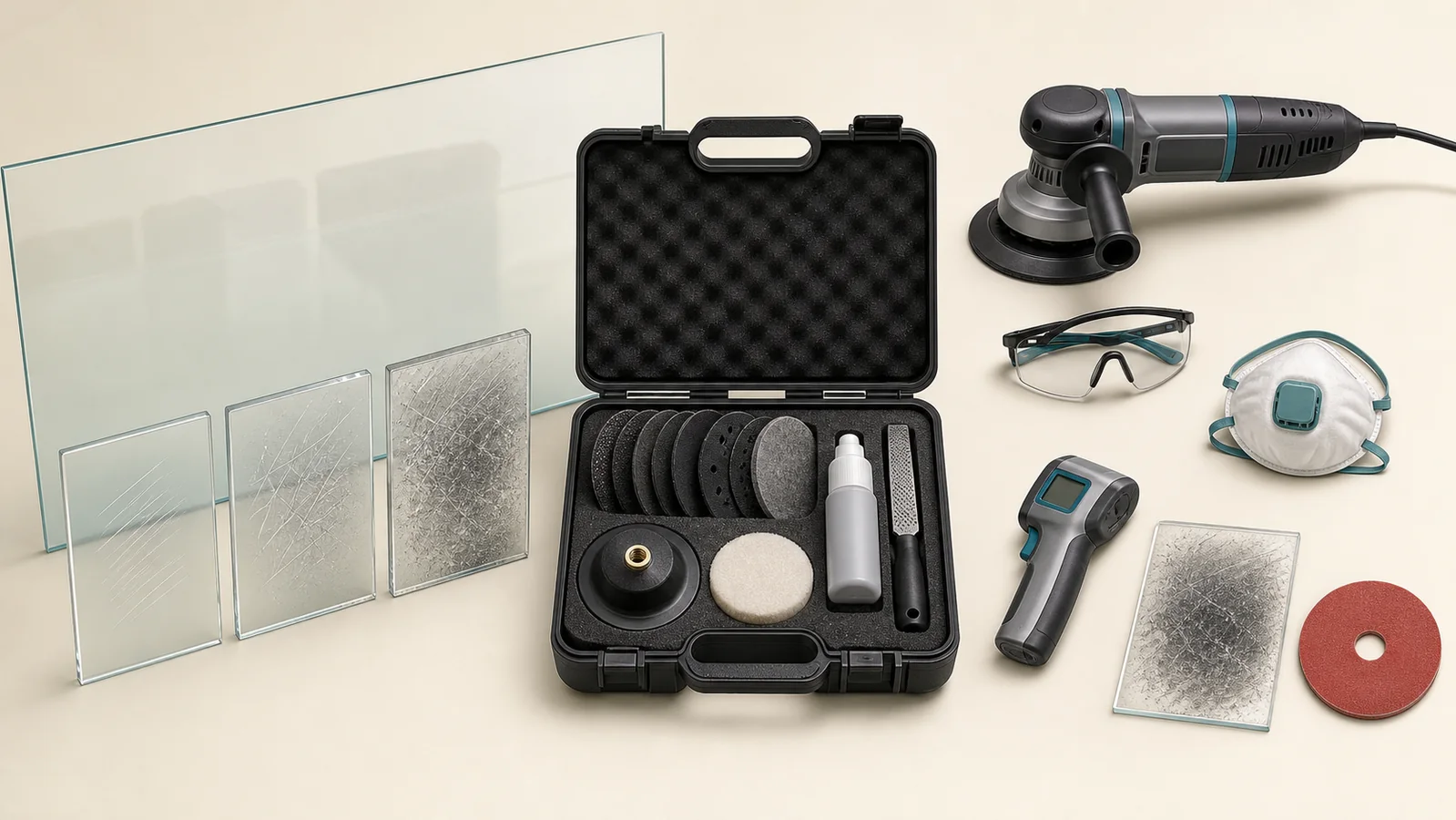
The 106-1000 case is a component package, not a finished workcell. It contains 3- and 5-inch Black and Grey abrasive paths plus backing and polishing parts. GlassRenu explicitly says the Professional Grade package does not include its Red disks. The current specialist seller separately lists the compatible polisher, clean water, eye protection and dust mask as required but not included; a non-contact thermometer is only recommended on that seller line.
That can be a sensible starting package when the named damage falls inside what the included abrasives can support and the business already owns the right machine and controls. It is not a complete answer to the phrase “glass scratch repair kit.”
If the mark has not yet been routed from cleaning or one-step polish into a professional multi-step system, use the cerium-oxide glass-polish decision first. If the glass construction or exposed surface is still unknown, identify what the pane record can establish before pricing abrasives. This page starts after those two questions and asks a narrower one: what must appear on the purchase order for this exact restoration system?
Restoration is a specialist branch of the broader professional window-cleaning equipment stack. It belongs there only when the entire route—not merely the case—has an owner.
Start with the damage class, not the case
GlassRenu’s current manufacturer reference assigns different first abrasive families to its damage classes. CAT-1 uses a foam-finishing and cutting-compound path. CAT-2 and CAT-3 start with Black disks. CAT-4 starts with the more aggressive Red disk. Grey disks and polishing parts then have their own positions in the system.
This is a purchase classification, not an operating recipe. It has one immediate consequence: a CAT-4 job cannot be closed by a package whose current owner says Red is absent. CAT-1 also should not be forced into a Black/Grey box simply because “scratch repair kit” appears in the product title. If the damage class is unknown, do not use package size or price to guess it.
The same restraint applies to the pane. A tempered mark, a clear-looking surface or a contractor’s request does not reveal the exposed coating or grant permission to remove glass. On construction work, keep this restoration purchase separate from the glass-lot and residue decision; cleaning scope does not silently become repair authority.
Open the 106-1000 receipt line by line
GlassRenu identifies the Professional Grade Scratch Removal System as SKU 106-1000 and describes it as a 3- and 5-inch entry package. WindowCleaner.com currently maps seller SKU 033-60-01 to manufacturer part 106-1000.
On that seller line, the box contains 3- and 5-inch backing pads; ten Black and ten Grey disks in each of those two diameters; a 5-inch polishing felt; an 8-inch rasp; 16 ounces of polishing compound; and a laminated instruction sheet.
Four required items sit outside the listed box: a variable-speed sander/polisher with a 5/8-11 spindle and RPM chart, 16 ounces of clean water, eye protection and a dust mask. The seller recommends a non-contact thermometer and dropcloth. The manufacturer adds the other critical exclusion: no Red disks.
This makes the 106-1000 receipt useful. It also makes it impossible to treat the word “system” as proof that every job, tool and control has been purchased.
The four current packages move different obligations into the box
The useful comparison is not good, better and best. Each package moves a different set of responsibilities from the buyer’s adjacent shopping list into the named box.
| Current package | Abrasive and size boundary | Power, temperature and training in the package | Purchase meaning |
|---|---|---|---|
| Professional Grade 106-1000 | 3/5-inch Black and Grey listed; Red explicitly absent | Polisher, water and PPE outside; thermometer seller-recommended | Compact route when the damage class fits and the buyer closes every adjunct |
| Professional Grade XL 106-2000 | 5/6-inch format; Red explicitly absent | Designed to pair with a handheld grinder; training not listed as included | Larger working format, not a deeper-damage upgrade |
| Enterprise Grade 106-5000 | 3/5-inch Black and Grey disks; 3/5/6-inch backing and felt; Red and 6-inch abrasives not listed | Laser temperature gun included; required corded polisher excluded; training not listed | Adds a 6-inch polishing interface and temperature observation while leaving the 6-inch abrasive, power and competence questions open |
| Service Grade 106-6000 | Product page describes sleeves across 3/5/6 and includes Red; exact Red diameters need confirmation because the current reference lists no 3-inch Red | Temperature gun, Makita grinder/polisher and certification training included | Closes more of the named system, but still needs a received-contents check and does not identify the pane or prove field acceptance |
The matrix does not make the highest tier the automatic answer. A business accepting only damage inside a documented Black/Grey path may have no reason to buy Red. A buyer working on smaller, localized areas may value the 3-inch path that the XL format does not advertise. The correct row is the smallest package that closes the documented job set without leaving a required component disguised as an assumption.
The package facts come from the current manufacturer pages for Professional Grade XL 106-2000, Enterprise Grade 106-5000 and Service Grade 106-6000. They are current package boundaries, not independent proof of performance.
The polisher can invalidate an otherwise correct cart
“Variable speed” is not the whole tool specification. GlassRenu’s manufacturer reference sets a minimum contract of corded power, direct-rotary drive, a 600–3000 RPM range and either a 5/8-11 SAE or M14 metric arbor. The current US specialist 106-1000 line calls for a 5/8-11 threaded spindle and RPM chart.
Those facts need to stay on the same record as the backing pads actually being purchased. A cordless random-orbit machine, an incompatible spindle or a tool whose speed range does not cover the system contract does not become compatible because a pad can be made to stick to it.
Do not convert the 600–3000 range into public stage settings. The current system owner and the trained operator retain that responsibility. For purchasing, the range is a gate: the exact machine either meets the current system contract or it does not.
Training belongs on the order when restoration is a new service
The current merchant page says formal training is unnecessary, yet it also marks the product for professional use and says in its Q&A that the kit takes finesse to master. The current Service Grade package includes virtual certification training. Those facts describe different commercial messages, not a neutral finding that training is optional for every buyer.
Treat competence as a deliberate purchase field. An experienced restoration operator replacing known consumables is in a different position from a window-cleaning company adding glass removal for the first time. If the new service has no qualified assessor, controlled practice path, inspection standard or person accountable for optical acceptance, a smaller carton price has not reduced that gap.
Distortion is one reason. Removing the visible line is not the only acceptance condition; the worked area still has to be judged for optical change from the viewing positions that matter. A product claim cannot accept that result on behalf of the building owner.
Close the purchase as one receipt
Before checkout, put seven lines under the same job and package identity:
- The glass owner, construction, exposed surface and permission to use the selected system.
- The damage class and the owner reference that assigned it.
- The manufacturer model and seller SKU, including a dated copy of included contents.
- Every required abrasive color and diameter, backing pad, felt, compound and replenishment line.
- The exact corded direct-rotary polisher, speed range, arbor and backing-pad match.
- Water, PPE, temperature observation, adjacent-surface protection and cleanup responsibilities.
- The training, supervision and optical acceptance owner for the work the business intends to sell.
If 106-1000 closes those lines with named adjuncts, keep it as the candidate. If Red, a broader size range, a thermometer, the polisher or training is genuinely required, compare the next tier or price those items separately. If the pane, damage class or competence owner is missing, the correct result is a named hold or specialist-service route—not a more optimistic reading of the word “kit.”