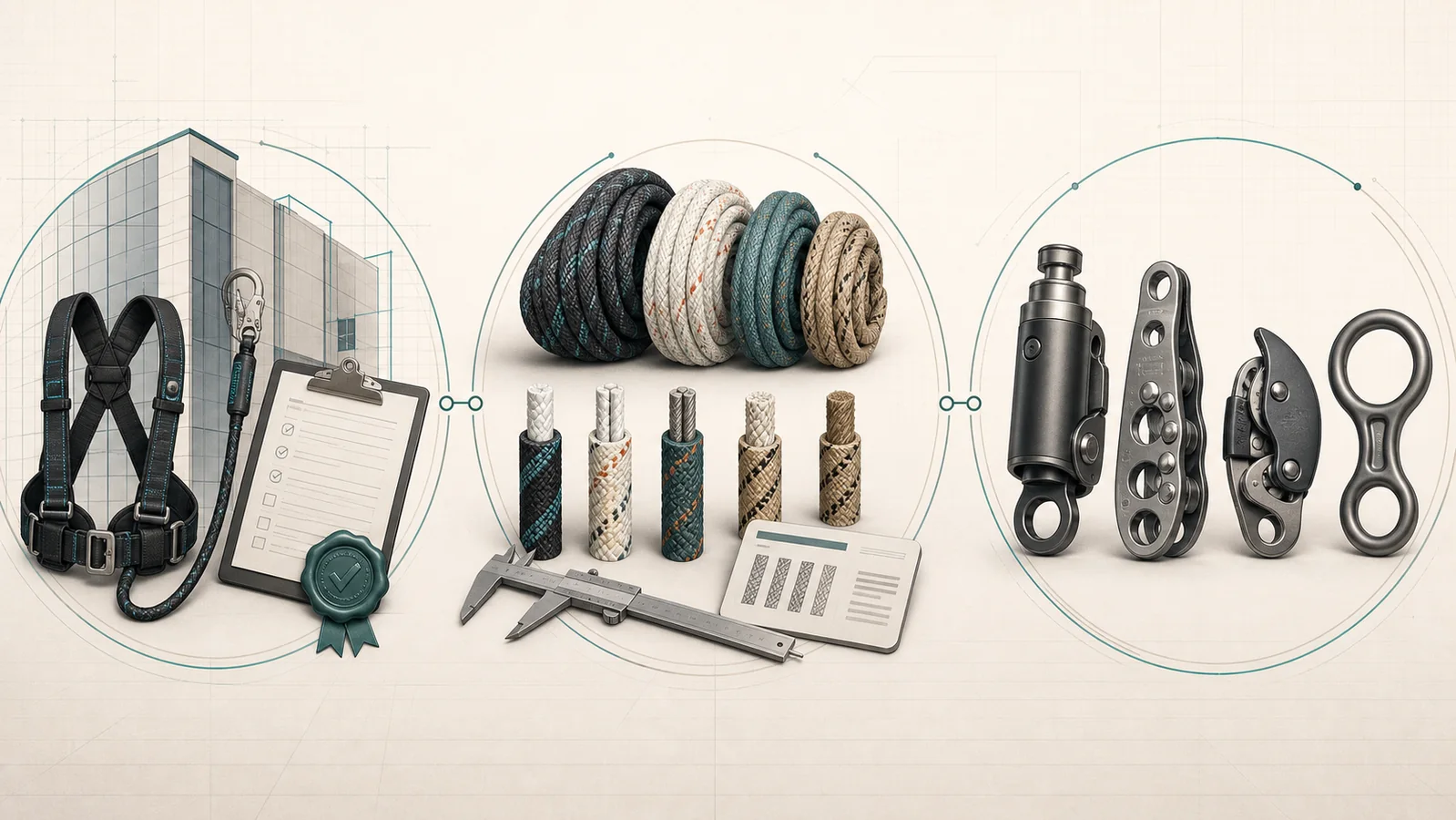
“Rope descender” is a product category, not a purchase specification. It does not identify the authorized work system, the rope the manufacturer owns, or the control behavior attached to one exact model. Those three records have to agree before shape, weight or price becomes useful.
That distinction matters because current catalogs place cylinder devices, racks, self-braking cam devices and figure eights under the same broad noun. Some are presented for controlled-descent systems; others are designed for experienced rope-access users, rescue or climbing. A shared category page does not make them substitutes.
Start with the responsible employer or qualified owner’s work plan. Then preserve the descender manufacturer, model, region and current instructions alongside the exact rope manufacturer, construction and diameter. Finally, keep every control term—lever brake, automatic overspeed, anti-panic or auto-lock—attached to the model that actually claims it.
If one of those nouns is still generic, the useful result is a rejection, a route back to the system owner or a hold. A visually convincing device is not evidence that the order is ready.
The product card starts one level too late
OSHA’s current general-industry definition describes a rope descent system (RDS) as a suspension system that permits controlled descent and stopping. The usual component list includes an anchorage, support rope, descent device, connectors and a chair or seatboard. The same definition excludes industrial rope access systems (IRAS).
That is why the first cart question is not “rack or cam?” It is “what system has actually been authorized?” The site’s roof-harness and complete-system decision owns that earlier work-method gate. The separate bosun-chair record owns the seat component. Neither can be inferred from the descender listing.
| Recorded plan | What may enter comparison | What the product card cannot decide |
|---|---|---|
| Authorized RDS | An exact descender documented as one working component of that RDS | The anchorage, support rope, connectors, chair, independent PFAS, training or rescue plan |
| Authorized IRAS or rope-access plan | A model admitted by that plan, its equipment owners and trained-user scope | Whether an RDS-oriented device or chair system can be borrowed into IRAS |
| Rescue, climbing or another vertical activity | Only equipment selected under that activity’s competent plan and current instructions | That window-cleaning search intent makes the equipment job-eligible |
| Unresolved suspended-work request | Nothing beyond evidence gathering | Which system class, owner, training or rescue obligations apply |
For a covered RDS, OSHA 1910.27 also keeps manufacturer instructions or qualified direction, training, pre-shift inspection, an independent personal fall-arrest system and prompt rescue outside the reach of a cart comparison. The descender can be exact while the job remains unapproved.
Rope compatibility is a named contract, not a diameter shortcut
A millimeter range is valuable, but it is only one field. The rope may also be owned by a named manufacturer family, construction, material, current condition and model-specific instruction set. “Fits 11 mm” is therefore not a complete compatibility statement.
The contrast is visible in current first-party pages. Sky Genie’s Variable Descent Control Device is sold in two sizes and is intended for use with Sky Genie Solid Braid Nylon Rope. The public page therefore gives a named rope family, not permission to insert any rope that appears close in diameter.
Petzl’s current US I’D S page specifies 10 to 11.5 mm rope. The current US RIG page specifies 9.5 to 11.5 mm. Their ranges overlap, yet the models have different stated users and functions. Diameter does not erase those differences.
| Current record | Published rope contract | Published control identity | Purchase boundary |
|---|---|---|---|
| Sky Genie Variable Descent Control Device | Two device sizes; intended for Sky Genie Solid Braid Nylon Rope | Variable descent-control device under its own instructions | Preserve the exact size and named rope; the family name alone is incomplete |
| Petzl I’D S, current US page | 10–11.5 mm | Self-braking, anti-panic, anti-error and AUTO-LOCK functions | Experienced-user, work-at-height/rope-access scope and the exact manual remain active |
| Petzl RIG, current US page | 9.5–11.5 mm | AUTO-LOCK; compact descender for expert rope-access users | The overlapping diameter does not import the I’D S anti-panic function or system role |
| MIO-D / MIO-R family overview | Not closed by the family overview; use the exact model’s current instructions | Cylinder or rack form with lever-brake and automatic-overspeed mechanisms | Do not infer rope fit from the silhouette or from another MIO model |
| Generic figure-eight listing | Unknown until an exact manufacturer, model and manual are recorded | The shape names a device type, not a complete control contract | Climbing or rescue search results cannot authorize a window-cleaning system purchase |
Condition remains part of the same record. Contamination, glazing, cuts, abrasion, heat exposure or an unknown history can invalidate what looked correct on paper. Where an approved rope may contact a building edge, the rope-protector decision owns that separate threat; buying a different descender does not solve it.
Brake words describe mechanisms, not a safety ladder
Feature names are easy to sort into an imagined hierarchy: more automatic words must mean a better device. Current manufacturer families show why that shortcut fails.
MIO’s current descender overview separates MIO-D and MIO-R models, which it describes with both lever-brake and automatic-overspeed mechanisms, from MIO-D2 and MIO-R2 models described with a lever-brake mechanism only. The same page also lists RR-1, RR-2 and RR-3 rack variants with different bar or swivel identities. These are model-family facts, not a universal progression from acceptable to superior.
Petzl’s current pages make a different distinction. Both I’D S and RIG publish AUTO-LOCK, but the I’D S also publishes anti-panic and anti-error functions while the RIG is explicitly positioned for expert rope-access users. Both current US pages state a 140 kg one-person working load limit, with more information assigned to their instructions. Matching that number still does not merge the products.
The procurement question is therefore not “Which device has the most brakes?” It is “Which exact mechanism, user scope and manual did the responsible system owner select for this rope and work plan?” A control feature may be useful evidence for that decision; it cannot make the decision independently.
An 11 mm rope can still produce four different answers
Suppose a purchase request says only: “We use 11 mm rope and need a descender that can stop.” Every word sounds specific. The request is still unable to choose among four current records.
| Candidate record | What 11 mm appears to answer | What remains unresolved | Disposition |
|---|---|---|---|
| Sky Genie device | Nothing conclusive from the public family statement alone | Exact device size, named solid-braid rope identity, system role and current instructions | Hold for exact manufacturer record |
| Petzl I’D S | The diameter is inside the current published 10–11.5 mm range | Authorized rope-access/work-at-height plan, exact rope, user scope, interfaces, load and manual | Candidate only after every owner agrees |
| Petzl RIG | The diameter is inside the current published 9.5–11.5 mm range | Expert-user rope-access role, exact rope, different control contract and system admission | Do not substitute from diameter overlap |
| MIO cylinder or rack family | The family overview does not publish enough rope detail to close the field | Exact model, current manual, compatible rope and complete RDS record | Return to manufacturer/model owner |
The same separation protects the backup system. A working descender is not automatically a rope grab or an independent fall-arrest component. When the approved plan uses a rope grab, the rope-grab, lifeline and lanyard record must close under its own manufacturer and system owners.
Finish with one procurement sentence, or do not place the order
A complete record should be readable without a product photo. It names the authorized method, responsible owner, exact device manufacturer/model/region/manual, exact rope manufacturer/construction/diameter, manufacturer-stated control function, user and load scope, interfaces, independent PFAS, anchorage, inspection status, training and rescue owner.
Exact working-system candidate: “Request this named cylinder or rack descender for this authorized RDS, with this exact rope and current model instructions, subject to the responsible owner’s complete-system approval.”
Exact rope-access candidate: “Request this named self-braking descender for this authorized IRAS or rope-access plan, with this exact rope, trained-user scope, interfaces and current instructions.”
Rejected candidate: “Reject this device because its work class, rope contract, model, function, load scope or current condition does not match the recorded plan.”
Owner route or hold: “Do not place the order until the employer, manufacturer or qualified owner resolves the named system, rope, device, inspection, training or rescue gap.”
Attach that sentence to the professional window-cleaning equipment plan. If the sentence still needs words such as “generic,” “about,” “probably” or “equivalent,” the product comparison has not reached a purchase.