A soft sleeve can be the correct answer to abrasion and the wrong answer to the edge in front of it.
That conflict is the purchase problem. “Rope protector” covers products that do different jobs: ordinary sleeves around a fixed rope, more abrasion- or heat-resistant sleeves, and bearing rollers intended for moving rope. None of those labels decides whether the rope should contact the edge at all.
Start with the already approved method and system. Preserve the exact rope identity, its role, the point it may contact, whether it remains fixed or moves, and the actual damage threat. Then compare one exact protector’s current stated scope. If the edge is sharp, damaged or not identified—or if the contact path itself has not been approved—the answer is not a more impressive-looking sleeve. It is another control or a hold for the responsible qualified owner.
The roof-harness decision owns the work method and complete protection system. The roof-anchor record owns the building connection, while the rope-grab and lifeline decision owns that component match. This page starts after those choices. It classifies one rope-contact threat and the protector type worth advancing; it does not teach placement, mounting, rigging or use.
Name the damage before naming the protector
OSHA 1910.140 requires covered ropes, lifelines, harnesses, belts and lanyards used for personal fall protection to be protected from being cut, abraded, melted or otherwise damaged. Those are separate failure mechanisms. A product that addresses one does not automatically address the others.
| Record | What must be exact | What a generic product label cannot prove |
|---|---|---|
| System and rope | Approved method, responsible owner, rope role, manufacturer/family and current instructions | That this rope or work method may use the product |
| Contact path | Contact point, edge geometry, material, damage and the approved route | That rope contact should occur at all |
| Threat | Cut, ordinary abrasion, severe abrasion, heat, melting or unknown | That abrasion language covers a sharp edge or heat |
| Motion and count | Fixed or moving rope, one or two lines, and owner-required dimensions | That a sleeve and a roller are interchangeable |
| Current state | Protector model/manual, inspection, impact, contamination, heat exposure and removal owner | That a previously used protector remains a candidate |
A missing identity or an unknown threat is a decision result, not an invitation to assume the mildest case. A receipt proves that something was bought; it does not prove what has happened to it since.
A fixed rope and a moving rope do not ask the same product question
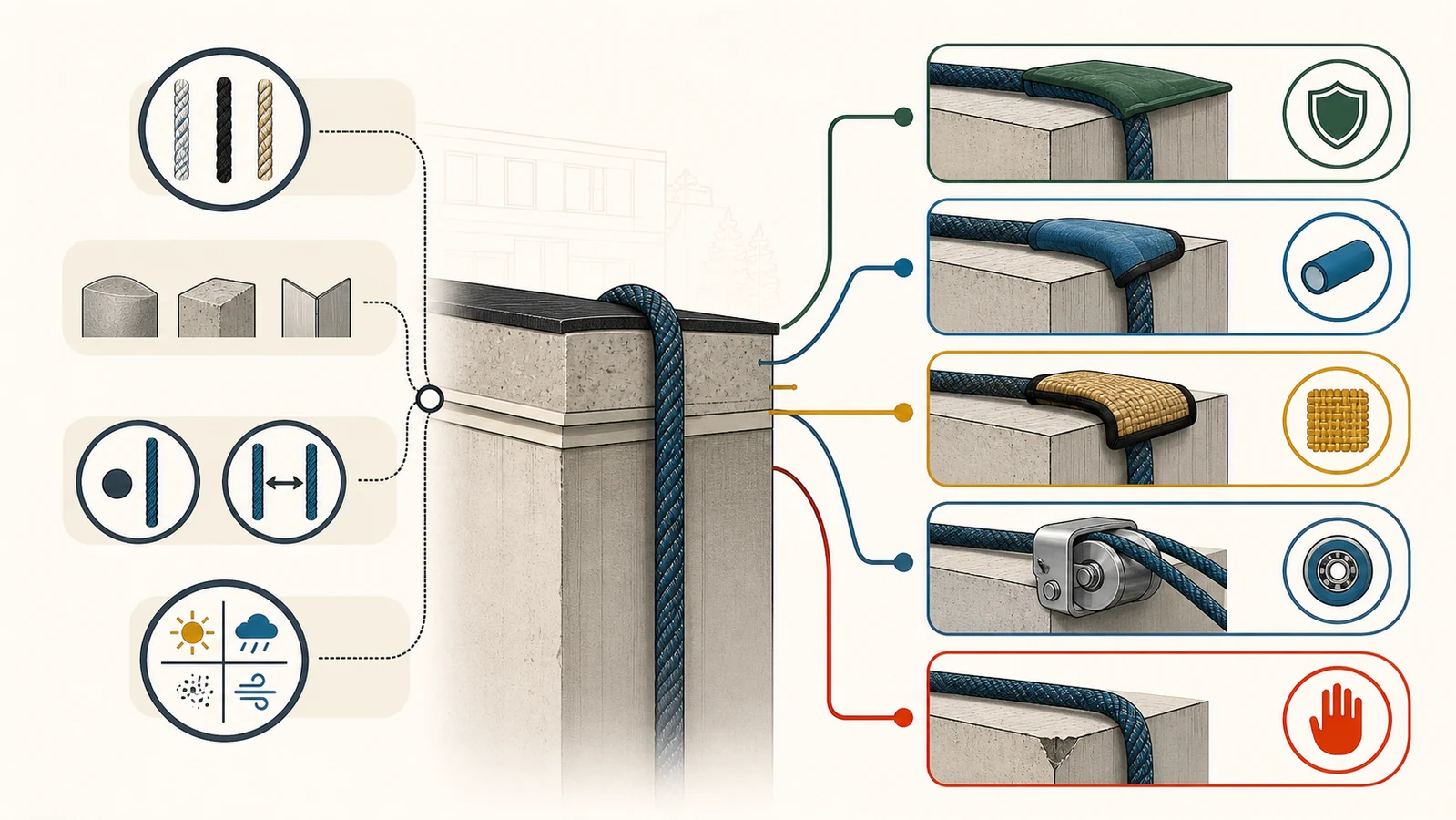
A fixed-rope protector and a moving-rope roller are not successive “strength levels.” They manage different contact conditions. Petzl’s current professional-rope category describes PROTEC and PROTEC PLUS as protection for a fixed rope, while ROLLER COASTER is a bearing device for one or two moving ropes. That distinction should be settled by the approved system and the exact rope path, not inferred from how the product looks.
For a fixed rope exposed to ordinary abrasion, an exact soft protector may become a candidate once the edge is not sharp and the owner’s scope, rope dimensions, retention design and current condition all match. If the named owner documents severe abrasion or heat within an exact product’s scope, a higher-resistance fixed-rope model may be the relevant candidate. When the approved plan contains a moving rope at the contact, compare an exact roller whose current owner permits that motion and the actual number of ropes.
“Moving” is not a cue to improvise a roller layout. “Fixed” is not proof that a sleeve is enough. Both words are inputs supplied by the approved system design.
A soft sleeve loses at the sharp-edge gate
Petzl states for PROTEC that the flexible protector does not protect against sharp edges and directs that problem to ROLLER COASTER. PROTEC PLUS carries the same exclusion. That is a useful category boundary: more abrasion resistance does not transform a fabric protector into a universal sharp-edge control.
OSHA’s 2024 edge-protection bulletin tells employers to cover exposed edges that a lifeline or lanyard could contact during a fall and to make sure protective material will not be displaced by a sliding line. Where covering is not feasible, the bulletin points to limiting fall distance or another control method. It does not provide a catalog rule for choosing a sleeve, nor does it approve any particular installation.
OSHA’s nonmandatory Appendix C likewise warns that sharp or rough surfaces can drastically reduce rope strength and discusses padding or an alternative means. Its nonmandatory status matters, but so does the warning: a visually small edge defect can change the category of the decision.
If the edge geometry, material, damage or motion is unknown, record qualified-person edge control or hold. Do not downgrade the threat to “abrasion” because a sleeve is easier to order.
Exact product names still do not close the job
Current Petzl records show how much detail remains after the product type is chosen.
| Exact current model | Manufacturer-stated scope and fields | Purchase boundary |
|---|---|---|
| PROTEC R003AA00 | Flexible fixed-rope abrasion protector; TPU, nylon and aluminum; 130 g; 56 × 5 × 2.5 cm; described for most professional rope diameters and anchor straps | “Most” does not approve this exact rope; it is not sharp-edge protection |
| PROTEC PLUS R003BA00 | Fixed-rope protector for particularly abrasive surfaces or heat; aramid, nylon and aluminum; 135 g; 56 × 5 × 2.5 cm; manufacturer claims three times the abrasion resistance of PROTEC | Heat and abrasion claims stay with this exact model and instructions; it is not sharp-edge protection |
| ROLLER COASTER R005AA00 | Reversible bearing protector for one or two moving ropes; steel and aluminum; 470 g; described for flat or angled faces | Product scope does not approve the structure, route, retention or mounting design |
The exact dimensions and weights identify the owner record; they do not rank the products. PROTEC PLUS’s manufacturer-published short heat and flame exposure limits do not approve an unidentified hot surface. ROLLER COASTER’s one- or two-rope field does not decide whether the approved system should put those ropes over that edge.
Petzl’s ROLLER COASTER page owns the moving-rope and current model facts. A current specialist rope-protector category is useful for locating exact items and part names in the window-cleaning market. Neither source can transfer a stated scope between models or approve a building edge.
Let the contact path decide whether anything gets ordered
| Outcome | Evidence that must agree | Purchase action |
|---|---|---|
| Avoid contact or another approved control | The contact can be eliminated or the responsible design chooses another control | Do not buy a protector to preserve an unnecessary contact |
| Exact fixed-rope abrasion candidate | Approved rope stays fixed; threat is ordinary abrasion; edge is not sharp; exact owner fields close | Advance only that exact model for system-owner approval |
| Exact high-abrasion or heat fixed-rope candidate | Current product owner explicitly covers the recorded threat and every scope limit remains attached | Keep the claim, model and current instructions together |
| Exact moving-rope roller candidate | Approved system says the rope moves; exact roller covers rope count and owner-controlled contact design | Advance the model without inferring a layout from its product page |
| Qualified-person edge control or hold | Edge is sharp, damaged or unknown; identity, motion, condition, inspection or design owner is unresolved | Do not order until the named owner closes the gap |
Keep this contact-path card with the professional window-cleaning equipment plan. A rope protector enters a purchase request only when the rope, threat, motion, edge and exact product all describe the same approved contact.