A polished demo can show a drone spraying a glass tower. It cannot tell you whether the quoted aircraft is the same configuration, whether its water-filled hose stays inside the weight limit, whether the property can support the operation or whether your actual soil comes off to the finish the client expects.
Start with one building, not a product brochure. Put its facade, dirty areas, water source, ground space and acceptable result beside the exact aircraft, window payload, batteries, pump, filtration, hose and crew. A window washing drone deserves a sales demonstration only when those two records can be tested together.
A drone video cannot qualify your building
Write five lines before contacting a vendor. If an ordinary ground method already finishes the work, use the ground-based high-window options first. The drone comparison begins where that route no longer closes and a real commercial building remains.
| Proof line | Record before the call | What the vendor must add |
|---|---|---|
| Building task | Facade/glass type, seals and coatings, soil, work band and required finish | Exact cleaning method and a representative sample plan |
| Flying configuration | Aircraft, batteries, window/spray payload, onboard tank and every attached item | One total takeoff-weight statement for the quoted US configuration |
| Ground system | Water source, treatment, pump space, hose route, runoff and power | Matching pump, filtration, chemistry, nozzle and water-filled hose specification |
| Operating authority | Address, airspace, people/vehicle exposure and property restrictions | Exact certificate, registration, Remote ID, waiver/authorization and crew path to verify |
| Acceptance | One representative pane/section and the finish the client will accept | The quoted system, crew and conditions used in a witnessed result |
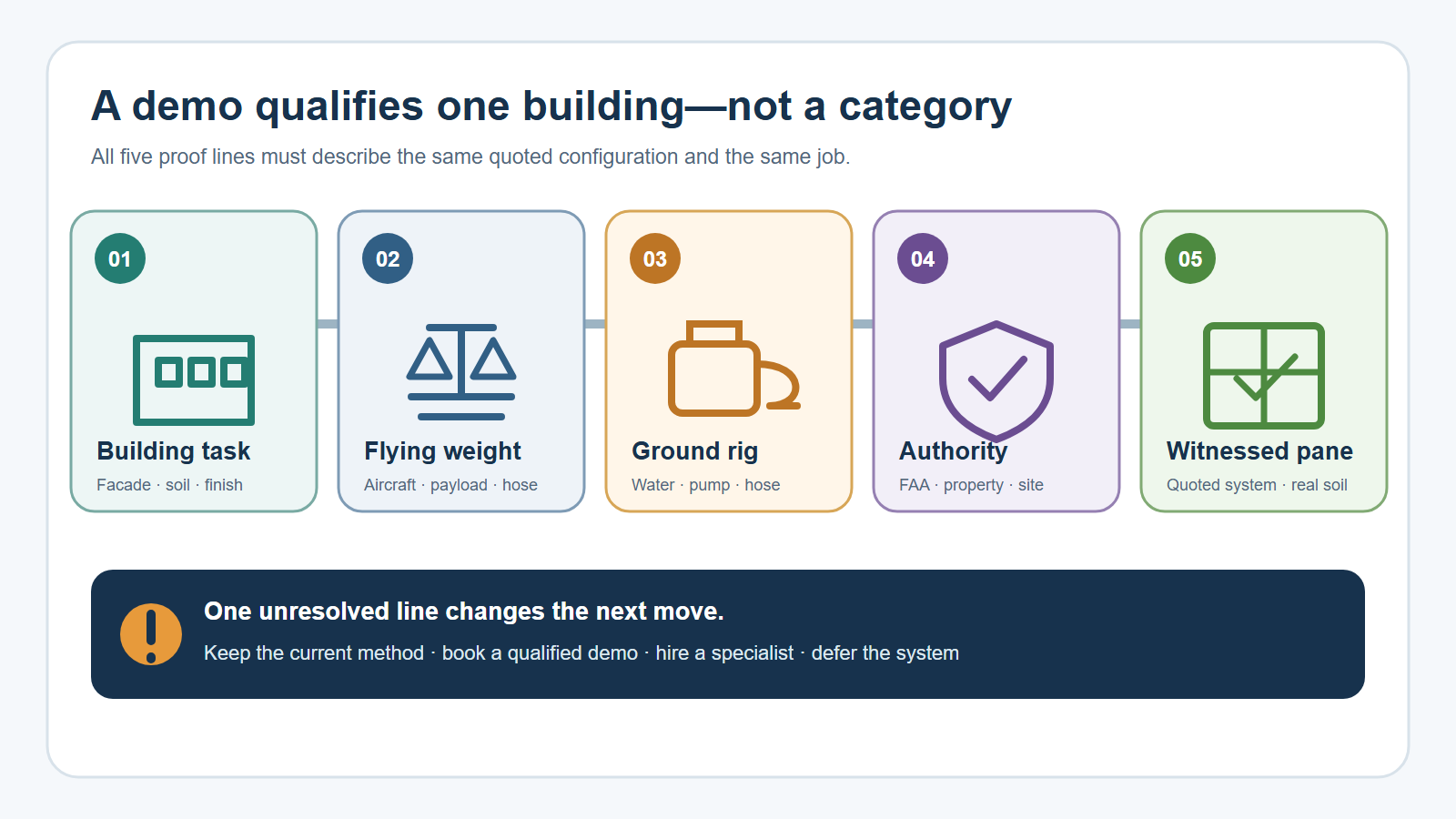
Maximum height and headline pressure are downstream facts. They matter after the building and exact system have names. A control range, a “turnkey” label or footage from another facade cannot close any of these five lines.
Put the entire flying configuration on one weight line
The FAA’s current Part 107 overview describes the small-UAS path for drones weighing less than 55 pounds. Its weight language includes the aircraft, attached systems, payload and cargo. A bare-aircraft number is therefore not the buying number.
Ask the vendor to state the actual total for the demo configuration: aircraft, installed batteries, window/spray payload, onboard liquid, nozzle or lance, the airborne portion of a water-filled hose and every attached guard, sensor or accessory. Preserve the manufacturer’s basis for each number instead of subtracting unlike “empty,” “with battery,” “payload” and “all-up” values yourself.
Current manufacturer documents show why the distinction matters. The Lucid Sherpa specification sheet lists an 80-pound maximum all-up operational capability and a separate 55-pound “FAA-Limitation” label. Capability is not permission to use 80 pounds under the cited small-UAS path. The current ABZ C10 datasheet publishes a 24.9-kilogram maximum takeoff weight and rounds the US column to 55 pounds. Because the FAA page says less than 55 pounds, the exact ready-to-fly value and its authority need to be documented—not decided by a rounded catalogue cell.
| Weight question | Evidence to obtain | Hold when |
|---|---|---|
| What is installed? | Exact aircraft version, batteries, payload, tank, nozzle/lance, hose and accessories | The quote names only the drone family |
| What is the total? | One ready-to-fly takeoff weight with stated fluid and hose condition | The seller provides only empty weight or maximum payload |
| What does the manufacturer permit? | Current exact manual/specification for that configuration | Parts or limits come from another version |
| What legal path is proposed? | The current authority owner ties that total to the intended operation | A capability label is being used as regulatory approval |
The hose is part of the aircraft decision
A cleaning drone is not just an aircraft with a spray tip. The ground side determines what reaches that tip: source water, filtration, pump, chemistry, hose diameter and length, fittings, power, tanks, controls and hose management. Change the ground rig and you may change the airborne load, pressure/flow, flight behavior, crew or finish.
Lucid’s current Sherpa manual describes spraying payloads connected to ground-based pumps and separates DI/clean-water rinse from window-payload chemical injection. ABZ’s current C10 manual likewise binds the water-filled hose and washing system to the aircraft’s technical limits. WINDOSMART publishes a different turnkey design: a custom 500-foot hose, a pump matched to its filtration/nozzle/hose route and integrated RO/DI with live TDS monitoring.
Those are three system descriptions, not interchangeable shopping parts. Do not attach a generic pressure washer because its connector fits, borrow a hose from a different demonstration or assume that “pure water” proves the finish. If source-water treatment and delivery still need definition, the complete water-fed pole system shows how source, treatment, delivered output and maintenance remain separate decisions; the same discipline applies here even though the delivery endpoint flies.
| Ground line | Record | Why it changes the demo |
|---|---|---|
| Water | Source, measured quality, treatment path, storage and refill | The finish and available flow depend on the water actually supplied |
| Pump and method | Exact pump, pressure/flow basis, nozzle and approved cleaning method | Maximum system pressure is not permission for a pane, seal or coating |
| Hose | Material, diameter, full route length, water-filled airborne portion and fittings | Weight, drag, snag points and delivery change with the real route |
| Site services | Power, pump/tank footprint, vehicle access, drainage and runoff owner | A flight-ready drone can still be a site-incompatible cleaning system |
| Controls and crew | Who flies, watches, manages hose, operates pump/chemistry and stops the work | Remote features do not erase the exact manual’s assigned roles |
Airspace and the work zone are separate approvals
Equipment training does not supply flight authority. The FAA’s current commercial-operator page routes business use through a Remote Pilot Certificate, aircraft registration and the applicable operating rules. The current Part 107 overview also addresses visual line of sight, people, maximum altitude, controlled-airspace authorization and waiver paths.
That is only the aviation side. The building record still needs the property owner’s permission, an acceptable ground/exclusion area, control of people and vehicles, facade and seal approval, water and chemical permission, overspray/runoff handling, insurance and any local requirement. The vendor should identify which party owns each answer; “our drone is certified” is not an answer to a property question.
Height illustrates the split. A manufacturer’s 150- or 200-foot cleaning claim describes its system under stated conditions. It does not tell you whether the aircraft remains visible around the building, whether the airspace is controlled, where uninvolved people may be, or whether the hose can cross the site. Ask for an operation map for the address, not a floor-count conversion.
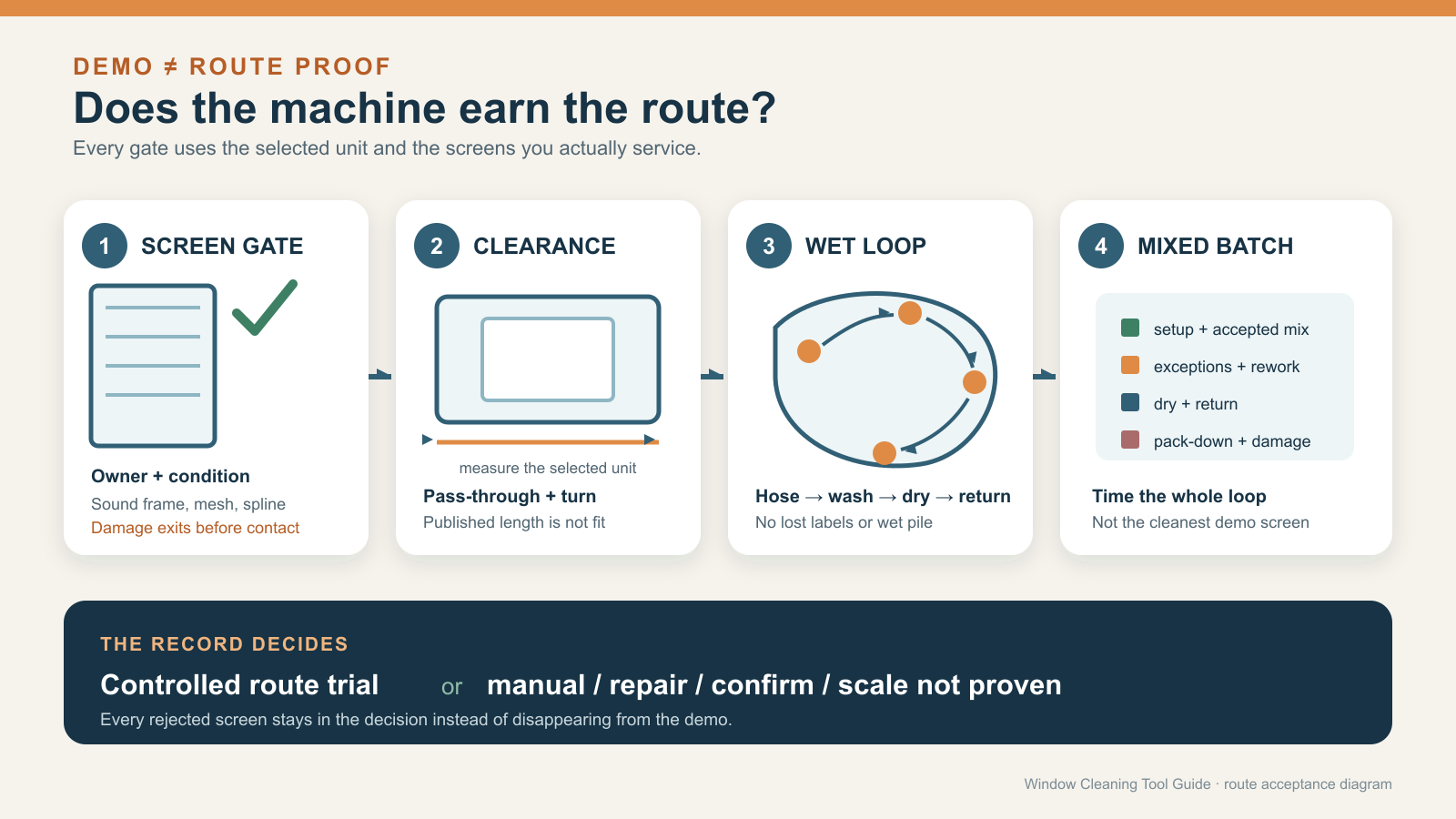
Let one representative pane challenge the sales promise
A vendor video proves that one configuration sprayed one surface under conditions you did not own. Your demo should use a representative pane or facade section and a written result agreed before the aircraft arrives.
Choose a sample that contains the ordinary soil and the awkward feature likely to change the method—such as a mullion pattern, recessed section, ledge, seal detail or recurring deposit. Do not manufacture a worst case just to make the equipment fail, and do not accept an already-clean show pane. The property owner or facade authority must approve the sample and method.
| Demo field | Freeze before the demo | Record after the sample |
|---|---|---|
| Surface | Facade/glass, coating, seals, frames and approved method | Any visible effect on glass and adjacent materials |
| Soil | Ordinary soil plus the named recurring deposit included in scope | What cleared, what remained and whether another method was required |
| System | Exact aircraft, payload, nozzle, chemistry/water, pump and hose | Any substitution or changed setting that would alter the quote |
| Conditions | Height band, weather basis, ground position, hose route and crew | Actual conditions, interruptions, landings and repositioning |
| Finish | Viewing condition, dry-state timing and accepted residue/edge standard | Witnessed pass, conditional pass or miss with photos owned by the buyer |
| Site effect | Overspray, runoff, noise, access and exclusion expectations | What reached adjacent surfaces and how the real work zone behaved |
The result does not have to be a purchase verdict. A sample may show that routine rinse soil fits while adhered deposits still need contact work; that the drone fits upper bands but a pole remains faster below; or that a specialist service deserves comparison before ownership. Those are useful boundaries, not failed demos.
Current systems publish different missing pieces
Current manufacturer documents provide enough detail to expose different questions, but not enough to choose a winner for an unmeasured building.
| Current system/source | Published decision facts | Question the quote must close |
|---|---|---|
| Lucid Sherpa | Optional window payload; 150-ft height; up to 19-minute flight; 3.4-lb spraying payload in the current spec; one pilot plus one ground crew in current product wording | Exact hardware/window payload, total ready-to-fly weight, pump/hose/water configuration, authority and representative finish |
| ABZ C10 | 24.9-kg max takeoff; 25.9-lb empty; max payload including hose 19.7 lb; ~18-minute flight; 196.9-ft height; version-2.4 manual assigns Pilot and Helper/Supervisor | Actual US configuration and weight, selected washing system, facade method, flight/site path and sample result |
| WINDOSMART current system | 200-ft cleaning height; 45+ minutes at 100 ft; custom 500-ft hose; integrated matched pump and RO/DI path | Exact aircraft/model, total weight, US authority, pressure/flow, crew, water conditions and representative finish |
Do not rank 45 minutes against 18 or 19 without the battery, height, payload, hose and operating basis. Do not rank 200 feet against 150 without the site’s visibility, hose route and airspace. And do not rank one-person controls against two named roles without the exact manual and proposed work zone. Each headline opens a question; it does not close the purchase.
Send the vendor one page, not a vague request
Attach the building record to the demo request and ask the vendor to complete the right-hand column for the exact configuration that will appear in the quote.
| Your building record | Vendor response required |
|---|---|
| Address, facade work band and representative sample location | Exact aircraft version, payload, batteries and cleaning method proposed |
| Glass/facade, seals/coating, soil and accepted dry finish | Current compatibility authority plus sample method and exclusions |
| Water source, treatment need, power, pump/tank footprint and runoff path | Exact pump, filtration, chemistry, nozzle, hose and utility requirements |
| Full hose route and airborne hose condition | Documented hose compatibility and one total ready-to-fly weight for that state |
| People/vehicles, ground area, visibility and property restrictions | Crew roles, exclusion/work zone and every FAA/property/local authority item still to verify |
| Witness, conditions and acceptance criteria | Demo schedule using the quoted configuration and a record of pass, limitation or miss |
| Expected jobs and current alternative | Training, maintenance, support and consumables tied to that exact system—without replacing your own cost model |
If the completed sheet shows that the existing ground method finishes the work, keep it. If the building fits but ownership or authority does not, compare an authorized specialist service. If the exact system and site can be tested but the finish is unproved, book only the representative demo. If a controlling answer stays missing, defer the system rather than buying around the blank.
A qualified drone belongs in the broader professional window-cleaning equipment plan only after the quote and demo describe the same building. The useful document is not the brochure you received; it is the one-page record the vendor was able to complete.