The quickest way to damage an Eze-Breeze cleaning job is to write glass on the work order. The current product pages describe vinyl-glazed panels. That one material correction changes the cleaner, the tools, the handling order and the point where routine cleaning must stop.
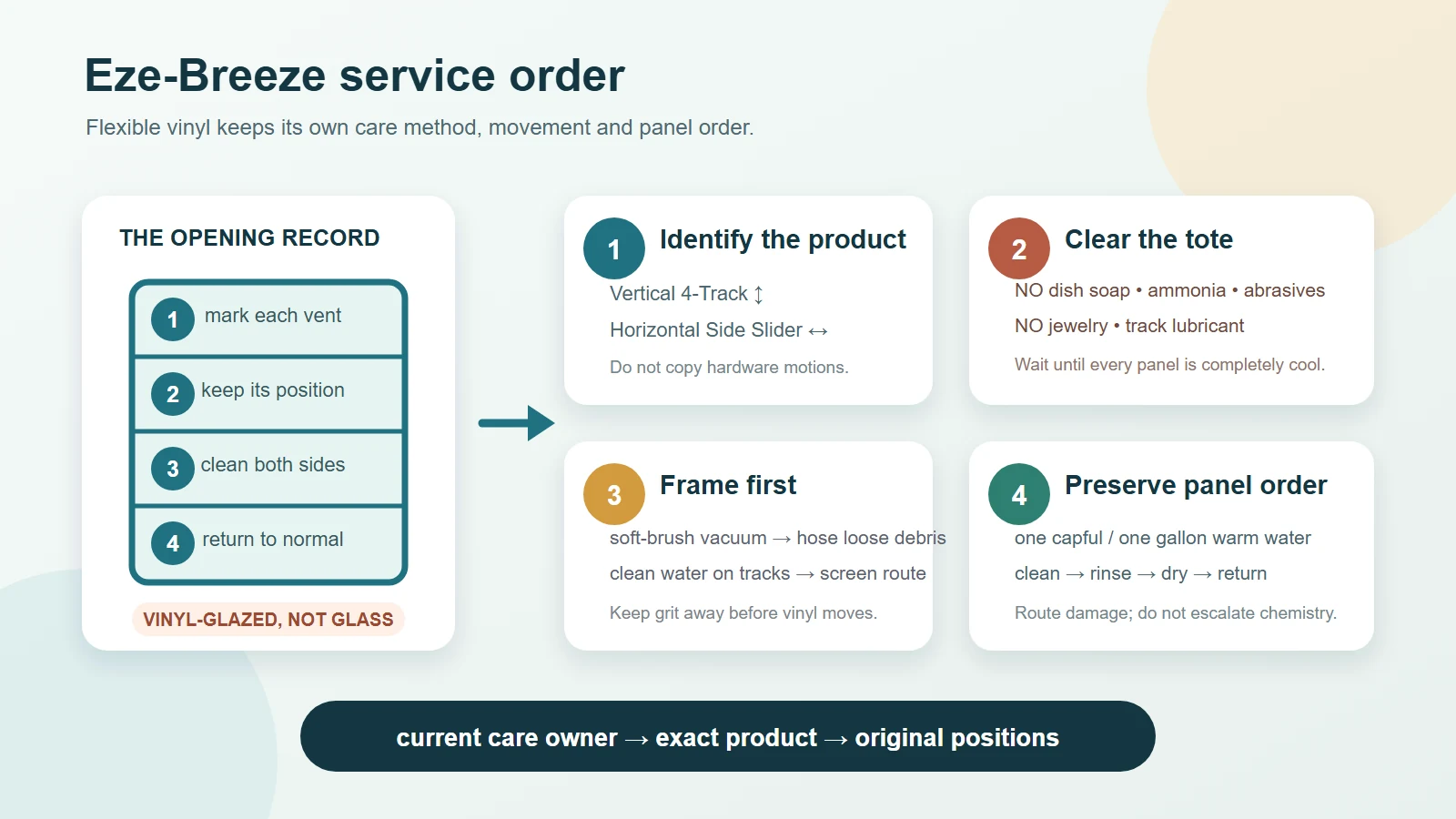
The current care route is specific: let the panels cool completely; remove jewelry and prohibited chemistry; vacuum the frame and hose away loose exterior debris; use a soft lint-free cloth with Woolite or Murphy Oil Soap at one capful per gallon of warm water; rinse and dry spot-free. Panel movement comes only after the exact product is identified.
Before arriving, ask for the product name and a photo of the opening. At the job, record the number and starting position of every movable panel. If the opening cannot be identified as a current Eze-Breeze product, leave the chemistry and hardware motion undecided.
Put the product name on the work order before the cleaner
The current Vertical 4-Track product page says its panels raise and lower and may use two, three or four vents. The current Horizontal Side Slider page describes two to ten vents moving left or right. A shared brand and material do not make those hardware motions interchangeable.
| Opening record | What the current owner establishes | Cleaning consequence |
|---|---|---|
| Vertical 4-Track, exact vent count known | Vinyl-glazed vents raise and lower; current care instructions show a matching tilt and removal path | The Vertical sequence may continue after the no-list and frame preparation close |
| Horizontal Side Slider, exact configuration known | Vinyl-glazed vents move left and right | Use the shared material-care fields, but do not import the Vertical latch, pin or tilt motion |
| Cabana Door or another Eze-Breeze product | The product family includes other frames and operating units | Obtain the exact configuration owner before moving or removing a panel |
| Clear flexible panel, product unknown | Appearance alone proves neither brand nor hardware | Hold product configuration; do not guess from a similar porch |
The transparent panel is flexible vinyl. Ordinary glass soap, a squeegee, a scraper, steel wool or a restoration chemical receives no permission from its position in the normal window-cleaning cart. Keep the broader professional window-cleaning tool setup outside this opening until the Eze-Breeze care owner admits each item.
Empty the glass-cleaning tote before you touch the vinyl
The current Eze-Breeze care guide starts with subtraction. Let every panel cool completely. Remove rings, bracelets, watches and anything else that may puncture the vinyl. Do not use alcohol- or ammonia-based products, dishwashing detergents or soaps, abrasives or other chemicals. Do not lubricate the main frame tracks or components.
| Item or condition | Current disposition | What replaces it here |
|---|---|---|
| Panel still warm from sun or ambient heat | Wait until completely cool | No universal wait time; recheck the actual panel |
| Rings, bracelets, watches or another puncture contact | Remove before handling | Clean hands and a cleared support area |
| Alcohol, ammonia, dishwashing soap, abrasive or other chemical | Keep off panels, screens and hardware | Only the current named solution and clean-water route |
| Scraper, steel wool, scrub pad or routine squeegee assumption | No inherited permission | Soft lint-free cloth under the current care method |
| Main-frame track lubricant | Do not apply | Soft cloth and clean water if the track needs wiping |
This is why the site’s repeatable window-soap batch does not transfer. The Eze-Breeze baseline is Woolite or Murphy Oil Soap, one capful to one gallon of warm water. Keep the cap as the published unit instead of inventing an ounce conversion.
Use a soft lint-free cloth, then rinse with clean water and finish dry and spot-free. The separate microfiber role guide can help reserve a clean physical cloth for the job; it cannot approve a detergent or turn an unknown cloth history into a vinyl-safe surface.
The frame gets cleaned before the first vent tilts
Loose grit must leave before vinyl moves across or rests near it. The manufacturer sequence begins by vacuuming the frame with a soft brush attachment. Hose loose dirt, dust and debris from the exterior. If the main-frame tracks or metal parts still need attention, wipe them with a soft cloth and clean water.
| Component | First action | Boundary that remains |
|---|---|---|
| Frame and recesses | Vacuum with a soft brush attachment | Do not drag collected grit onto the vinyl |
| Exterior panel faces | Hose away loose debris | The rinse does not authorize pressure equipment or an unlisted chemical |
| Tracks and metal parts | Soft cloth and clean water when needed | No track lubricant under the current care guide |
| Screens | Keep the exact screen supported and follow its care owner | Use the separate screen-cleaning decision rather than copying the vinyl wash |
| Unknown screen retainer or damaged frame | Leave it in place | Return to the exact screen-retainer removal path or the product owner |
The frame-first work is not housekeeping around the real job. It prevents grit from becoming a moving contact and makes panel resistance visible before a vent is carrying wash water.
On a Vertical 4-Track, panel order is part of the method
Only continue with this motion when the opening is a matching Vertical 4-Track. Start with the vents closed. Raise the bottom panel approximately one inch, release its thumb latches and tilt it onto a stable support. Lower the remaining panels to the bottom, raise the next panel by the same stated amount and tilt it onto the panel below. Repeat until the top panel faces up.
| Vertical 4-Track state | Recorded move | Release condition |
|---|---|---|
| Before movement | Photograph the opening; number each vent’s starting position | Exact product and vent count agree with the current owner |
| Bottom vent | Closed, raised about one inch, thumb latches released, tilted onto stable support | Hardware moves normally without forcing or brittle-part failure |
| Remaining stack | Lower to the bottom and repeat one vent at a time until the top faces up | Every vent remains supported and its position remains known |
| Exposed face | Clean with the named solution, rinse with clean water, dry spot-free | Return that vent to normal, then complete its opposite side and the remaining vents |
| Full removal, if the current job requires it | Use the Vertical-specific lower-pin release; mark each removed panel | Reverse the exact procedure to reinstall; do not transfer the motion to a side slider |
The care guide says its illustrated cleaning steps apply across Eze-Breeze products, but its hardware motion is written around the Vertical 4-Track. The current Horizontal Side Slider page proves a different left-right product. Carry the shared vinyl chemistry and gentle surface preparation across the family; carry a latch, pin, tilt or removal motion only when the installed hardware and its owner agree.
The optional final product has a naming conflict
The current webpage recommends Eze-Breeze Vinyl Cleaner. The currently hosted care PDF recommends Vinyl Protector & Preservative. Those names may reflect a rename, replacement or different products. The two owners do not prove which explanation is correct.
| Care field | Current evidence | Decision |
|---|---|---|
| Baseline wash | Both current owners state Woolite or Murphy Oil Soap at one capful per gallon of warm water | Executable when the other care conditions pass |
| Webpage optional product | Names Eze-Breeze Vinyl Cleaner | Record the name; do not infer the formula or substitute |
| PDF optional product | Names Eze-Breeze Vinyl Protector & Preservative | Record the name; do not treat it as the webpage product without proof |
| Bottle entering this job | Exact current label and authorized-dealer confirmation not yet attached to the opening | Hold the optional product; do not hold the separate baseline wash |
Ask an authorized Eze-Breeze dealer for the current exact product and label if that optional finish matters. A cart does not become more professional by carrying a branded bottle whose identity the work order cannot close.
Finish by restoring the opening, not by chasing every haze
Return every vent to its recorded position. Confirm latches and normal movement without forcing brittle or damaged hardware. Record any scratch, puncture, haze, brittle area, failed motion or stain that remains after the routine method.
Do not convert a remaining mark into permission for vinegar, abrasive work, glass polish or restoration chemical. The current Eze-Breeze warranty makes improper cleaning, harmful solvents, painting, coating and other aftermarket products consequential. It does not ask this article to decide a warranty claim; it gives a good reason to stop improvising.
| Closeout result | Use it when | What stays on the work order |
|---|---|---|
| Clean under current instructions | Product, material, cool state, no-list, baseline method and panel order all agree | Exact product, vent count, solution, both-side completion and returned positions |
| Hold product configuration | Brand, product, vent motion or hardware does not match the available owner | Photos and the missing product identification |
| Hold care preconditions | Panel is warm, puncture contacts remain, prohibited products are present or stable support is unavailable | The exact condition that must change before cleaning |
| Hold optional care-product identity | The bottle and current owner cannot resolve the Cleaner versus Protector & Preservative naming | Baseline care may finish; the optional product does not enter |
| Route damage to an authorized dealer | Scratch, puncture, haze, brittleness, failed hardware or an unknown stain remains | Location, photos, prior method and the unattempted escalation |
A clear panel is useful. An opening whose product, vent order and exceptions remain serviceable from the same record is the finished job.