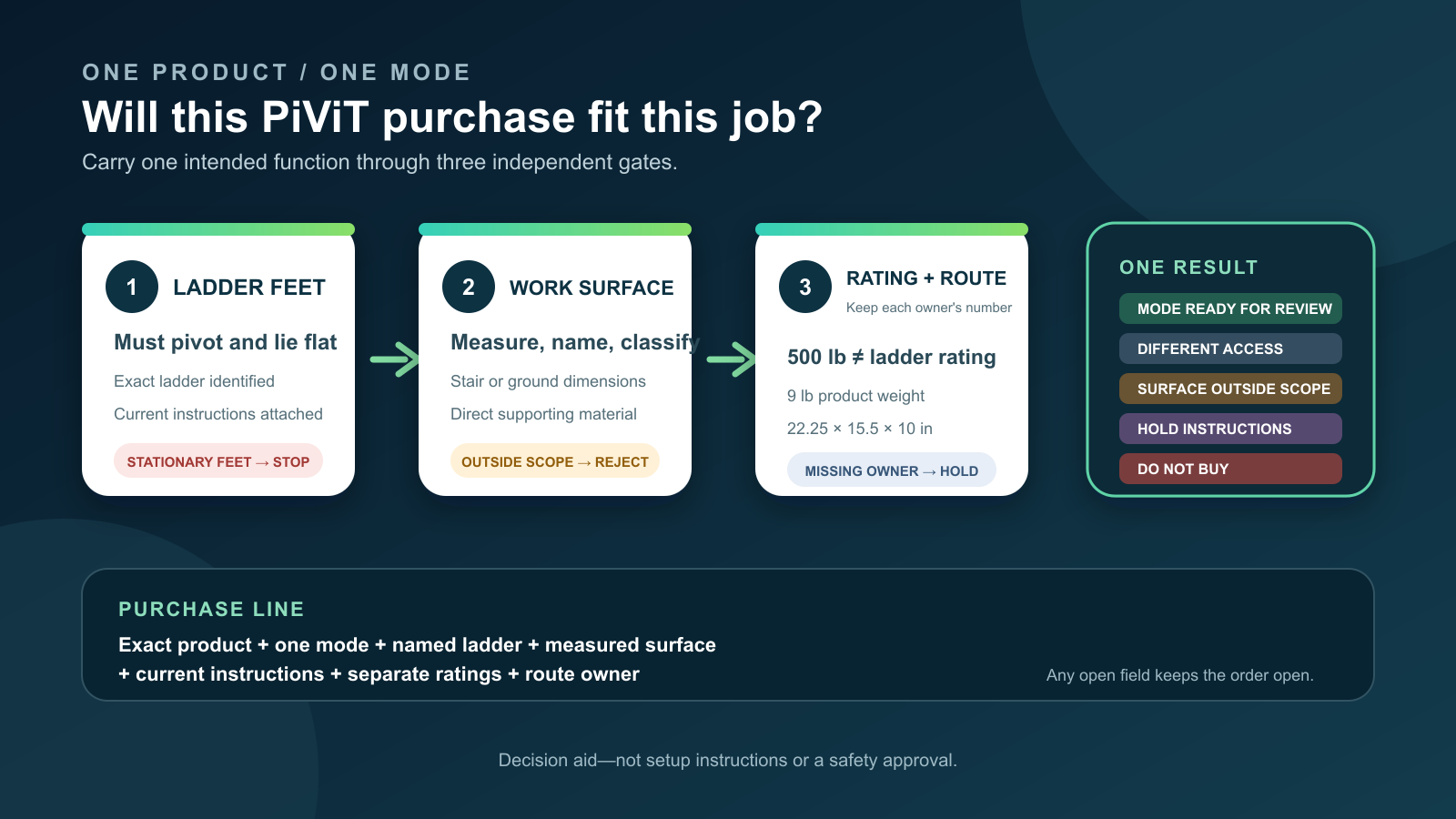
The PiViT Ladder Tool can fit a purchase only after you reduce its many advertised uses to one intended mode. For a leveling decision, that means the exact ladder has feet the manufacturer permits, the actual stair or ground matches the published surface boundaries, and the ladder’s own label and the job’s access plan still work.
There is an immediate rejection case: ProVisionTools says not to place the PiViT under the stationary feet of a step ladder or A-frame ladder. Its FAQ recommends feet that pivot and lie flat on the PiViT surface. A product photo, the word “leveler,” or the advertised 500-pound accessory capacity cannot override that foot geometry.
Start with the ladder you already intend to use. If its type, load, reach, condition or job authorization is not closed, use the window-cleaning ladder guide first. The PiViT decision begins only after that ladder remains a candidate.
One product page is describing several different purchases
The current ProVisionTools product page presents the PiViT as a leveler, ladder jack, stand-off, shelf and tool carrier, among other roles. Those labels describe different relationships between the accessory, ladder, work surface and load. They should not be combined into a general verdict that the product “works for the job.”
Write down the problem before evaluating the product. “Reach a second-story window” is still too broad. “Assess one manufacturer-described leveling mode for the named extension ladder on the measured stair” is a decision that can be checked.
| Advertised function | Question that function creates | Disposition for this purchase record |
|---|---|---|
| Leveling on a stair or uneven ground | Do the exact ladder feet and measured surface meet the current manufacturer boundaries? | Continue through this page’s foot and surface gates |
| Ladder jack | What current instruction, ladder pair, platform and load owners apply? | Open a separate mode record; do not borrow a leveling result |
| Stand-off | What contacts the building, and does the exact ladder/accessory combination fit? | Route to the ladder-standoff guide and current product instructions |
| Shelf or tool carrier | What load, retention and intended-use instructions govern the items carried? | Evaluate separately; no leveling conclusion transfers |
| Roof-related use | Is the surface within the maker’s named scope, and who owns the roof work method? | Outside this article; no roof setup or work authorization is provided |
A good result is deliberately narrow: one exact product, one mode and one job record. If the crew later wants a second function, it needs the instructions and evidence for that function.
The ladder feet can reject the accessory before the surface does
The ladder brand or broad style is not enough. The relevant observation is how the exact feet behave. The current manufacturer FAQ rejects stationary step-ladder feet and recommends only feet that pivot and can lie flat on the PiViT surface.
That makes the foot check a purchase gate, not a setup step. Read the ladder label and current instructions, identify the ladder configuration intended for the job, and observe the feet without assuming that similar-looking shoes have the same permission.
| Observed ladder record | PiViT fit result | Next purchase action |
|---|---|---|
| Stationary feet on a step or A-frame ladder | Outside the manufacturer’s stated foot condition | Do not buy it for this ladder/mode; select another authorized access method |
| Feet pivot and can lie flat on the accessory, with the exact ladder identity readable | Foot gate may continue | Measure and classify the actual work surface; keep current ladder instructions attached |
| Feet appear movable but cannot lie flat in the intended relationship | The maker’s stated condition is not met | Use a different ladder/access method; do not improvise an interface |
| Ladder identity, configuration, foot movement or instructions are unknown | No fit result is supportable | Hold the order until the exact owner evidence is available |
This gate also protects against a common shopping shortcut: buying the accessory first and trying to make the existing ladder fit later. The ladder remains the controlling object.
Surface fit has numbers, not just “uneven”
“Stairs” and “uneven ground” are descriptions, not measurements. The FAQ’s current stair reference is a 7.5- to 8-inch riser and a 10-inch tread. For uneven ground, it states a correction range from 0.5 to 13 inches. Record the actual dimension and surface before comparing it with those declarations.
The supporting layer matters too. The maker says the PiViT may be used on carpet, but says not to place paper or a drop cloth beneath it because the product must grip the direct surface. The same FAQ names asphalt shingles for its roof scope and excludes metal and tile roofs. This page treats those statements only as buy/hold/reject boundaries; it does not teach a roof method.
| Surface case | Evidence to record | Decision effect |
|---|---|---|
| Stair | Actual riser, tread, material, condition and current manufacturer instruction | Outside the named 7.5–8 in riser or 10 in tread reference returns a surface-scope hold or rejection |
| Uneven ground | Actual height difference, supporting material, stability and applicable site control | Below or above the named 0.5–13 in range is outside the declared correction range; inside it still needs all other gates |
| Carpet | Direct carpet contact, condition and current owner permission | The FAQ names carpet, but that fact does not authorize the ladder or the job |
| Paper, drop cloth or unknown layer beneath the tool | The intervening layer and why it would be present | Reject the proposed interface under the current FAQ; do not treat the layer as protection |
| Metal or tile roof | Surface identity only | Outside the manufacturer’s named roof scope; use another authorized method |
| Wet, contaminated, moving or unclassified support | Condition and the competent owner responsible for the access plan | Hold; a catalog dimension cannot close an unstable or unknown support condition |
A number inside a published range is not a green light. It means only that one rejection reason has not fired. The exact ladder, intended purpose, support condition, current instructions and responsible site owner remain active.
The 500-pound number belongs to the accessory
ProVisionTools states a 500-pound capacity for the PiViT when used as a ladder jack and on its ramps. That is not a new duty rating for the ladder, and it does not establish the capacity of every combined configuration. It is especially poor evidence for a leveling purchase if the selected ladder’s label, total load or intended-use record is missing.
For construction work within its scope, OSHA 1926.1053 keeps ladder load within the maximum intended load or manufacturer rating and requires ladders to be used only for their designed purpose. The practical purchasing lesson is to keep each owner’s number attached to its own object instead of choosing the largest number on the page.
| Object | Evidence owner | What the record may conclude |
|---|---|---|
| PiViT accessory | Current PiViT instructions and the manufacturer’s mode-specific rating | Whether the accessory remains within its stated mode and capacity |
| Exact ladder | Ladder label, manufacturer instructions and total supported load | Whether that ladder remains within its own type, purpose and rating |
| Combined access arrangement | Every current component instruction plus the competent job owner | Whether the exact combination is permitted; no single catalog number decides it |
| Window-cleaning job | Employer/site authority and the rules applicable to that work | Whether the access method is authorized at that location and time |
If the intended PiViT mode does not have a current instruction you can attach to the purchase record, the correct result is a hold—not a transfer of the 500-pound statement from another advertised role.
Nine pounds and a 22-inch footprint must live somewhere
The same FAQ lists the PiViT at 9 pounds and 22.25 inches long by 15.5 inches tall by 10 inches wide. Those are not incidental specifications for a route vehicle. Record the compartment or rack position, how the accessory is retained, the carry path through gates or stairs, and where a dirty or wet unit is isolated before it reaches other tools.
Nine pounds also joins the complete carried load; it does not replace the ladder weight. If ladder material and handling are still being compared, keep that decision in the fiberglass-versus-aluminum ladder comparison. Squeezing a PiViT into the vehicle is not enough if adding and retrieving it makes the selected ladder route unworkable.
A practical dry run can remain purely logistical: confirm the stated dimensions against the intended storage space and trace who loads, carries, cleans, inspects and returns the accessory. It should not become an improvised field setup or a substitute for the current product instructions.
Finish with one PiViT result, not a versatility score
The order record should contain an exact product identity, one intended mode, the named ladder and foot observation, the measured surface, the current instructions, separate ladder/accessory ratings, the job authority, and the 9-pound route footprint. Anything less leaves the purchase dependent on memory or marketing language.
| Result | When it applies | What happens next |
|---|---|---|
| Exact mode ready for owner review | One mode, exact pivoting/flat feet, measured in-scope surface, current instructions, separate ratings and route all close | The responsible owner may review the documented purchase; this page does not approve the job |
| Different ladder or access method | Stationary feet, incompatible foot behavior, unsuitable ladder or failed whole-ladder decision | Remove the PiViT from this job’s order rather than adapting the interface |
| Surface outside product scope | Measured dimension, material or supporting layer conflicts with the current owner statement | Choose another authorized method; do not average or round the boundary into a pass |
| Hold current instructions or site authority | Mode instruction, ladder identity, surface condition, applicable owner or combined-use permission is missing | Keep the order open until that exact evidence is supplied |
| Do not buy for this job | A hard conflict remains, the route has no workable storage/handling owner, or the accessory solves no authorized access problem | Reopen the full window-cleaning equipment decision and choose another access branch |
A defensible purchase line might read: “ProVisionTools PiViT LadderTool; leveling mode only; exact ladder and pivoting-flat foot geometry recorded; measured surface compared with the current FAQ; ladder and accessory ratings retained separately; current instructions and site owner named; 9 lb, 22.25 × 15.5 × 10 in route space confirmed.” If you cannot write that line truthfully, the product is not ready for this job’s order.