NOVUS #1, #2 and #3 look like a sequence. They are not a three-bottle permission slip. The current product family assigns #1 to cleaning and shine, #2 to fine scratches and #3 to heavy-scratch preparation. But the installed plastic owner can narrow that sequence—or reject every bottle in it.
For a purchase record, start with the plastic manufacturer, product line and exposed coating. Then classify the task, select one exact NOVUS number, attach that number’s current safety sheet and record the allowed method. #1 is the maintenance candidate, #2 the fine-scratch candidate, and #3 a heavy-damage preparation candidate before #2 and #1. Unknown, coated or owner-rejected plastic does not advance merely because a test spot looks acceptable.
The plastic name does not own the finish
“Acrylic,” “polycarbonate” and “plexiglass” are shopping words, not complete surface identities. Two clear panels can have different hard coats, films, laminates or care instructions. The useful first field is the current manufacturer and product line, followed by the cleaning-side finish.
Current material-owner documents show why. ACRYLITE’s care guidance permits plastic cleaner or polish within its acrylic-sheet scope and sends fine scratches to hand plastic scratch remover. Its deeper-scratch path is a more advanced sanding and buffing process—not an invitation to keep increasing product or pressure.
Plaskolite’s general TUFFAK guidance gives an even sharper split. It says fine scratches may be reduced with NOVUS #2 followed by #1 on the applicable surface, yet says abrasion-resistant coated products should not be buffed because the process can worsen damage, remove coating and create optical distortion. Its exact TUFFAK M5 compatibility table goes further: NOVUS #1, #2 and #3 are all listed as not compatible.
Those are not contradictory recommendations. They are different product owners controlling different surfaces. Record the exact owner before using a broad product page or kit to fill in the answer.
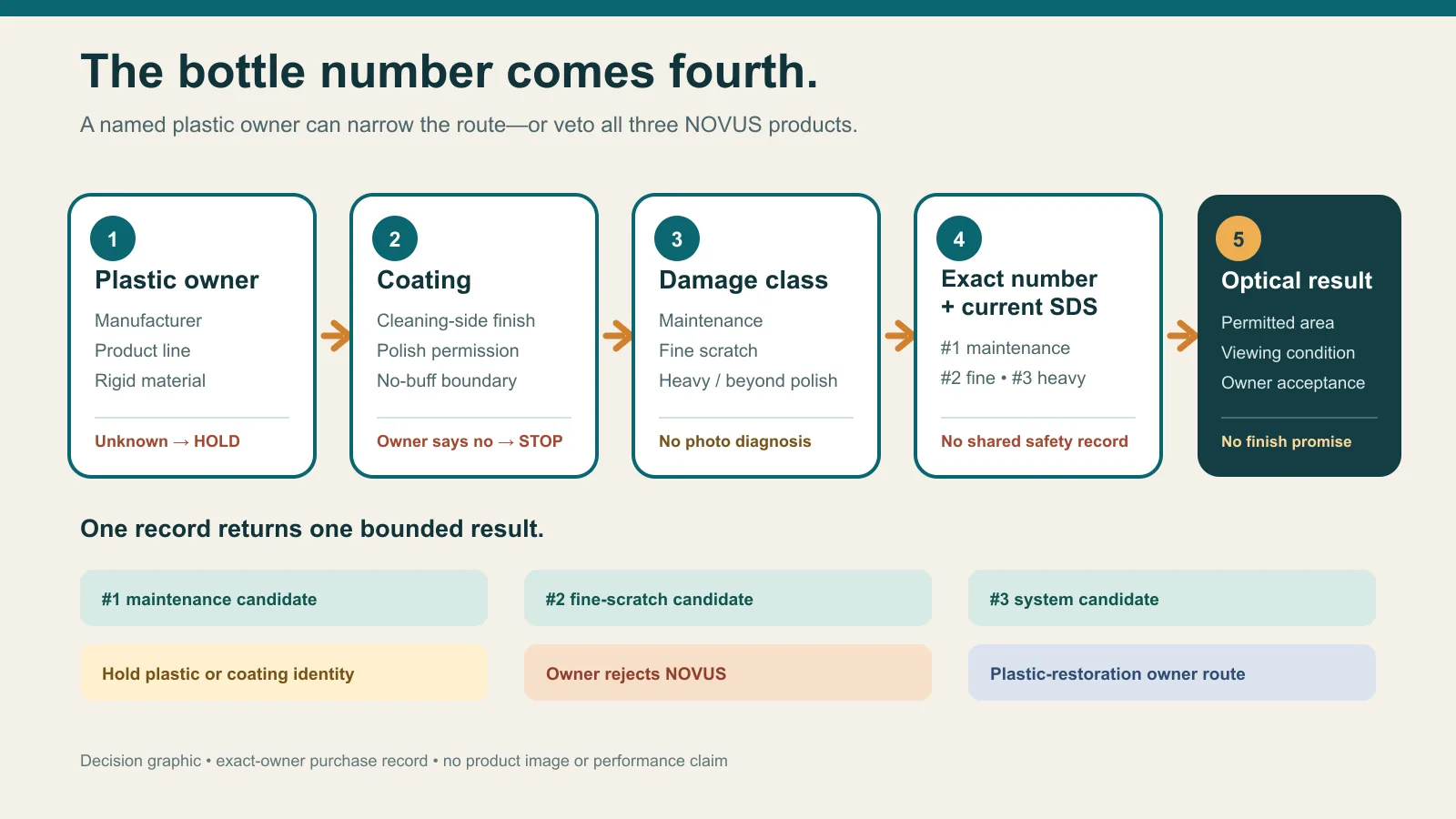
The map is intentionally one-way. A product role cannot flow backward and create surface permission. If the owner is unknown, hold the purchase. If the owner rejects polishing or the exact NOVUS family, use an owner-permitted care route or send the material to its service owner.
Flexible clear vinyl is a separate material decision. The Eze-Breeze cleaning guide keeps flexible-vinyl panel order, cleaning method and damage limits with that system’s owner; it is not a substitute compatibility record for rigid acrylic or polycarbonate.
#1 is not the middle ground
Once the surface is eligible, choose the number by task rather than by package size or the assumption that every job begins at #1.
| Exact product | Owner-stated role | Purchase implication | What remains open |
|---|---|---|---|
| NOVUS #1 Clean & Shine | Clean and shine for hard plastics | Maintenance candidate on an owner-permitted surface | It does not inherit #2’s exact role; the selected container still needs its current label and SDS |
| NOVUS #2 Fine Scratch Remover | Fine scratches and abrasions | Fine-scratch candidate after owner permission and damage classification | A photo alone does not prove the damage is fine; coated-plastic restrictions still apply |
| NOVUS #3 Heavy Scratch Remover | Heavy-damage preparation before #2 | System candidate only where the owner permits the sequence | Deep gouges, coating loss or optical distortion may already be outside the polish route |
The current #1 page also uses fine-scratch language in its marketing. That does not erase the family’s exact #2 role. When owner pages overlap, preserve the narrowest identity: one task, one selected bottle, one current label and one safety sheet.
A kit is inventory, not a diagnosis. Window Cleaning Resource currently identifies its NOVUS kit as SKU 302-30-12 and offers 2-ounce and 8-ounce choices containing all three products. Buying all three does not prove that the installed surface accepts any of them or that the observed damage needs the complete sequence.
The seller page also says the products contain no abrasives, while the same page warns against coated plastics and NOVUS’s own tips explicitly discuss abrasive action in #2 and #3. Do not average those sentences into “probably safe.” The material owner and current manufacturer documents control the decision.
The safety sheets split the family again
A three-bottle kit does not have one interchangeable safety record. NOVUS currently publishes separate 2025 SDS documents for #1, #2 and #3, each tied to a different use.
| Exact number | Current SDS identity | Decision-relevant distinction |
|---|---|---|
| #1 | Issue/revision February 25, 2025, version 1.0; clean and shine for hard plastics | Not GHS-classified, while still naming ventilation, suitable gloves and safety glasses or goggles |
| #2 | Issue/revision February 25, 2025, version 1.0; clean and restore plastic surfaces | Signal word Danger; skin- and eye-irritation, carcinogenicity and repeated-exposure classifications, with named protection and ventilation controls |
| #3 | Issue/revision February 25, 2025, version 1.0; heavy scratch remover for hard plastics | Not GHS-classified, while still naming ventilation, suitable gloves, eye protection and protective clothing |
That difference changes job acceptance. It is not a reason for this page to prescribe gloves, a respirator or a ventilation plan for a particular site. The responsible worksite owner uses the selected bottle’s current label and SDS, the real exposure conditions and the applicable hazard assessment. The purchasing rule is simpler: if the exact number and current document are not attached to the order line, the job is not ready.
Do not let “not classified” become “no controls.” The #1 and #3 sheets still contain handling and protection language. Do not let the stronger #2 classification migrate to the other bottles either. Each record stays with its exact product.
A test spot cannot overrule a coating
NOVUS tells users to keep the plastic cool, remove dust and dirt, and test in a small inconspicuous area. That sequence begins only after the installed plastic owner permits the product and method. A hidden area can reveal an optical result on one permitted surface; it cannot validate an unknown material, waive a no-buff instruction or reverse the TUFFAK M5 compatibility result.
Record the proposed contact materials as well. Cloths and bonnets carry product and residue from one step to another. The microfiber-cloth guide treats task role and contamination ownership as purchasing fields; “clean cloth” is not evidence that the same cloth can move between maintenance, abrasive work and final finishing.
Powered work is a separate branch. NOVUS’s current tips mention a power buffer for larger or badly damaged areas, separate clean cotton bonnets for each product and low speed around 1,000 RPM to avoid overheating. That is a manufacturer condition, not universal authorization. An abrasion-resistant coating owner may still prohibit buffing; the job still needs the exact tool, pad or bonnet, operator and heat-control plan. This page does not turn the number into a buffer setup instruction.
If only manual work is owner-permitted, keep the purchase record manual. If the exact plastic owner permits powered polishing, preserve that authority and the responsible worksite controls separately. Missing either answer returns a hold rather than an improvised method.
Finish on an optical result, not a bottle number
The order and job record should end in a named disposition. It should not end with “try #3 next” simply because a mark remains.
| What the record proves | Outcome | Next move |
|---|---|---|
| Exact plastic and finish permit maintenance; no scratch-removal task is established; #1 label, SDS and method are closed | #1 maintenance candidate |
Order the exact #1 container only if the responsible owner accepts the job record |
| Exact owner permits polishing and classifies the condition as a fine-scratch task; #2 controls are closed | #2 fine-scratch candidate |
Keep the result limited to the permitted area and owner acceptance |
| Exact owner permits heavy-damage preparation and the #3 → #2 → #1 sequence; exact documents and methods are closed | #3 system candidate |
Record each exact product and method instead of treating the kit as one line |
| Plastic product, coating or cleaning-side finish is missing | Hold plastic or coating identity |
Obtain the owner document before buying or testing |
| Exact owner rejects buffing or lists the NOVUS products as incompatible | Owner rejects NOVUS |
Choose the owner’s permitted care method; do not test around the veto |
| Deep scratch, gouge, coating loss, optical distortion or result lies outside the exact polish scope | Route to plastic-restoration owner |
Stop escalating number, speed, pressure or repeat count |
Glass does not enter this table. If the damaged surface is glass, the cerium-oxide and glass-restoration decision has different process, coating, training, heat and optical-acceptance owners. If the issue is a mineral deposit on glass rather than plastic damage, the Bio-Clean decision keeps that product and deposit-versus-etch boundary separate.
The last useful field is the owner-accepted optical result: exact viewing conditions, permitted area, what changed, what did not, and whether coating or distortion appeared. Without that result, this page cannot promise restored clarity. With it, the business can make the next purchase decision without asking a bottle number to answer a material question.
In the professional tool-stack plan, NOVUS belongs under the installed-material record, not under a generic glass-cleaning chemical list. The order line is complete only when it names the plastic owner, coating, damage class, exact number, current SDS, method and accepted result. If the plastic owner closes the route, none of the three labels reopens it.