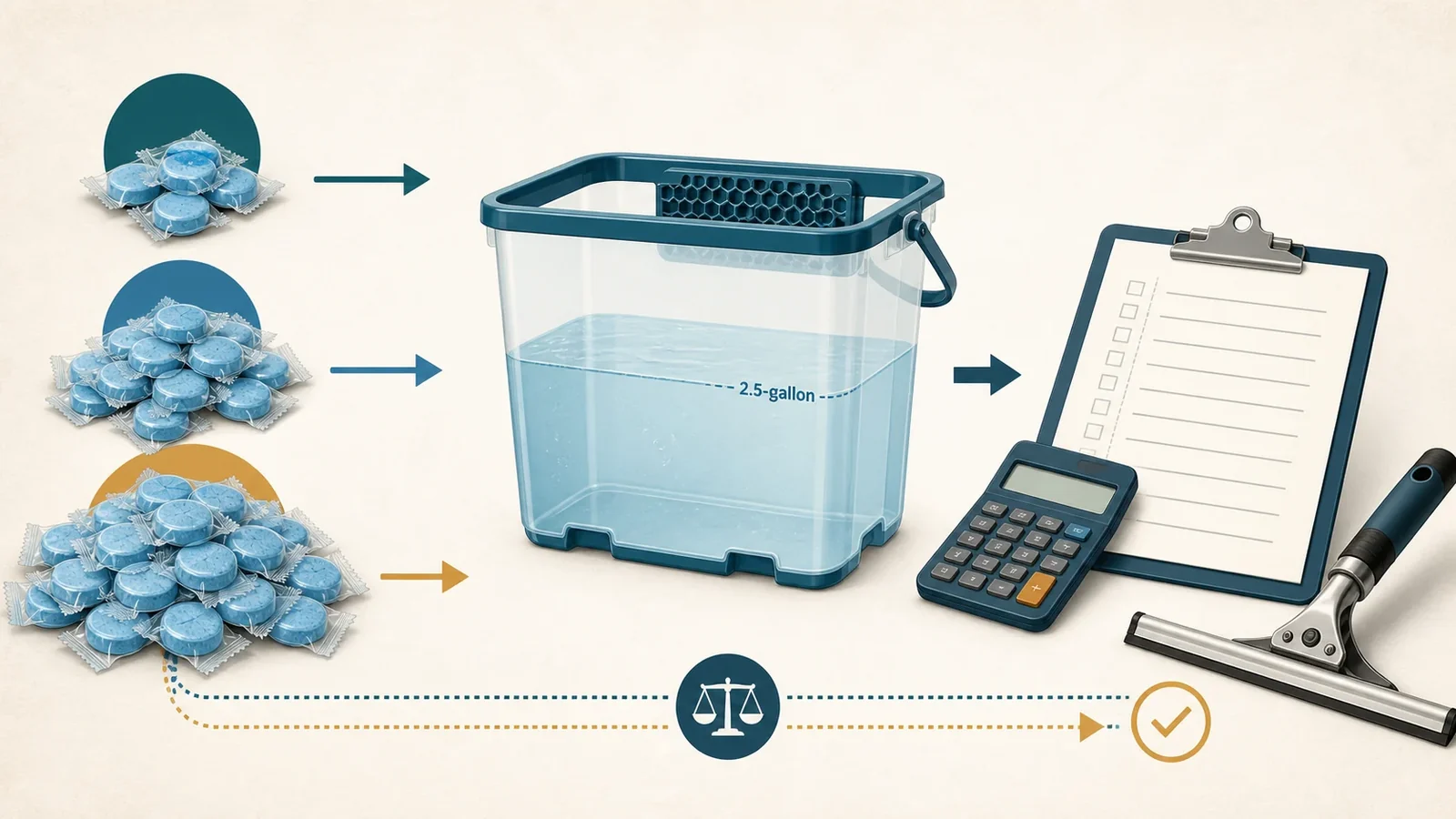
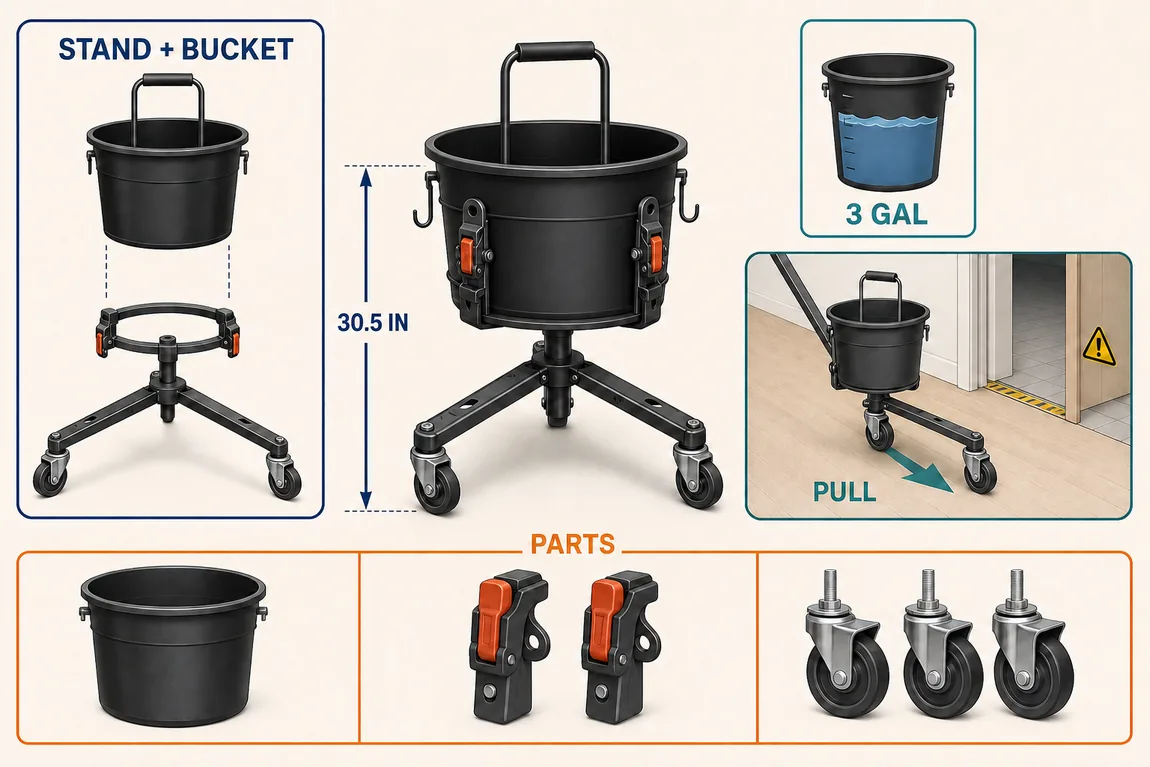
Hi Slide should not be the first correction poured into a troublesome bucket. It is a glide additive for an existing soap-and-water solution, not the cleaner itself and not a repair for damaged rubber.
The current Cliche Chemicals Hi Slide product direction starts at 2 teaspoons per US gallon of working solution. It names a separate branch—2 additional teaspoons per gallon for direct sun or razor work—and says the product goes into the bucket solution rather than the soap bottle. Those numbers become useful only after the exact primary cleaner, the water actually in the bucket, the exposed surface and the squeegee condition are known.
If the cleaner or surface permission is unknown, do not calculate a batch. If a line repeats at the same point on the rubber or the strip moves in its channel, return to the tool. If the existing permitted mix already stays workable for the intended pass, there is no problem for this additive to solve.
In a complete professional window-cleaning setup, this is a narrow consumables decision. Hi Slide does not choose the squeegee, washer, scraper or access method.
A dry pane and a bad blade can feel alike at the handle
“Chatter” describes an effect at the tool. It does not name the cause. A pane can become too dry for the intended pass, but a dirty edge, a nick, a loose strip, an unsuitable base mix or a surface-specific restriction can also change how the squeegee feels.
Observe the pattern before opening another bottle.
| What is actually observed | Owner of the next decision | Hi Slide disposition |
|---|---|---|
| The known, permitted base solution loses its usable wet film before the planned pass across comparable panes; the rubber is clean, fixed and visibly intact | Working condition and additive record | An exact Hi Slide batch may be evaluated |
| A narrow water line starts at the same point on the rubber after the edge is cleaned | Rubber edge and channel record | Diagnose the edge; do not use additive as a parts repair |
| The strip creeps sideways, protrudes unevenly or chatters while visibly moving | Retention system | Restore the exact clip or lock before changing chemistry |
| Drag appears only over adhesive, paint, mineral deposit or another localized contaminant | Surface and treatment owner | Ordinary wetting additive does not close the contaminant |
| The known solution remains workable and the squeegee pass is controlled | Existing route | No additive is required for the recorded condition |
The same-position line and moving-strip branches belong in the squeegee-rubber replacement diagnosis, where edge, profile and retention are separated before an order. A direct-sun pane is not an excuse to skip that check.
Razor work needs another owner as well. Hi Slide’s current direction mentions a conditional extra dose for razor work, but that wording does not authorize a blade on the installed glass. The window-scraper decision must first establish that the exact exposed surface permits the proposed method and that the holder, blade and protection parts are identified.
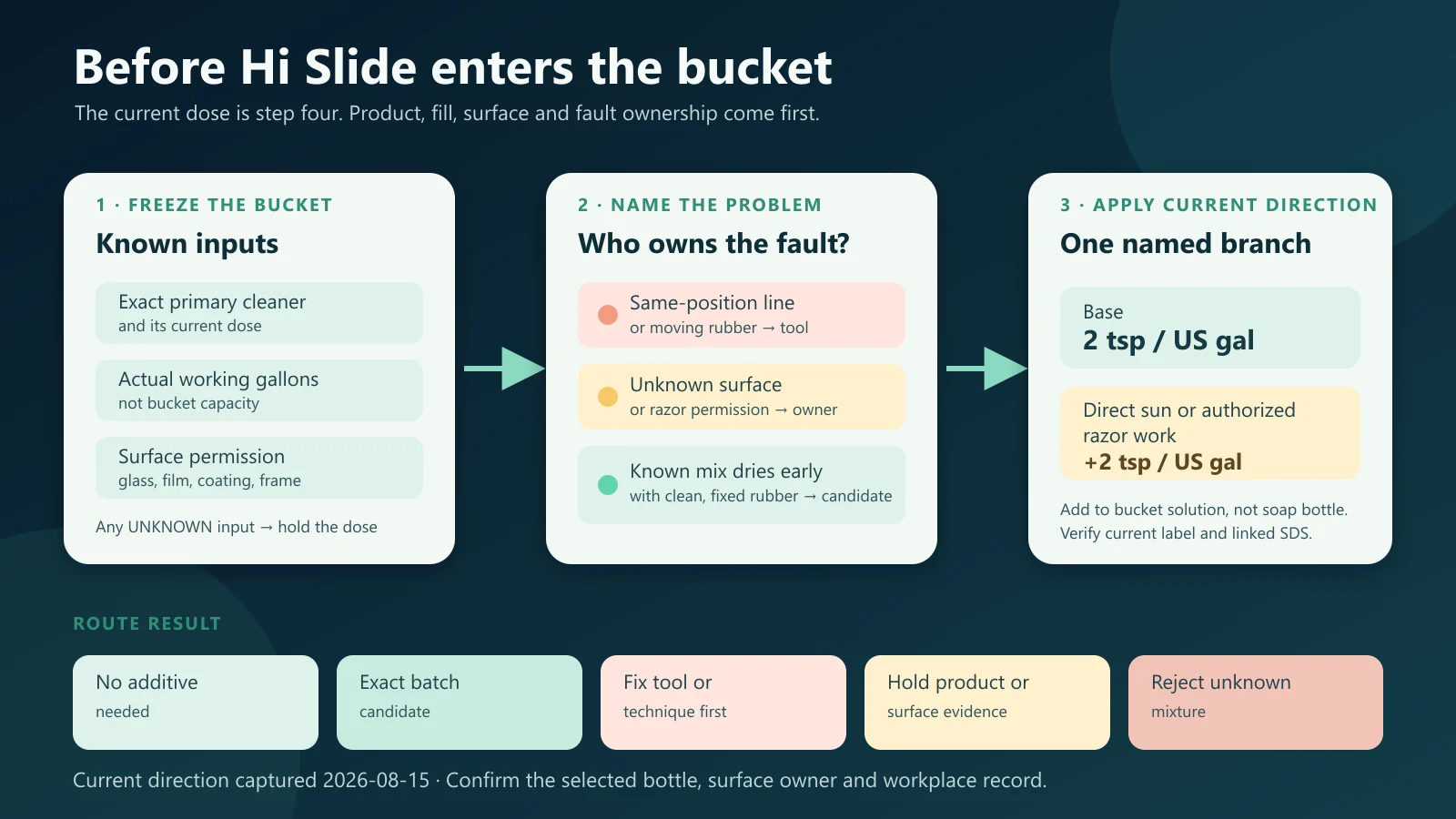
The current direction has two branches, not a flexible range
The exact product page gives a base direction and a named conditional increment. It does not publish an open-ended “2 to 4 teaspoons depending on preference” range.
| Actual water in the bucket | Base direction: 2 tsp/gal | If the current direct-sun or authorized razor-work branch applies: add | Total for that named branch |
|---|---|---|---|
| 1 US gal | 2 tsp | 2 tsp | 4 tsp |
| 2 US gal | 4 tsp | 4 tsp | 8 tsp |
| 3 US gal | 6 tsp | 6 tsp | 12 tsp |
| 4 US gal | 8 tsp | 8 tsp | 16 tsp |
| 6 US gal | 12 tsp | 12 tsp | 24 tsp |
A 6-gallon bucket holding 3 gallons uses the 3-gallon row. Capacity is not working fill. For that ordinary base branch, the record is 3 US gal × 2 tsp/gal = 6 tsp. Only a named current condition moves the same 3-gallon bucket to 6 tsp base + 6 tsp conditional increment = 12 tsp total.
Keep teaspoons as teaspoons. There is no need to introduce a second measuring unit when the current direction and the route measure agree. Recheck the bottle if its wording differs from the captured product page.
This page also assumes the base cleaner has already been selected and mixed under its own current direction. The window-cleaning soap batch guide owns that earlier step, including product role and actual working-fill arithmetic. Hi Slide supplies an additive line beneath that cleaner record; it cannot fill in a missing cleaner name or ratio.
Keep the change at the bucket boundary
The seller’s current Q&A says to add Hi Slide to the bucket solution, not directly to the soap bottle. Following that boundary preserves the identity of both concentrates and makes the route change visible.
Before addition, the line should already show:
exact primary cleaner — its current dose — actual US gallons — exposed surface permission — rubber/retention status — route condition
Then add one Hi Slide field: exact product, amount and whether the base or named conditional branch supplied it. Do not premix it into an unidentified soap bottle, where the next user can no longer recover either product’s dose. Do not treat the product-page statement that it can join a window-cleaning solution as proof that every cleaner, film, coating, frame finish or seal permits the combination.
Where the surface owner and workplace procedure allow a representative-pane observation, keep the rest of the route fixed. Record whether the intended pass retained a workable wet film, whether chatter changed, and whether residue or another unwanted result appeared. That observation belongs only to the exact pane group, mixture, tool and conditions recorded. It does not become a universal performance claim.
If the result is poor, go back to the first changed field instead of pouring again. An unknown cleaner or surface produces an evidence hold. A visible rubber or retention fault exits to the tool owner. A condition outside the current product direction is not permission to invent another increment.
The safety sheet belongs beside the bottle
WindowCleaner.com currently links an exact Hi Slide safety data sheet. The document identifies a liquid mixture and is printed September 3, 2021. That date matters: the live link makes it the current document offered by this seller, but the selected bottle and responsible workplace owner still need to confirm that it is the controlling sheet for the product on the route.
The SDS uses the signal word “Warning” while also stating that no hazardous materials are present under its GHS classification section. It separately describes possible eye, skin and respiratory irritation. Reducing those lines to “harmless” would discard the document’s own controls.
For this exact sheet, the route record should carry protective gloves and chemical goggles or a face shield, the label, and the response information appropriate to the workplace. Storage is in the original closed container in a cool, dry, well-ventilated place, protected from freezing. The sheet also says to avoid environmental release and prevent entry to sewers or public waters.
Those are handling and storage fields, not reasons to alter the dose. The product direction owns the teaspoons; the current label, SDS and workplace owner control use, storage and response. If the bottle, label or regional document does not match the 2021 sheet, stop and obtain the current record rather than blending the two.
Write the purchasing result on the route line
The purchase can now end in one of five places without a generic best-product verdict.
No additive required is the honest result when the permitted base mix remains workable for the intended pass. Exact Hi Slide batch candidate means the cleaner, actual gallons, surface, tool and named condition all close, so the current teaspoon line can be recorded. Fix rubber or technique first keeps a same-position edge fault, moving strip or uncontrolled pass from becoming chemical demand.
Hold product or surface evidence applies when the selected bottle, current direction, SDS, cleaner, film, coating or adjacent finish cannot be matched. Reject unknown mixture applies when the contents or proportions already in the bucket cannot be reconstructed; adding another product would make the result less interpretable.
A closed route line looks like this:
Primary cleaner and dose — 3.0 US gal working fill — Cliche Chemicals Hi Slide SKU 284-30-05 — 6 tsp base, or 12 tsp total only with the named current condition — surface owner — rubber/retention check — SDS date — representative-pane result — next route decision.
Keep that line with the bucket record. If any field changes, the previous result no longer decides the next batch.