The tank is the easy part. The hidden fluid path decides the purchase.
“Chemical resistant” does not name a liquid, a concentration or a complete sprayer. It may describe selected seals while saying nothing useful about the hose, shutoff, wand, nozzle or residue left from the last fill. Two sprayers can hold the same number of gallons and belong to different chemical families. Two listings can even appear to describe the same sprayer while disagreeing about its capacity and current product number.
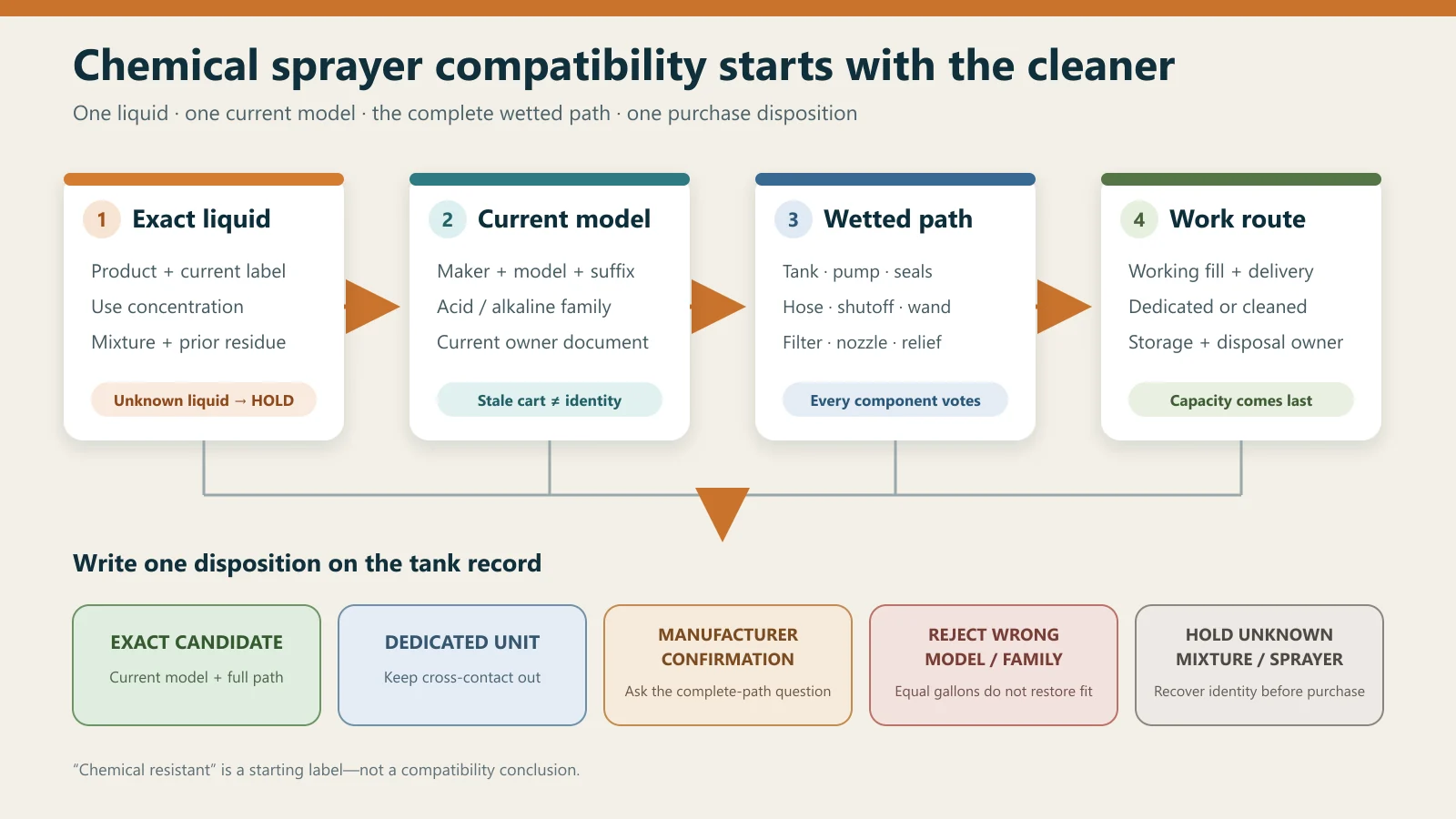
Start with the exact cleaner. Then ask its current owner and the exact sprayer manufacturer whether that liquid, at the intended concentration, may contact every wetted component in that model. If the answer covers only a seal material, a broad chemical class or a stale seller title, the purchase record is not finished.
Name the liquid before comparing tanks
Write the liquid record without using “general cleaner,” “acid wash” or “chemical mix” as a substitute for identity. The useful fields are:
[manufacturer and exact product] / [current label and SDS] / [use concentration] / [single product or mixture] / [known residues from previous fills] / [temperature and duration in the equipment] / [surface and job already authorized by its owner]
This page does not decide whether the cleaner belongs on the glass. The window-cleaning soap decision owns the ordinary bucket-cleaner route. OneRestore, Bio-Clean and Cleansol BC each keep their own product, surface and use boundaries. A sprayer cannot lend permission to a cleaner that has not passed its own job record.
Concentration matters because a manufacturer’s compatibility table may name both the substance and a maximum guide concentration. Mixture status matters because ingredients can change compatibility when combined, and because residue in a previously used tank makes the next fill a mixture in practice even when the new label names one product.
The current SOLO CLEANLine industrial catalog makes that distinction visible. Its table gives selected substance and concentration guidance for named models, then says those guide values are not suitable for mixtures of different chemicals. The table is a model-owner resource, not a permission slip to interpolate a blend.
If the exact liquid or concentration is missing, stop shopping by capacity. The next useful action is to recover the current product document or ask the cleaner manufacturer for the exact intended-use identity. There is no defensible sprayer query until the liquid is known.
Every wetted part gets a vote
A pump sprayer is a chain of contact surfaces. The liquid may touch the tank wall, dip tube, piston or diaphragm, seals, valves, hose, shutoff, wand, nozzle and pressure-relief components. It may also remain in threads, filters or dead spaces after the tank looks empty.
Record the complete path for the exact model—not a representative photo and not another size in the same brand family.
| Wetted-path field | Evidence to capture | Purchase effect |
|---|---|---|
| Tank and pump body | Exact material from the current model owner | Reject if the liquid owner or sprayer owner excludes the material |
| Piston, O-rings and gaskets | Material, part number or current replacement kit | One named elastomer supports only its declared scope |
| Dip tube and internal valves | Material and whether the manual includes them in compatibility | Missing identity becomes a manufacturer question |
| Hose | Liner/material, fittings and current model association | A compatible tank cannot rescue an excluded or unknown hose |
| Shutoff and wand | Wetted metals, polymers, springs and seals | Exterior appearance does not reveal internal contact materials |
| Nozzle and filter | Material, pattern, orifice and service parts | Compatibility and usable spray pattern must both close |
| Pressure relief | Current model design and release instruction | Required for the work route; not proof of chemical compatibility |
| Previous fill | Exact prior liquid and validated cleaning/dedication rule | Unknown residue returns a mixture hold |
The current Tolco Model 942 page identifies product 150300, a 2-quart (1.9-liter) sprayer with a Viton O-ring and piston cup, an adjustable stream-to-fine-mist nozzle and a foamer tip. Those are useful exact-product facts. They do not establish that every fluid-contact part accepts every cleaner that can coexist with Viton.
That is why “Does this sprayer have Viton seals?” is too small a manufacturer question. Ask:
For [exact cleaner], used at [concentration] with no other product mixed in, does current model [manufacturer, model and suffix] permit contact through its complete tank, pump, seals, dip tube, hose, shutoff, wand, filter and nozzle? Which current compatibility table or manual controls, and does the unit require dedicated use?
A useful answer identifies the current model and document, not just a material class. Keep the answer with the sprayer’s label and replacement-parts record. A compatible original seal does not guarantee that an unverified replacement kit preserves the same path.
Acid and alkaline model names are not interchangeable
Current manufacturer families show why gallon size should not lead the comparison.
SOLO’s current CLEANLine category separates A models intended for acidic agents from B models intended for alkaline agents. In the current catalog, the A line uses FKM seals and the B line uses EPDM seals. The 305-A and 305-B are both listed at 1.5 gallons and 45 psi; the 307-A and 307-B are both listed at 2 gallons and 45 psi. The shared capacity and pressure do not merge the suffixes.
| Current owner example | Published family role | What it can decide | What it cannot decide |
|---|---|---|---|
| SOLO 305-A / 307-A | Acid A family with FKM | Put an identified acid candidate in the correct family for a matrix check | Approve an unlisted acid, mixture or another model |
| SOLO 305-B / 307-B | Alkaline B family with EPDM | Put an identified alkaline candidate in the correct family for a matrix check | Approve every high-pH cleaner or transfer B facts to A |
| SOLO foamer models | Separate foam-oriented family | Preserve foam output as an exact-model requirement | Turn a standard spray model into a foamer |
| Chapin 22251XP | Exact acid-staining/acid-cleaning model | Evaluate one named acid route under this model’s current owner | Admit bleach, caustic solution or a different Chapin model |
These rows are examples of owner logic, not a universal elastomer chart. Temperature, concentration, exposure duration, formulation, other wetted materials and the exact model still matter.
The current Chapin 22251XP product page makes an equally important point. It describes a two-gallon acid-use sprayer with acid-resistant seals, a ceramic nozzle and a pressure-relief feature. The same owner tells users not to spray flammable, chlorine/bleach, caustic or other named corrosive or reactive solutions in that model. “Acid resistant” is not “all harsh chemicals.”
Chapin also warns that using multiple chemicals can create cross-contamination even after cleaning. For a company that routinely carries more than one chemistry, a dedicated sprayer may be the cleanest purchase decision. Color or a handwritten nickname can support identification, but it does not replace the exact product/model label and the owner-approved dedication rule.
An obsolete two-gallon title hides a two-quart identity
A seller cart can surface a product and still fail to identify what should be purchased.
The current J. Racenstein URL for item 515-039 carries the title “Pump Sprayer 2 Ga, Chem Resistant,” but the page marks the item obsolete. Its body describes a Tolco Model 942 with a 64-ounce, two-quart tank and lists MPN 150012. Tolco’s current manufacturer page describes Model 942 as product 150300 with 2-quart (1.9-liter) capacity.
| Identity field | Specialist cart | Current manufacturer page | Decision |
|---|---|---|---|
| Status | Obsolete | Current product page available | Do not use the cart as a current purchase target |
| Title capacity | 2 gallons | 2 quarts / 1.9 liters | Conflict; title cannot close size |
| Body capacity | 2 quarts / 64 ounces | 2 quarts / 1.9 liters | Capacity aligns only at the body level |
| Product/MPN | 150012 | Product 150300 | Conflict; exact package identity is unresolved |
| Model name | 942 | 942 | Shared name does not erase the other conflicts |
This is not a reason to choose or reject Tolco as a brand. It is a reason to discard the stale cart as final authority. If Model 942 remains a candidate, begin from the current manufacturer identity and find a current authorized route that returns the same product number, capacity, components and documents. If those fields do not converge, the outcome is manufacturer compatibility confirmation or hold—not “close enough.”
The conflict also shows why a search result title should never populate a fleet record by itself. Record the model label on the actual unit or current manufacturer-controlled product, then attach the cart only after it resolves to that identity.
Capacity comes after compatibility
Once chemistry and identity pass, capacity becomes a real operating decision.
Rated capacity is not automatically the planned working fill. The job may need headspace, a smaller batch to avoid storage, or a lower carried mass for the route. Record the batch volume from the cleaner owner, the sprayer’s marked capacity, the manufacturer’s fill limit, the liquid’s approximate mass and the distance the unit must be carried. Do not invent a fill rule from the article.
A larger tank may reduce refills and increase the amount of chemical that must be carried, contained, transported and disposed of. A small dedicated unit may cost less to isolate yet require more refill cycles. A foamer, fan pattern or extension may matter more than another half-gallon if the exact job requires that delivery mode and the current model owner permits it.
Capacity also changes the consequence of an error. An unknown residue in a two-quart unit is still a compatibility problem; more gallons only scale it. Resolve the mixture and fluid-path questions before using productivity to break a size tie.
The complete sprayer also sits inside a larger work setup. The professional window-cleaning tools guide owns the rest of the job-ready kit. This page does not select access equipment, authorize a surface, prescribe protective equipment or validate runoff merely because the sprayer fits the liquid.
Write the tank label before filling it
The tank label should be writable before money or chemical enters the unit:
[exact cleaner] / [use concentration] / [single-product or mixture status] / [sprayer manufacturer, model and suffix] / [current compatibility owner and revision] / [working fill] / [dedicated or owner-approved cleaning route] / [one disposition]
Choose only one disposition.
| Disposition | Evidence required | Purchase action |
|---|---|---|
| Exact sprayer candidate | Exact liquid/concentration, current model identity, complete wetted-path compatibility, usable delivery mode and closed work route | Preserve the owner documents and verify the current purchasable cart before ordering |
| Use a dedicated chemical sprayer | Exact model passes the liquid, but cross-contamination or repeated-use control makes sharing unacceptable | Assign one clearly identified unit and replacement-parts record to that liquid under the owner’s rules |
| Manufacturer compatibility confirmation | Liquid and candidate model are known, but a concentration, component, suffix, mixture statement or document is missing | Send the complete-path question; do not substitute a broad “chemical resistant” reply |
| Reject wrong model or seal family | Current owner excludes the chemical family, named solution, concentration or required component | Remove that exact model from the comparison; equal capacity does not restore it |
| Hold unknown mixture or sprayer | Product, concentration, prior residue, model label, seller identity or wetted path cannot be resolved | Quarantine the equipment decision until the missing identity has a current owner |
A good chemical sprayer record is narrower than a product category and more useful than a material slogan. It names one liquid, one current model and every part between the tank and the spray.
If that full line will not fit on the tank label, it is not ready to enter the tank.