Lay the rope grab, lifeline and lanyard labels side by side. If the manufacturer, model, rope construction or system role changes between them, the purchase is not resolved.
A rope grab is not a free-standing piece of fall protection. It is the moving connection between a named vertical lifeline and the lanyard or harness side of an approved system. A familiar shape, a seller category or a 5/8-inch marking cannot carry the rest of that identity with it.
The earlier roof-harness decision owns the approved access method, body support and complete-system plan. The roof-anchor decision owns the building and anchorage record. This page begins after both boundaries: it decides whether one exact grab belongs on one exact lifeline with the named connector chain. It does not teach installation, orientation, movement, inspection technique or rescue.
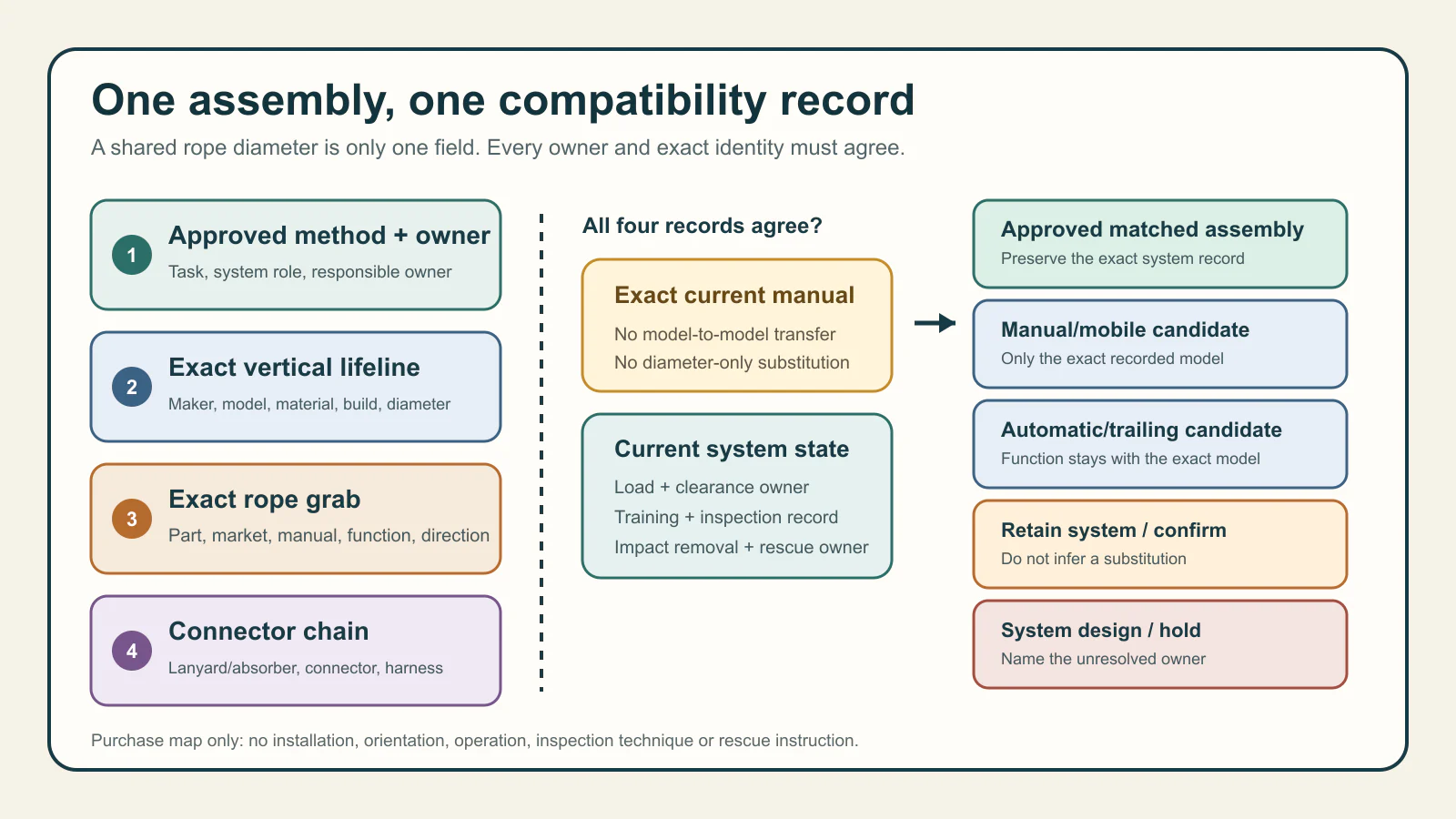
The short answer is to preserve one unbroken record: approved method and system owner; exact lifeline manufacturer, material, construction and diameter; exact grab manufacturer, model, market and current manual; operation and required direction; named lanyard or energy absorber, connector and harness; and the training, inspection, impact-removal, clearance and rescue owners. The first missing or conflicting field decides the hold.
Start with the lifeline label, not the moving metal
OSHA’s fall-protection technical guidance describes a vertical lifeline as the line anchored above the worker, while the rope grab or sliding fitting connects that line to the lanyard and harness chain. That division matters in procurement: the rope and grab are separate objects, but their compatibility belongs to one system decision.
The same guidance warns that components can look alike without being interchangeable and calls for a compatibility assessment when manufacturers or product lines are mixed. OSHA 1910.140 also keeps compatibility, inspection, removal after an impact and prompt rescue attached to covered personal fall-protection systems. Neither source supplies a universal rope-grab table. They explain why the buyer needs the exact current owner record.
| Record | Exact evidence to preserve | What cannot replace it |
|---|---|---|
| Approved method and owner | Exact task, system role and employer plus competent or qualified owner as applicable | A product category or familiar brand |
| Vertical lifeline | Manufacturer, family/model, material, construction, labeled diameter and current instructions | Diameter alone or visual rope color |
| Rope grab | Manufacturer, part/model, market, current manual, function and owner-stated direction | Shape, finish or the word automatic |
| Connector chain | Named lanyard or energy absorber, connector, full-body harness and approved anchorage record | A generic lanyard already in the truck |
| Current system state | User/load and clearance record, training, inspection, impact-removal, rescue and end-of-line owners | Original receipt or past familiarity |
A missing field is not a request for a more universal-looking grab. If the rope has no recoverable manufacturer/model identity, if the current manual cannot be found, or if the proposed grab comes from a different system family without written compatibility evidence, retain the approved assembly or route the exact combination to its manufacturer or qualified owner.
Person count belongs to that same record. OSHA’s technical guidance says a vertical lifeline generally supports one worker. Buying a second grab does not create a second approved user path on an existing line. If the plan changes the number of people, lines or anchor relationships, the system owner must close that changed design before another component can be selected.
Five-eighths of an inch is not a compatibility result
Diameter is necessary when the exact manual says it is. It is not sufficient because two ropes can share a nominal diameter while differing in manufacturer, material, construction, strength record and the grab model permitted on them.
Current exact products make the contradiction visible. Guardian publishes SKU 01508 for 5/8-inch rope and states that its fall-arrest use requires a shock absorber integrated into the rope or connecting device. In the current 3M Protecta Cobra manual, AC202D is limited to named 3M-branded 5/8-inch three-strand nylon/polypropylene-blend rope and named lanyard/force limits. AC202A10 is also a 5/8-inch model, yet its named rope is three-strand polypropylene and its integral lanyard remains part of that exact contract.
| Exact current owner record | Published rope or connector scope | Safe purchase reading |
|---|---|---|
| Guardian 01508 | 5/8-inch rope; stated fall-arrest use requires a shock absorber in the rope or connecting device | Keep this exact model, rope and absorber boundary together |
| 3M Protecta AC202D | Named 3M-branded 5/8-inch three-strand nylon/polypropylene-blend rope plus model-specific lanyard/force limits | Do not transfer its fields to another Cobra model |
| 3M Protecta AC202A10 | Named 3M-branded 5/8-inch three-strand polypropylene rope and its integral lanyard | Treat the integral lanyard as part of this exact identity |
Those are three scoped identities, not a ranking. Guardian’s diameter does not approve either 3M rope. AC202D’s lanyard permissions do not transfer to AC202A10. A seller’s phrase “for 5/8-inch rope” cannot prove the missing manufacturer, construction, operation or connector-chain fields.
A published rope-strength value does not repair the mismatch. Strength belongs to the exact rope record; compatibility also depends on how the named grab and connector chain are authorized to work with it. Two components can each carry credible individual ratings and still lack evidence that they form the approved assembly being purchased.
3M’s current cable-and-rope-grab category reinforces the distinction at category scale. It separates rope and wire/cable products, manual and automatic operation, multiple diameters, and models with different lanyard arrangements. Its vertical-lifeline manual maps exact lifeline models to exact grabs and warns that substitutions can jeopardize compatibility. A filter can narrow the catalog; only the exact model/system record can close the purchase.
The lanyard and current part number finish the record
The grab’s function changes what must be named next. Manual, mobile, automatic/trailing and panic-related descriptions are product contracts, not synonyms. The current owner may also assign a direction, orientation, compatible lanyard length, energy absorber, connector or maximum arrest-force boundary to that exact model. Record those fields; do not infer how to operate the device from this comparison.
Lifecycle matters too. MSA currently presents rope lifelines and rope grabs as a system between compatible body support and suitable anchorage, while approvals can vary by configuration, part and country. Its current category marks guided panic part 10113287 discontinued and exposes other distinct product identities. A discontinued label does not identify a replacement, and an available-looking part does not prove successor compatibility.
J. Racenstein’s current rope-grab category is useful for window-cleaning commercial context and exact item identity. It separates anti-panic/lanyard and fall-arrest categories and lists specific product sizes and configurations. That is enough to freeze what a buyer saw. The cart still cannot approve a cross-brand lifeline, supply a training record or decide the job’s clearance and rescue plan.
The confirmation request should name the exact lifeline label and manual; exact grab part/model, region and current manual; stated function and direction; exact lanyard or absorber and connectors; harness and anchorage system; user/load and clearance record; training status; inspection and impact history; end-of-line treatment owned by the instructions; and rescue responsibility. Ask whether that complete assembly is approved as recorded. Do not ask whether the grab is “generally compatible” with the diameter.
That request separates procurement from operating readiness. A written match can identify the only candidate worth advancing, but the responsible employer and system owners still retain training, pre-use and periodic inspection, removal after an impact, clearance and rescue decisions. The article never turns a compatible purchase candidate into permission to put the system into service.
Let the first mismatch decide the purchase
| Disposition | Evidence that closes it | Purchase action |
|---|---|---|
| Approved matched assembly | The approved method and current complete-system record already name this lifeline, grab and connector chain | Preserve the exact assembly; replace only under its current owner record |
| Exact manual or mobile candidate | Current manual, rope material/construction/diameter, function, direction and connector chain all agree | Request this exact model for final system-owner approval |
| Exact automatic or trailing candidate | The same exact records close and the owner specifically names the automatic/trailing function | Keep that function attached to this model; do not substitute by label |
| Retain current system or obtain manufacturer confirmation | A cross-brand, successor-part, rope-construction, lanyard or current-model question remains | Do not swap; send the complete identity record to the responsible owner |
| Qualified-person system design or hold | Method, owner, lifeline identity, load/clearance, training, inspection, rescue or another system field is unresolved | Do not place the rope-grab order until that named system gap closes |
Keep the compatibility card beside the professional window-cleaning equipment plan. The rope grab enters an order only after the lifeline, exact model, lanyard and responsible complete-system owner all describe the same assembly.