Do not choose a bird poop cleaner from the stain alone. The first purchasing fact is how much material is present and what the proposed work may disturb.
One isolated mark on a known window can remain a surface-care problem. An exterior ledge with repeated layers, dry residue, roosting evidence or material likely to become airborne is a different job. NIOSH tells employers at roost sites to restrict the area, determine the extent of contamination and consider the amount and location, the structure, weather and nearby people. That assessment happens before a bottle enters the comparison.
There is no universal spot count or square-foot cutoff in the guidance. Use the condition in front of you and the responsible employer’s plan. If the scale, dryness, disturbance path or surface is uncertain, the purchasing result is a hold.
The mess chooses the lane before the cleaner does
| What is actually present | Shopping lane | Result before any cleaner comparison |
|---|---|---|
| One isolated mark; exact glass or coating is known; no accumulation, dusty residue or disturbance path | Ordinary surface care | Use the glass owner’s ordinary cleaning route first. A special cleaner is optional, not assumed. |
| Limited deposits on an exact hard, nonporous or otherwise named surface; current product page, label and SDS are available | Exact cleaner candidate | Compare one product record against that exact surface and the job’s controls. |
| Repeated accumulation, dry or dusty material, a roost area, material that may be disturbed, or nearby public or worker exposure | Contaminated-area plan | Stop routine product shopping. Restrict and assess the work under the responsible employer or qualified owner. |
| Unknown amount, dryness, surface or coating, product identity, document version, runoff or disposal authority | Named hold | Record the missing fact and the person or authority who can close it. |
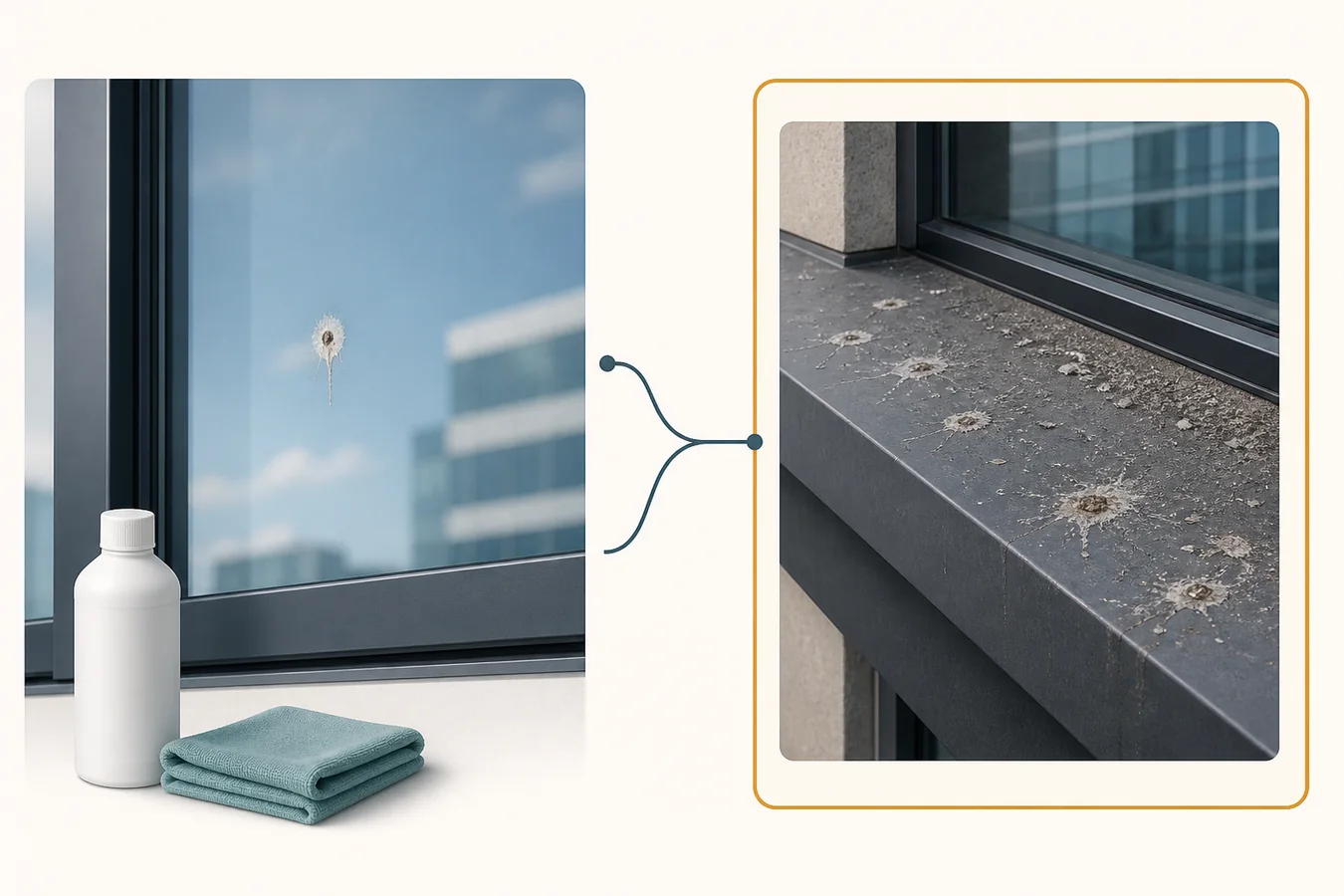
The four rows are not a cleanup procedure. They decide whether product comparison is admitted. They also prevent the opposite mistake: treating every small mark as a contaminated site when an owner-approved ordinary window route would close the job without another chemical.
A spray bottle cannot turn an accumulation into a routine spot
NIOSH’s current histoplasmosis guidance is deliberately about the work environment, not a preferred cleaner. It says work-related histoplasmosis often involves disruption of bird or bat droppings. At a roosting site, the planning questions include the extent and location of the material, building condition, weather and whether people are nearby.
That is why dry and likely to be disturbed belong on the purchase record. NIOSH says not to shovel or sweep dry, dusty material and discusses wetting as a way to reduce aerosolization when removal is required. It also says potentially contaminated waste must be disposed of under the applicable state and local requirements. This article does not turn those points into a removal, respiratory-protection or disposal method. They show why the employer and site plan must exist before an accumulated-area cleaner is selected.
A product page can own the identity and stated scope of a liquid. It cannot determine whether a ledge is a roost site, who may enter the area, what workers could inhale, where runoff may go or which waste rule applies. Enzyme, microbial, green and non-toxic are not substitutes for those owners.
If the work is genuinely one isolated spot, keep the answer proportionate. Identify the surface and use its ordinary care instruction. If the mark remains and the owner permits another cleaner class, then compare an exact bottle. The special product must earn its place; the query does not make it mandatory.
Current cleaners do not describe the same job
The current public records below are not interchangeable, and this is not a ranking.
| Exact record | What the current public owner says | Purchase limit |
|---|---|---|
AIRZYME Waste Digester, SKU DISAZ-1GAL |
The live Bird B Gone page describes a one-gallon product for accumulations and names roofs, ledges, window sills, I-beams or girders and areas near HVAC. | Its linked SDS is revision-dated 2015, identifies product code 83-9919 and lists the relevant use as Deodorant. Reconcile the exact current label, SDS and container before treating the live page as the complete record. |
Evo Blend Microbial Bird Dropping Cleaner, SKU BX-EVO |
Bird-X describes a one-gallon microbial cleaner for buildup on hard, nonporous surfaces and names roofs, awnings, decks, patio umbrellas and boat covers. | Hard, nonporous does not identify an architectural glass coating. The inspected application list does not explicitly name glass, so the exact surface still needs current owner confirmation. |
| Winsol Dirty Bird seller records | WindowCleaner.com and J. Racenstein currently sell product records for organic waste on several building or washable surfaces. | These are specialist merchant records. They prove commercial availability and query relevance, not a current manufacturer permission for a named glass or coating or a biological decontamination result. |
AIRZYME shows why all three documents matter. The live product page, the linked label and the linked Airzyme SDS each own a different part of the record. The SDS says the mixture is not GHS classified, but it also contains glove, eye and respiratory-protection fields, tells users to prevent entry to sewers and public waters, and calls for disposal under local or national rules. Not classified cannot be edited into harmless, safe for every site or safe for every surface.
Evo Blend creates a different boundary. Its current owner identifies hard, nonporous applications and publishes precise dilution and equipment directions. Those directions become relevant only after the exact job and surface are admitted. A roof or deck example does not transfer to film, a factory coating, sealant or every exterior window assembly.
Dirty Bird presents the merchant-authority problem. Current window-cleaning suppliers are useful evidence that professionals encounter and buy the category. Seller descriptions still do not replace a current manufacturer label and SDS. WindowCleaner.com’s own answer also distinguishes waste digestion from disinfecting. Do not add a disinfection promise because the underlying soil is biological.
Glass permission belongs to the exposed surface
Washable and nonporous are broad material descriptions. A commercial pane can expose bare glass, applied film, an exposed low-e coating, a protective treatment or an etched finish. The cleaner meets that exposed layer first.
For an isolated mark, identify the window product and cleaning side. Read the surface owner’s current care instruction before treating a bird-dropping product’s broad surface language as permission. The site’s Magic Eraser on glass decision shows the same ownership rule for abrasive contact: knowing the substrate is glass does not reveal the exposed finish or authorize another contact material.
Keep adjacent materials in the record too. Sill coating, frame finish, sealant, gasket, wall cladding and runoff route can have different owners from the pane. A cleaner admitted for one hard nonporous target does not automatically inherit the entire window opening.
Equipment is a later question. If an exact cleaner survives the scale, surface, label and employer gates, the chemical sprayer compatibility guide can bind the exact concentration to every wetted tank, seal, valve, hose, wand and nozzle. A compatible sprayer cannot repair an ineligible surface or an unresolved contaminated-area plan.
The ordinary glass route remains a real outcome. When the surface owner supplies a suitable cleaning method and the job is one limited mark, there may be no business reason to add a specialty gallon, a new sprayer or a disposal burden. Buying less equipment can be the complete decision.
Put one surviving outcome on the equipment plan
Ordinary surface route. One isolated mark is on an exact, owner-documented surface. Use the owner’s ordinary care method; do not add a specialty product unless the remaining soil and current surface permission justify it.
Exact cleaner candidate. The material is limited, the exact surface is named, and the product page, label, SDS, employer controls and runoff or disposal owners agree. Record the exact SKU and document dates. This admits a purchase comparison; it does not claim a cleaning result.
Contaminated-area plan required. Accumulation, dry dust, disturbance, roosting context, uncertain extent or nearby exposure moves the job out of routine product shopping. The responsible employer or qualified owner must classify and control the work before a cleaner is compared.
Hold the line item. A scale, surface, coating, product identity, label or SDS version, employer owner or disposal answer is missing. Name the missing owner instead of filling the gap with seller adjectives.
Write the surviving record as: [job scale and condition] on [exact surface], with [exact product and current documents or ordinary care owner], under [employer and disposal owner] → [one outcome]. Then attach only that result to the professional window-cleaning equipment plan. A cleaner without that sentence is not purchase-ready.