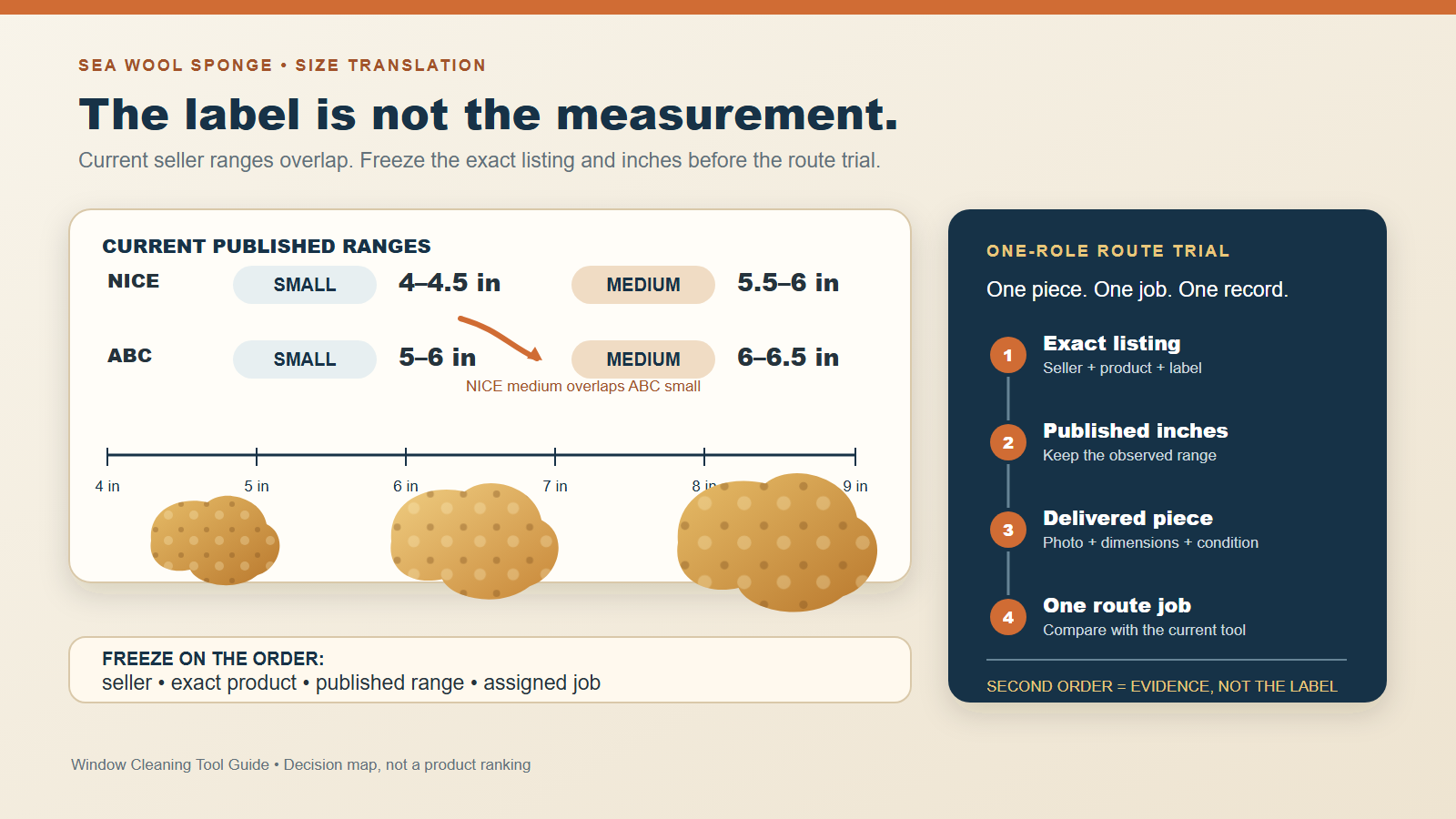
A “small” sea wool sponge is not a standard size. One current professional listing calls 4–4.5 inches small; another calls 5–6 inches small. Their medium options differ too. If you shop by the dropdown word, you are not comparing like with like.
Choose the exact seller and published inch range first. Then give one delivered natural piece one defined job—such as French-pane detail work or frame and track work—and compare it with the tool already doing that job. Do not place a bulk order from the size label alone.
This is a narrow addition to a professional window-cleaning tool setup, not a replacement for the whole stack. A sea wool sponge earns a place only when the exact listing, received piece and route role all agree.
“Medium” is not a measurement
The current NICE Natural Sea Wool Sponge listing publishes small at 4–4.5 inches, medium at 5.5–6 inches and large at 7–8 inches. The current ABC Natural Sea Wool Sponge listing publishes small at 5–6 inches, medium at 6–6.5 inches, large at 6.5–7 inches, XL at 7–7.5 inches and jumbo at 7.5–8.5 inches.
| Exact listing | Seller label | Published size | What the label cannot prove |
|---|---|---|---|
| NICE Natural Sea Wool Sponge | Small | 4–4.5 in | That another seller’s “small” is comparable |
| NICE Natural Sea Wool Sponge | Medium | 5.5–6 in | A unique medium-size band |
| NICE Natural Sea Wool Sponge | Large | 7–8 in | Which ABC label is equivalent |
| ABC Natural Sea Wool Sponge | Small | 5–6 in | That it is smaller than NICE medium |
| ABC Natural Sea Wool Sponge | Medium | 6–6.5 in | The same hand fit or shape as another piece |
| ABC Natural Sea Wool Sponge | Large / XL / Jumbo | 6.5–7 / 7–7.5 / 7.5–8.5 in | A one-to-one match with NICE large |
| New England 4S / #103 | Product number | 5 in nominal | Equivalence to either seller’s named size |
The overlap is the buying issue. NICE medium reaches 5.5–6 inches, while ABC small reaches 5–6 inches. NICE large spans inches covered by more than one ABC label. The New England Natural Sponge 4S/#103 listing adds a nominal 5-inch professional-use option without trying to call it the universal “small” or “medium.”
Write the seller, product name and inch range on the same line. “One medium sea wool sponge” is an incomplete order record; “NICE Natural Sea Wool Sponge, medium, published 5.5–6 inches” can be checked later.
Give the sponge one route job
A size becomes useful only in relation to a job. NICE declares tracks, frames, French panes and detailing for its listing. ABC declares windows, detail work, French panes, frames, tracks and sills. New England names windows, frames and moldings for its #103 product. Those are seller-declared roles, not independent proof that any one piece will outperform the tool already on your route.
| Possible role from an exact listing | Current-tool alternative to record | Useful trial question |
|---|---|---|
| French-pane or divided-light detail work | The applicator, cloth or detail tool currently used | Does this exact delivered piece fit the assigned panes and handling pattern? |
| Frame, molding or sill work | Current damp-wipe or applicator method | Does it close the defined frame job without creating a second unclear role? |
| Track work | Current track brush, cloth or extraction step | Can the piece enter the actual track geometry and release collected debris under the exact care path? |
| General “window cleaning” with no named step | Not yet named | Do not trial yet—name the route step first |
Keep the assignment narrower than “washing windows.” If microfiber already owns detailing, use the microfiber role and rotation plan to name that alternative. The sponge does not automatically inherit every wet-work, scrub or finishing task just because a seller places it in a window-cleaning catalog.
The delivered piece still has to earn its place
Natural material adds a second comparison: the item received. NICE notes that natural-piece size may vary. Acme’s natural-sponge overview separates wool, yellow and grass sponge types and describes wool as one of the softest types. That type description does not authorize the piece for every coating, film, finish or debris condition.
On arrival, retain the order identity and photograph the piece beside a ruler. Record its dimensions and shape as received. If the exact seller’s directions support preparation for use, repeat the measurement in that working state; otherwise do not invent a soak, bleach, peroxide or drying routine to make the record look complete.
Check integrity and embedded debris before first contact, and keep the first trial inside the surface and task authority you already have. This article does not claim scratch-free use, a service life, a hygiene outcome or better absorbency than a synthetic sponge or cloth. Those results must come from the exact route trial, not the word “natural.”
| Record | Ready entry | Hold condition |
|---|---|---|
| Listing identity | Seller, exact product and ordered label | Product or type cannot be matched |
| Published range | The inches shown on that exact listing | Only “small,” “medium” or “large” is published |
| Delivered piece | Photo, dimensions, shape, integrity and visible debris | The piece cannot be inspected or identified |
| Working-state note | State and preparation allowed by the exact seller directions | Preparation or care authority is missing |
| Assigned surface/task | One supported route role and known surface boundary | The trial would extend into an unverified coating, film or debris condition |
Make the second order from the trial, not the label
The trial card needs both the candidate sponge and the incumbent tool. If the current tool already closes the route step cleanly, quickly and predictably, “keep current tool” is a valid result. A natural sponge does not need a permanent belt slot merely because the first piece was usable.
| Trial field | What to enter | Why it changes the decision |
|---|---|---|
| Exact seller and listing | Seller, product, ordered label and order reference | Stops facts from migrating between listings |
| Published inch range | The current range copied with its observed date | Makes the next order reproducible |
| Delivered dimensions and condition | Photo and measurements in the recorded state; integrity/debris note | Natural variation becomes visible rather than assumed away |
| One assigned job | Exact route step, surface boundary and frequency | Prevents a vague all-purpose verdict |
| Current-tool alternative | Tool/process already used for the same step | Creates a real keep-or-replace comparison |
| Exact care authority | Seller/manufacturer direction used; no borrowed recipe | Makes upkeep part of the route cost and repeatability |
| Observed route result | Fit, handling, debris release and added process steps—only what was actually observed | Separates trial evidence from catalog language |
| Disposition | Use it when | Next action |
|---|---|---|
| TRIAL ONE EXACT LISTING | The listing publishes inches, declares the selected role and supplies an exact product/care identity | Order one piece and complete the delivered-piece record before expanding |
| KEEP CURRENT TOOL | The incumbent already closes the role, or the delivered piece adds no useful route advantage | Do not create a duplicate role or permanent carrying slot |
| HOLD UNPUBLISHED DIMENSION | The seller provides only a size word, identity is uncertain, or task/surface/care authority is missing | Get the exact inch range or authority before ordering |
Only after the piece earns a repeated route job should it enter the tool-belt load decision. The useful name on that record is not “medium sponge.” It is the exact listing, published range, delivered-piece description and job it proved it can own.