A winter glove only has to feel warm while it is sitting in the truck. Ten minutes later, that same hand may need to close around a wet squeegee, fold a detailing cloth into a clean edge, hold a screen by its frame and work a pole lock. Those movements do not ask the glove for the same thing.
Glacier Outdoor currently puts several waterproof neoprene models in front of that decision. Kenai Waterproof is nylon-lined. Ice Bay adds fleece. Perfect Curve adds fleece, pre-curved fingers and a wrist strap. They are three construction branches, not a good-better-best warmth scale.
The short answer is to name the hardest hand movement on the route, identify one exact model, measure around the working hand’s knuckles using the current chart, and keep wet entry, edge wear and chemical protection as separate fields. If the cart does not preserve those facts, the brand name is not enough to order from.
Start with the hand that has to finish the edge
Cold-weather window cleaning mixes full-hand grip with much smaller movements. A water-fed pole asks the hand to hold and reposition a shaft for long periods. A traditional set asks for a stable squeegee grip, then a precise cloth fold at corners. Screen work adds repeated contact with frames and mesh edges. A scraper, broken edge or chemical task can introduce a different protective requirement entirely.
Write the route by movement before comparing gloves.
| Route moment | Hand movement to preserve | Exposure to record | What would reject the pair |
|---|---|---|---|
| Water-fed pole work | Sustained full-hand grip, clamp operation and hose handling | Wet pole, outdoor cold, cuff position and route duration | The actual pole controls cannot be operated cleanly or the wet path enters above the glove |
| Squeegee pass | Repeatable handle angle and controlled pressure | Wet handle and solution contact | Grip changes when wet or the handle cannot be released normally |
| Detailing the edge | Cloth pinch, fold and corner reach | Wet cloth and fine frame contact | The user cannot present a clean cloth edge without fumbling |
| Screen handling | Broad grip plus fingertip placement | Frame corners, mesh edge and repeated abrasion | The glove contacts a sharp edge or develops visible damage |
| Chemical or sharp-tool task | Whatever motion the task requires | Exact chemical, blade, broken glass or cut hazard | The exact glove lacks the required documented protective rating |
This keeps the glove page in its lane. The site’s high-window tools guide decides whether a job stays on a ground-based method. Belay, ladder or access risk does not become acceptable because a glove improves grip. Likewise, the microfiber cloth guide owns the cloth’s route role and care; this page asks only whether the gloved hand can still fold and place that cloth.
These three models are branches, not a warmth ladder
The current manufacturer pages provide enough construction detail to make a shortlist, but not enough to award an all-route winner.
| Current model | Published construction | Distinctive field | What the page does not prove |
|---|---|---|---|
| Kenai Waterproof | 2 mm nylon-lined TechLine neoprene; seamless palm; sharkskin texture | The only one of these three described with a nylon lining and quick-drying interior | A minimum temperature, better detailing dexterity or longer life |
| Ice Bay | 2 mm fleece-lined TechLine neoprene; glued and blind-stitched; seamless textured palm | Fleece lining; Glacier Outdoor names window washing among its work uses | That every window-cleaning motion suits it or that fleece is always preferable |
| Perfect Curve | 2 mm fleece-lined TechLine neoprene; seamless palm; pre-curved fingers; Pro Strap | Pre-curved hand shape plus a securing strap | That the curve matches a particular hand/tool or reduces fatigue on this route |
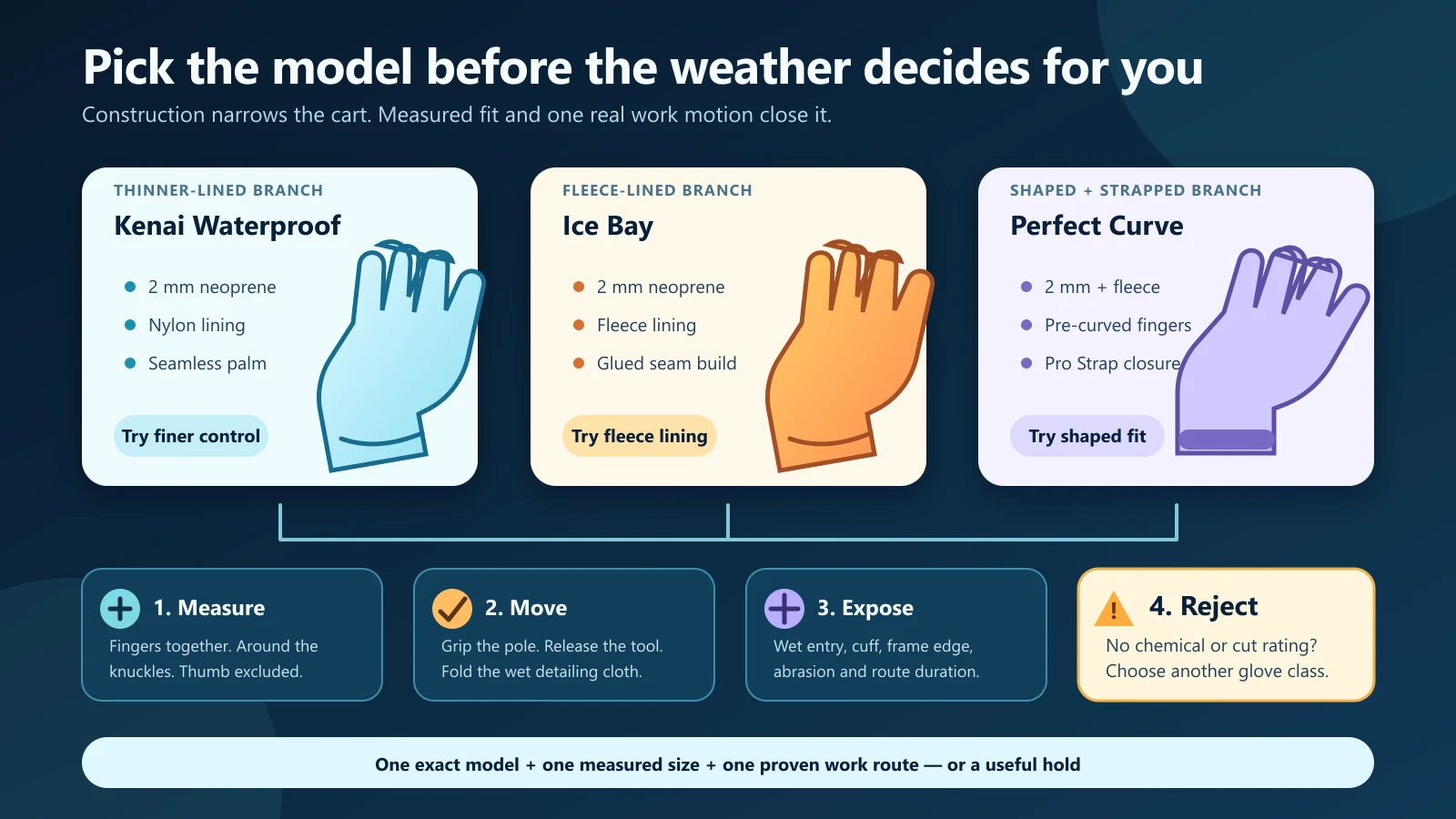
Use this as a candidate split. Kenai belongs on the try-on list when a nylon-lined 2 mm glove is the construction you want to evaluate. Ice Bay belongs there when fleece and its glued, blind-stitched build matter. Perfect Curve belongs there when the pre-curve and strap are relevant to the grip. Actual warmth, wet grip, control feel and fine movement have to be observed on the selected size and tools; they cannot be copied from the materials list.
Current specialist cart identities also need to stay attached to the model. WindowCleaner lists Kenai under part-number family 016BK and Ice Bay under 813BK. A receipt that says only Glacier gloves will not preserve which lining, shape or service part the crew expects next time.
Measure the working hand before choosing the lining
Glacier Outdoor’s current sizing method is simple: hold the fingers together, keep the hand flat, measure around the knuckles and do not include the thumb. Use that current official size chart for the selected model at the time of purchase.
Do not substitute a current work-glove label for that measurement. A large from another maker is not a hand dimension, and a loose glove that accepts a liner does not prove that the same model can still control a wet handle. Record five things on the order:
- left and right hand circumference if they differ;
- the hand that performs the finer detailing motion;
- the chart and date used;
- the selected model and size, including the complete part number where available;
- the return or exchange condition before the pair is exposed to water or soil.
The point is not to make tightness a virtue. The point is to make fit observable. On a clean try-on, the fingertips should reach their intended position, the palm should close around the actual handle without excess folds, and the selected closure should remain where the route expects it. If the glove changes the release, pinch or control motion, change the size or model before treating it as work equipment.
Waterproof does not finish the job description
Glacier Outdoor describes all three models here as 100% waterproof. For Ice Bay, the current page ties that statement to 2 mm fleece-lined neoprene and glued, blind-stitched construction. For Kenai, it names 2 mm nylon-lined TechLine neoprene and a seamless palm. Those are useful product facts.
They do not state how long a particular person’s hands remain warm, what happens when water enters at the opening, or whether a cuff sits inside or outside the sleeve used on the route. They also do not supply a performance result for a squeegee handle coated in a specific solution.
Treat waterproof as one row, not the verdict. Add:
- where the wet path reaches the wrist;
- whether the sleeve sends water into or over the opening;
- how long the wet/cold block lasts before a dry change is available;
- whether the user can still operate each required lock, buckle and tool release;
- where a dry spare pair will live.
No universal temperature cutoff belongs in that record unless the exact manufacturer publishes one for the selected model and task. Wind, exposure time, activity, individual circulation, fit and wet entry all remain job variables. A merchant review may describe one person’s day; it does not become a route rating.
Put the wear point on the same order line
Neoprene care starts before the wash. Glacier Outdoor’s current care guidance says to inspect for tears, punctures and fraying, and to avoid sharp objects. That matters on a window route because screen corners, frame hardware, tool edges and damaged glass can put wear where a fishing-product description does not.
Name the contact point. If the thumb-and-forefinger web rubs a screen frame all day, record it. If the fingertips pick hardware or fold abrasive debris into a cloth, record that instead. Inspect those areas before the route and before trusting the pair to keep water out the next day. A hole or separating seam moves the pair out of the waterproof route even if the rest of the glove looks new.
The current Glacier warranty excludes extended wear and tear, misuse, modification and caustic exposure. That makes service life an operating observation, not a promised number. Current WindowCleaner reviews include both satisfied users and reports of fingertip or thumb wear; those reports are reasons to inspect the actual route, not evidence that every pair lasts a fixed number of days.
Care also belongs to the purchase. The current owner calls for gentle hand washing in cold water with mild soap, flat drying in a ventilated area and no machine drying. Its longer neoprene-care guidance adds rinsing after use, avoiding bleach and high heat, air drying away from direct sun, and storing without hard folds. A crew that cannot dry the pair before the next shift needs another pair or a different rotation, not a more confident product claim.
Cleaning chemistry starts a different glove decision
Waterproof neoprene is not automatically chemical PPE. WindowCleaner’s current Ice Bay Q&A says the product is not tested or rated for chemicals and does not recommend it as chemical PPE. Glacier’s warranty also excludes damage from caustic substances. Those statements are more useful for this decision than a generic material phrase such as chemical resistance.
When the route uses more than ordinary water and the selected cleaning method, begin with the exact product label and safety data sheet. The chemical owner, concentration, contact time, splash route and employer’s hazard assessment must identify the glove material, thickness, breakthrough or change schedule and any other protection required. The site’s professional glass-cleaning solution guide keeps formula and surface permission with that separate choice.
The same boundary applies to cut hazards. A textured neoprene palm is not a cut rating. Broken glass, sharp scraper handling or a damaged frame requires the exact task’s documented protection and handling method. Do not layer an unrated glove into a new claim just because the combination feels thicker.
Let one pair earn one route
Choose a Kenai candidate when the exact current nylon-lined 2 mm model, measured size and wrist design are the construction you want to verify for the route’s grip and detailing movements. Choose an Ice Bay candidate when fleece lining and its published glued, blind-stitched construction match the shortlist, then confirm that the selected size can still perform the fine work. Choose a Perfect Curve candidate when pre-curved fingers and the Pro Strap belong to the actual handle and cuff problem, not simply because the model has more features.
Choose another glove class when the job needs a documented chemical, cut, impact or temperature performance that these current product owners do not provide. Hold the purchase when the model is unidentified, the hand was not measured, the required control cannot be operated on a clean try-on, or the wet path and wear point are still unknown.
Once those fields close, place the exact pair in the broader professional window-cleaning tool stack with its own care and replacement path. The useful record is not “Glacier gloves work.” It is “this model, in this measured size, keeps this hand capable on this one route—and stops before the next hazard.”