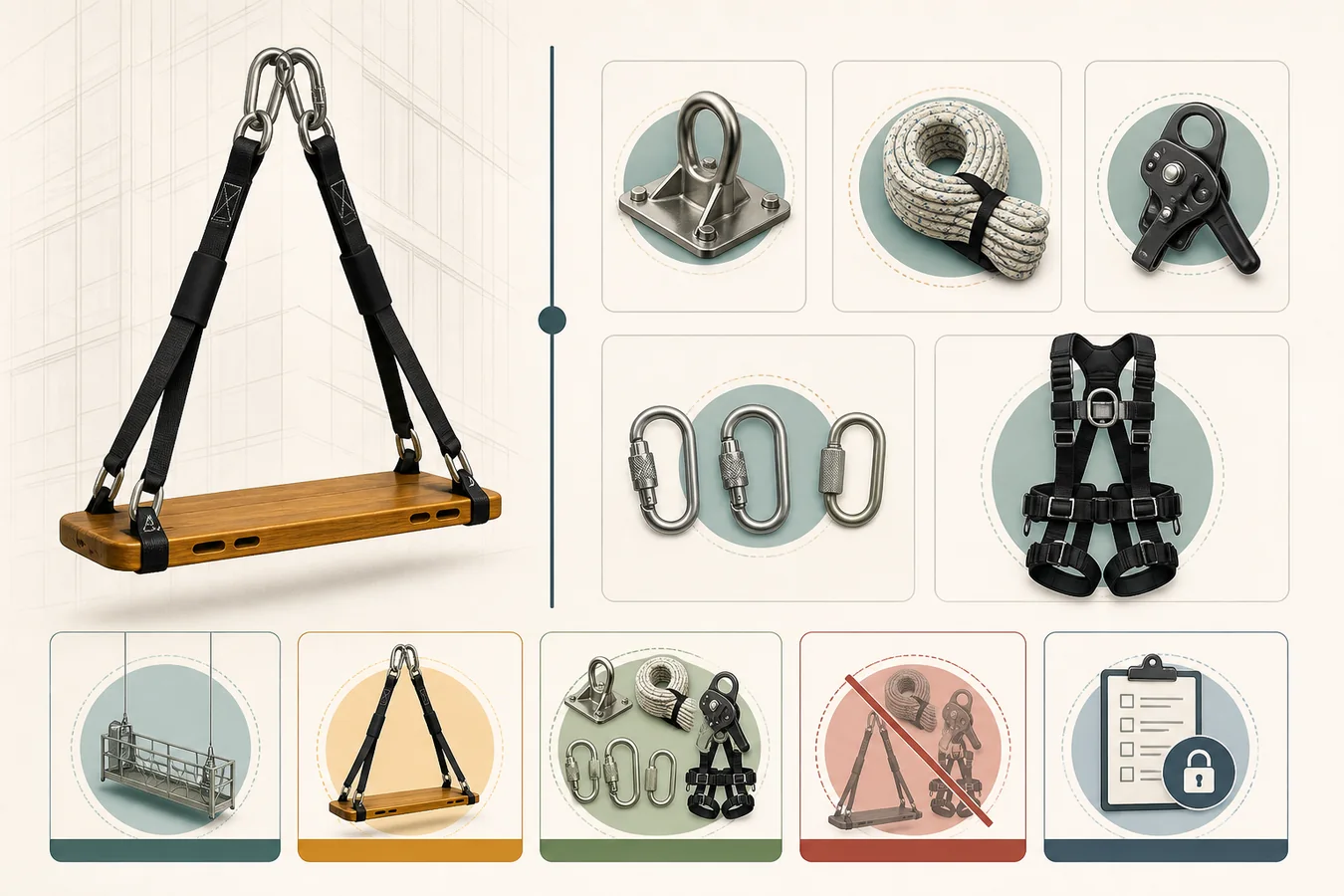
A product page can name the exact bosun chair and still leave most of the purchase unidentified. In OSHA’s current general-industry definition, the chair or seatboard is one usual component of a rope descent system (RDS), alongside the roof anchorage, support rope, descent device and connectors. The seat is not the system.
Before comparing two-point and four-point chairs, record what kind of suspended work the employer has actually authorized. OSHA separates RDS from industrial rope access systems (IRAS) and defines a scaffold as another class. A chair sold for suspension does not choose among them.
Then decide whether the cart is replacing one known chair inside an existing approved system or proposing a more complete system purchase. Those requests need different evidence. Both still need the exact model and current instructions, the rest of the working system, a separate independent personal fall-arrest system where 1910.27 applies, job-specific anchorage information, inspection, training and rescue ownership.
If the class or owner is unknown, do not solve the uncertainty with a more elaborate chair. The correct purchase result is another authorized access method or a hold with the missing owner named.
Put the cart in the correct system class before comparing seats
“Bosun chair,” “boatswain chair” and “rope access chair” are often used loosely in search results. The governing records are narrower. OSHA 1910.21 defines an RDS as a suspension system for controlled descent and stopping and says it usually consists of an anchorage, support rope, descent device, connectors and a chair or seatboard. The same definition expressly excludes IRAS, while a scaffold is separately defined.
OSHA’s 2020 interpretation to the International Window Cleaning Association confirms that an IRAS does not become an RDS merely because a worker can descend and stop. Other fall-protection provisions may apply, but 1910.27(b) is not the IRAS rule. That classification belongs to the employer and the responsible safety owner, not a merchant category.
| Recorded work class | What the chair page can do | What it cannot decide |
|---|---|---|
| Authorized RDS | Compare an exact chair or seatboard as one component inside the recorded RDS | Anchorage, support rope, descent device, connectors, independent PFAS, job approval or rescue |
| Authorized IRAS | Route the request to the exact IRAS plan and its owners | Re-label the system as RDS because a seat appears in the cart |
| Suspended scaffold or hoist system | Route to the applicable scaffold or hoist design and platform record | Treat an RDS chair as an interchangeable platform |
| Ground, ladder or another authorized method | Remove the chair from this job’s order | Create a suspended-access need from product availability |
This page starts after the work-method choice owned by the roof-harness and complete-system decision. It does not reclassify the job.
The seatboard is the 300-pound exception in the federal component rule
The most easily misused number is 300 pounds. Under OSHA 1910.27(b)(2)(vii), all components of a covered RDS except seatboards must be capable of sustaining a minimum rated load of 5,000 pounds. Seatboards must be capable of supporting a live load of 300 pounds.
That sentence does not give the whole RDS a 300-pound rating. It does not transfer 5,000 pounds to the chair. It also does not approve a product simply because a seller repeats one of the numbers. The exception tells procurement to keep the seatboard’s load record separate from every other component record.
| Purchase record | Evidence that must stay attached | Why the chair card cannot replace it |
|---|---|---|
| Seatboard | Exact manufacturer/model, current instructions, stated load scope, two- or four-point interface, inspection and current condition | The federal number is not an exact-model identity or condition report |
| Worker and secured tools | Worker, clothing and all carried or secured equipment under the employer’s load method | A nominal seatboard figure does not calculate the actual job load |
| Working RDS | Support rope, descent device, connectors and compatibility owned by the approved system | A seat cannot lend its rating or instructions to other components |
| Anchorage | Written building-owner information and the responsible job record where 1910.27 applies | A product photo cannot identify or certify the building connection |
| Independent PFAS | A separate anchorage, body-support and connector system with its own owner | The working chair and support rope do not become independent fall arrest |
| Operation | Manufacturer limitations or qualified direction, trained user, pre-shift inspection, prompt rescue and secured tools | A fresh purchase does not supply the trained operation and rescue record |
The roof-anchor record owns the structure and anchorage evidence. Where the approved rope path meets an edge, the rope-protector decision owns that separate contact problem. Neither fact is supplied by the chair’s point count.
Two-point and four-point names identify models, not a winner
Point count is useful only after the system class and owner close. It identifies how a particular chair is configured; it is not a universal “safer/better” scale.
Sky Genie’s current Bosun’s Chairs category separates two-point models such as BC-2 and BC-2U from four-point models such as BC-4 and BC-4U. The suffixes also distinguish padding, belts or adjustable straps. A search result that stops at “Sky Genie chair” has not preserved the exact product.
MIO’s current family matrix likewise lists separate window-cleaning models. The manufacturer describes BCW4-EXP and BCW4-EX as four-point designs intended to provide added stability, and SBW2-EXP and SBW2-EX as two-point designs that allow the chair to tilt more easily for extended reach. Those are manufacturer-stated roles for that family—not permission to choose point count without the system owner.
| Current manufacturer record | Identity fields worth preserving | Question returned to the system owner |
|---|---|---|
| Sky Genie BC-2 / BC-2U family | Exact suffix, two-point identity, belt, pad or strap configuration and current instructions | Does this exact chair and interface belong to the recorded RDS? |
| Sky Genie BC-4 / BC-4U family | Exact suffix, four-point identity, included accessories and current instructions | Are all required connections and roles owned by the existing system record? |
| MIO SBW2-EXP / SBW2-EX | Exact two-point window-cleaning model, padding, back-support and tool-holder configuration | Is the manufacturer’s handling description compatible with the approved task and system? |
| MIO BCW4-EXP / BCW4-EX | Exact four-point window-cleaning model and configuration | Does the approved system call for this exact interface rather than simply “more stability”? |
Padding, a belt, tool holders and bucket clips can change an exact SKU. They do not complete the descent system or the separate fall-arrest system. Tool holders also do not replace the employer’s requirement to secure equipment against falling.
A chair listing and a system listing answer different purchase requests
Sky Genie’s current catalog makes the distinction visible. Its Bosun’s Chairs category lists individual chairs and replacement accessories. Its Bosun’s Chair System listing separately asks the buyer to select a chair and a rope length. A chair-only listing and a system listing therefore do not describe the same cart.
For a chair-only request, procurement should already hold the exact approved RDS identity and ask whether the replacement chair, interface and current instructions belong to it. If any component substitution changes the system record, the responsible owner must close that change before order.
For a complete-system request, a bundled chair and rope still do not decide the building anchorage, independent PFAS, job applicability, inspection, training or rescue. “System” in a product title describes the seller’s package; it is not a verdict that the job is ready.
Chair-only record: existing approved RDS owner + exact current system identity + exact replacement chair model, interface and instructions + load and condition record.
Complete-system record: authorized RDS method + every proposed working component + separate PFAS + anchorage evidence + exact chair + load, inspection, training and rescue owners.
If neither line can be completed, the missing record—not the catalog—is the next destination.
Five order outcomes keep the missing owner visible
| Outcome | Evidence that closes it | Procurement action |
|---|---|---|
| Alternative access or different system class | The authorized plan is ground or ladder work, IRAS, suspended scaffold or another non-RDS method | Remove the RDS chair from this order and route to that method’s owner |
| Exact chair-only component candidate | Existing approved RDS, exact chair model, interface and instructions, seatboard load, compatibility and current condition all agree | Request only the named replacement; do not substitute from appearance |
| Exact complete RDS-system candidate | Authorized RDS plus every working component, anchorage evidence, separate PFAS, load, inspection, training and rescue owners close | Preserve the complete record for responsible-owner approval before order |
| Wrong class or wrong model rejected | Product belongs to another system class, family, interface or instruction set | Reject the item even if its generic name and capacity look plausible |
| Qualified-owner confirmation or hold | Class, authority, anchorage, system component, independent PFAS, model, load, condition, training or rescue remains unresolved | Name the gap and keep the purchase unplaced |
Keep the final chair-to-system record beside the professional window-cleaning equipment plan. A chair becomes orderable only when its exact identity and every system owner describe the same authorized job.