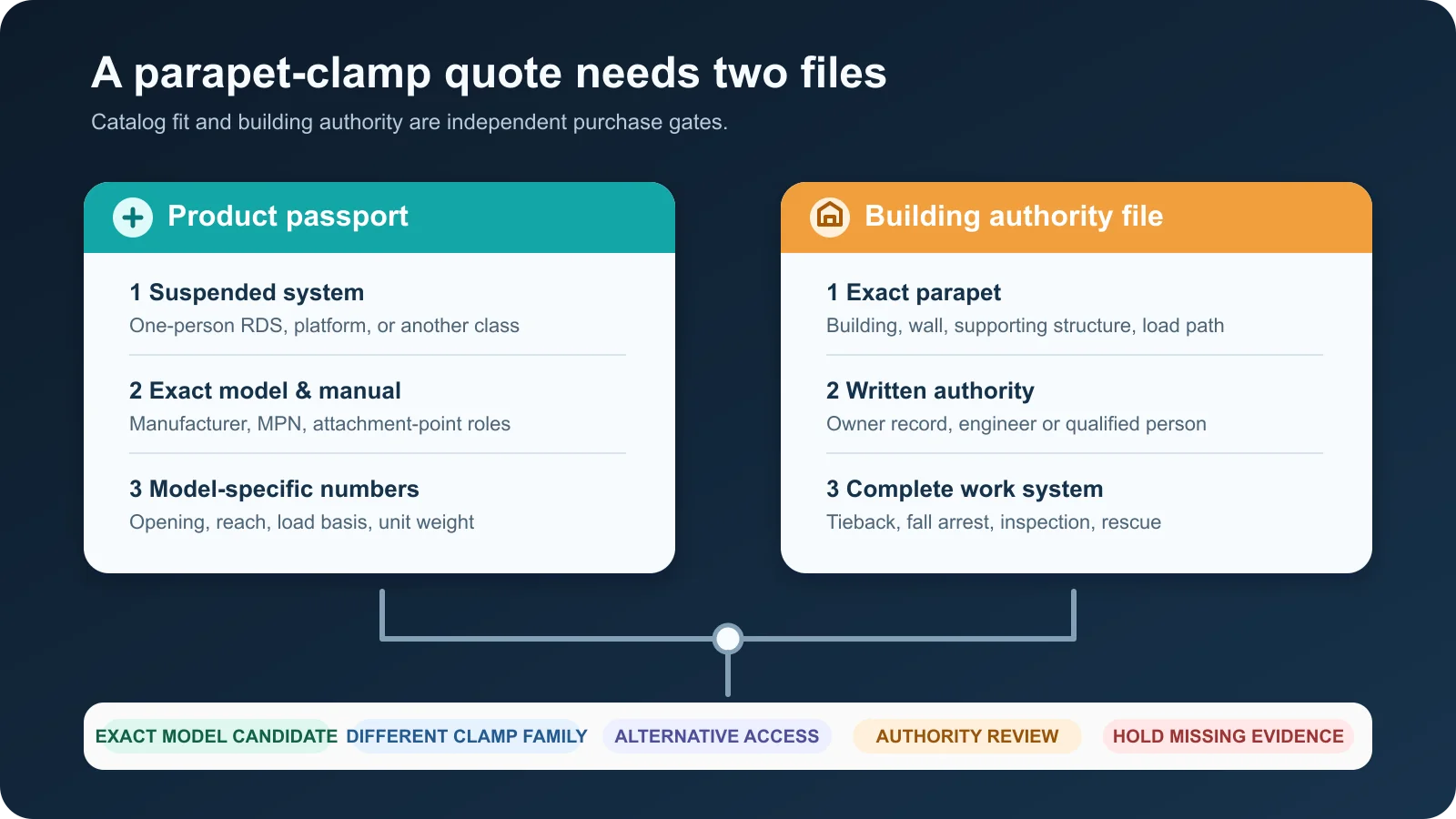
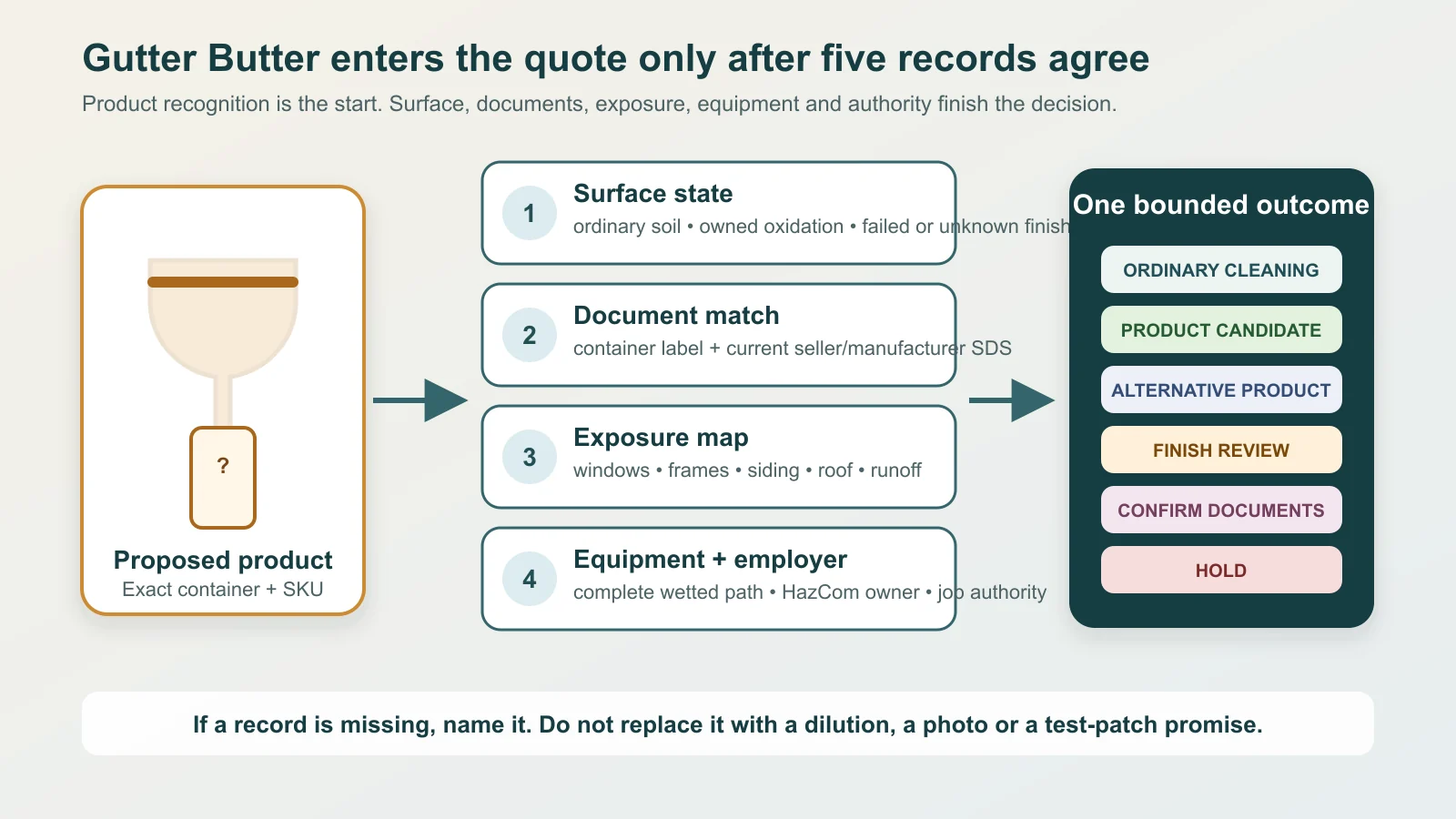
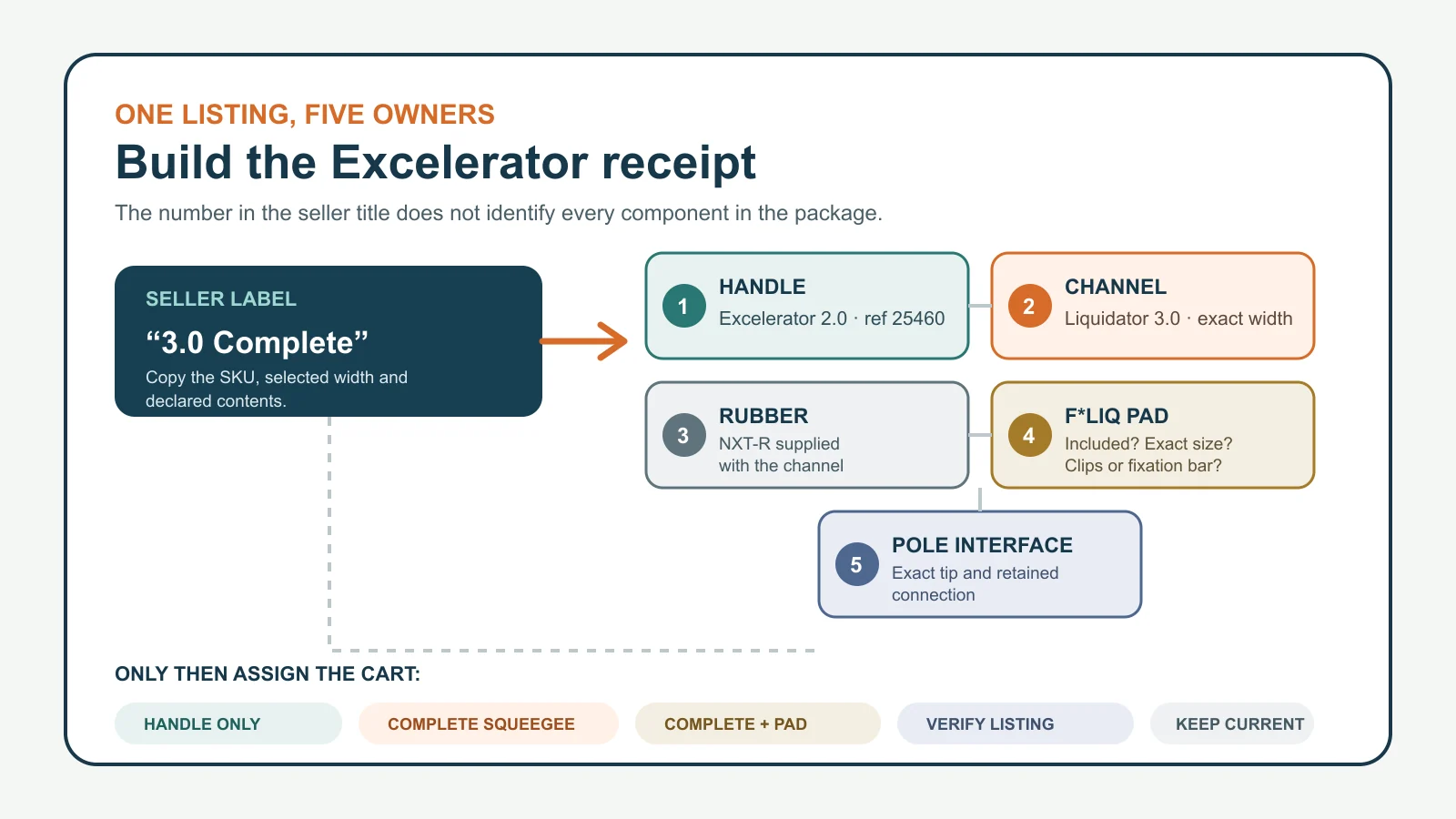
A buyer can place four white pads in one cart and accidentally order four different tools: a 6-by-9-inch pad sold for stain-removal products, a 25-centimeter hook-and-loop pre-cleaning pad, a thick industrial hand pad, and a 17-inch floor-polishing disc. The checkout page may group them by color. A window-cleaning work order cannot.
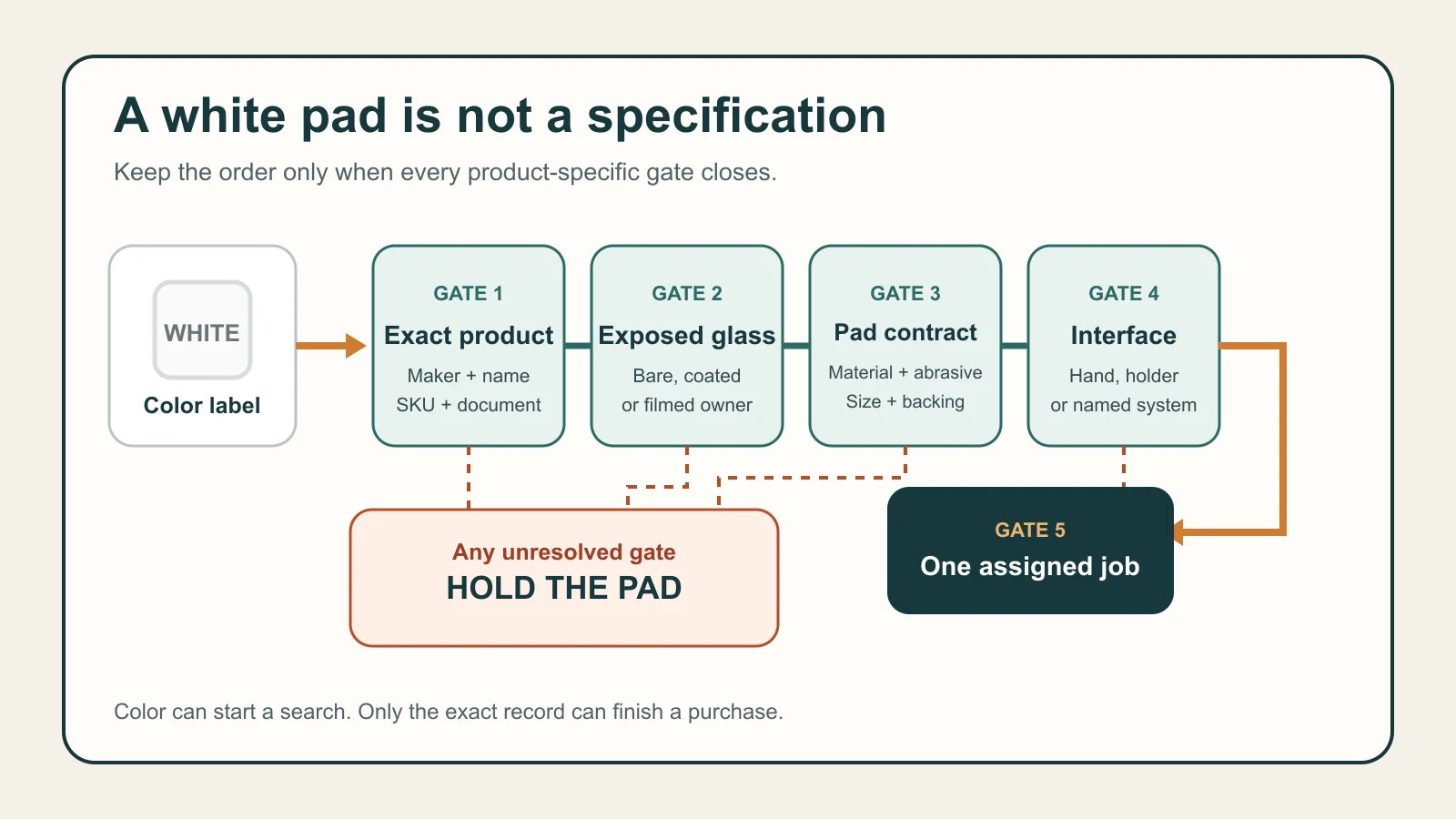
Keep a candidate only when the manufacturer and product number, declared pad construction, exposed-glass owner, physical interface and one assigned job are all known. If the listing gives you only white, soft or non-scratch, the product record is unfinished.
This is a specialty line inside a professional window-cleaning tool setup. It is not the default washer, brush or cloth, and it does not inherit permission from another white product.
Four white products do not make one category
The useful comparison is not which pad looks gentlest. It is what each current owner actually publishes.
| Exact owner | Product record | Size and interface | Documented role | Do not transfer |
|---|---|---|---|---|
| XERO | White Scrub Pad, SKU 209-15-34-XP | 6 x 9 inches; the inspected page does not close a named holder | Applying paste or powder stain-removal products | Glass claim, backing or fit to another anonymous 6 x 9 pad |
| Unger | OPS20 Scrub Pad, white | 25 cm, 100% polyester, hook-and-loop path to PHH20/PHD20 | Water pre-cleaning for firmly adhering dirt | Fit to another holder or a generic water-fed pole |
| 3M | Scotch-Brite 350 Hand Pad | 95 x 158 mm, 28 mm; hand use or Twist-Lok 961 | Wet or dry cleaning of named delicate surfaces including glass | Regional availability or permission for every installed glass product |
| 3M US | Scotch-Brite 7445, product 7000000727 | 6 x 9 inches; hand, hand-block or named industrial equipment paths | Mild, super-fine abrasive cleaning with nepheline syenite | Equivalence to XERO, Unger or a pad sold only by color |
The XERO page calls its exact item soft and describes glass use. Unger calls OPS20 abrasive, assigns it to firmly adhering dirt and recommends water. The 3M 350 technical sheet identifies polyester fiber, a dedicated soft mineral and polymer resin. The 3M 7445 US page identifies a different mineral and says its performance is similar to grade-0000 steel wool. Those statements can coexist because they describe different products.
That last comparison does not collapse 7445 into steel wool. Grade, rust and glass permission for 0000 steel wool remain a separate decision. The point here is narrower: a color word cannot carry the construction, abrasion or care record.
The floor pad is the useful wrong answer
3M also sells a White Super Polish Pad 4100. The current US product owner describes a round 17-inch pad for light floor cleaning, spray cleaning and dry buffing with a rotary machine. It shares a color with the small hand pads and little else that completes this purchase.
This is why cutting a white pad to fit a holder is not a neutral shortcut. The new shape may fit mechanically while the original product still belongs to a different machine, surface or chemical system. A usable product name survives cutting; a color label does not.
The same caution applies to unlabeled pieces carried in a bucket. Once the packaging and SKU are gone, the operator may no longer know whether the piece is XERO, OPS20, 3M 350, 7445 or something else. Appearance cannot reconstruct the missing owner.
The exposed glass can veto the pad
A pad maker owns the pad statement. The glass, coating or film maker owns the exposed surface. Both must admit the contact.
Vitro’s current architectural-glass guidance starts routine cleaning with clean water, mild nonabrasive solution and a nonabrasive applicator. For coated glass, it specifically does not recommend abrasive cleaners. That rule is narrower than a seller’s broad glass claim and therefore changes the purchase.
Write the cleaning-side surface, not simply window. Bare architectural glass, an exposed factory coating, applied film and flexible glazing are different records. If applied film is present, the separate tinted-window-cleaner decision owns the film and care document. If the visible layer cannot be identified, use SURFACE_OWNER_REVIEW; do not let a white-pad listing supply the missing permission.
A small area can record the result after permission exists. It cannot convert an unknown coating into bare glass or broaden one manufacturer’s claim to another product. The same principle keeps a melamine Magic Eraser and a metal scraper in their own evidence paths.
The holder is part of the order
A loose pad and a complete pad system are different purchases. The exact dimensions, backing and attachment method decide whether the pad can be controlled by hand, a handheld holder, an indoor pole head or a water-fed accessory.
Unger publishes OPS20 at 25 centimeters and names PHH20 and PHD20 as its hook-and-loop holders. Its current product-assortment catalog lists each holder at 24 centimeters. That one-centimeter difference is part of the manufacturer’s system record, not evidence that any pad slightly wider than a holder will work.
Unger creates another exact branch for the nLITE Scrubber. Its sell sheet identifies NLSPH as the holder supplied with five pads, names OPS20 as the replacement pad and ties the assembly to nLITE water-fed poles and Gen 2 angle adapters. A normal OPS20 cart line therefore still needs the intended holder path; the pad SKU alone does not choose between handheld, indoor holder and nLITE work.
The 3M 350 sheet separately names Twist-Lok 961 as an optional holder and permits hand use. XERO’s inspected page gives a 6-by-9-inch product but does not close a named holder. Record that field as unknown instead of borrowing an interface from another 6-by-9 pad.
If the ordinary job is loose soil or routine washing, a window-cleaning brush or washer may already own the work. Extra reach does not promote a pad either; the exact pole and angle adapter still have their own connection and operating boundaries.
Write one job on the order line
The order can finish in five places. None requires ranking every pad on the market.
| Outcome | Use it when | Minimum record | What happens to the cart |
|---|---|---|---|
EXACT_WHITE_PAD_CANDIDATE |
Product owner, surface owner, job and interface agree | Maker, SKU, document, material/abrasive, size/backing, holder, surface, soil, liquid and care | Keep that exact line for the named job |
USE_EXISTING_WASHER_OR_MICROFIBER |
Owner-approved routine cleaning covers the soil | Existing method, surface and care owner | Remove the specialty pad |
DIFFERENT_SPECIALTY_PAD_REVIEW |
The named soil needs another documented system | Exact remaining condition and next product owner | Move to the separate steel-wool, melamine, scraper or restoration decision |
SURFACE_OWNER_REVIEW |
The exposed coating, film or glazing is unknown or restrictive | Window/glass identity and current care document | Hold contact products |
HOLD_UNIDENTIFIED_PAD |
The piece has no recoverable maker/SKU or construction | Missing identity field | Discard it from clean-glass assignment or keep it quarantined from the route |
Care stays attached to the chosen product. The 3M 350 document says to rinse the pad after use and use a nylon brush for deeply embedded soil when needed. It does not give every white pad the same washing method or a guaranteed reuse count. Contamination, wear and delivered identity remain observations for the exact piece.
An acceptable order entry can be concise: Unger OPS20; 25 cm; 100% polyester; PHH20 handheld path; water; firmly adhering dirt; exact glass owner permits the method; rinse path retained; one pre-cleaning role. A line that says only white non-scratch pad is not an equivalent shorthand. It is a color description with the decision fields missing.