Open three current product pages and the word scrim stops being a useful readiness signal. Windows101’s Scrim Polishing Cloth, SKU L176, says it needs to be boiled in water before use. The NICE Scrim page recommends washing before use. A UK retailer’s Unger SCRMW listing says its pre-washed cloth is ready straight from the pack.
Those are three instructions for three exact products, not a contradiction you should average into a home-made washing rule. They also do not create three immediate buying options for a US operator: both US scrim pages observed for this article showed sold out, while the ready listing is from a UK seller.
The fast answer is therefore product-specific. A first-use instruction means the cloth still needs that preparation. A sold-out or region-mismatched listing cannot close today’s cart. Keep a verified clean microfiber or huck cloth in the detailing role until one exact scrim has a closed product identity, usable preparation path and current US availability.
This is one narrow cloth decision inside a larger professional window-cleaning tool setup. It does not decide how many towels a route needs, promise a lint- or streak-free result, or turn a seller’s product description into a field test.
The first-use line outranks the word scrim
Treat scrim, linen and pre-washed as identity clues. None of them answers every readiness question.
The first-use line is the decisive field because it tells you what the seller expects between delivery and clean-glass duty. On the observed Windows101 L176 page, that line says to boil the cloth in water before use. On the NICE page, it says to wash before use, with a seller Q&A recommending that the first wash be separate. The UK SCRMW seller describes that exact item as pre-washed and ready from the pack.
Do not move an instruction from one row to another. Boiling L176 does not become a rule for NICE. The low-temperature wash and air-dry guidance published for the UK SCRMW listing does not fill the care blank on an unrelated product. Even two products described as pre-washed may differ in material, dimensions, grade, hem, treatment and what the seller means by ready.
Also separate washed state from current state. A product can be seller-declared ready yet unavailable, or available but still require first-use preparation. The usable-now result needs both.
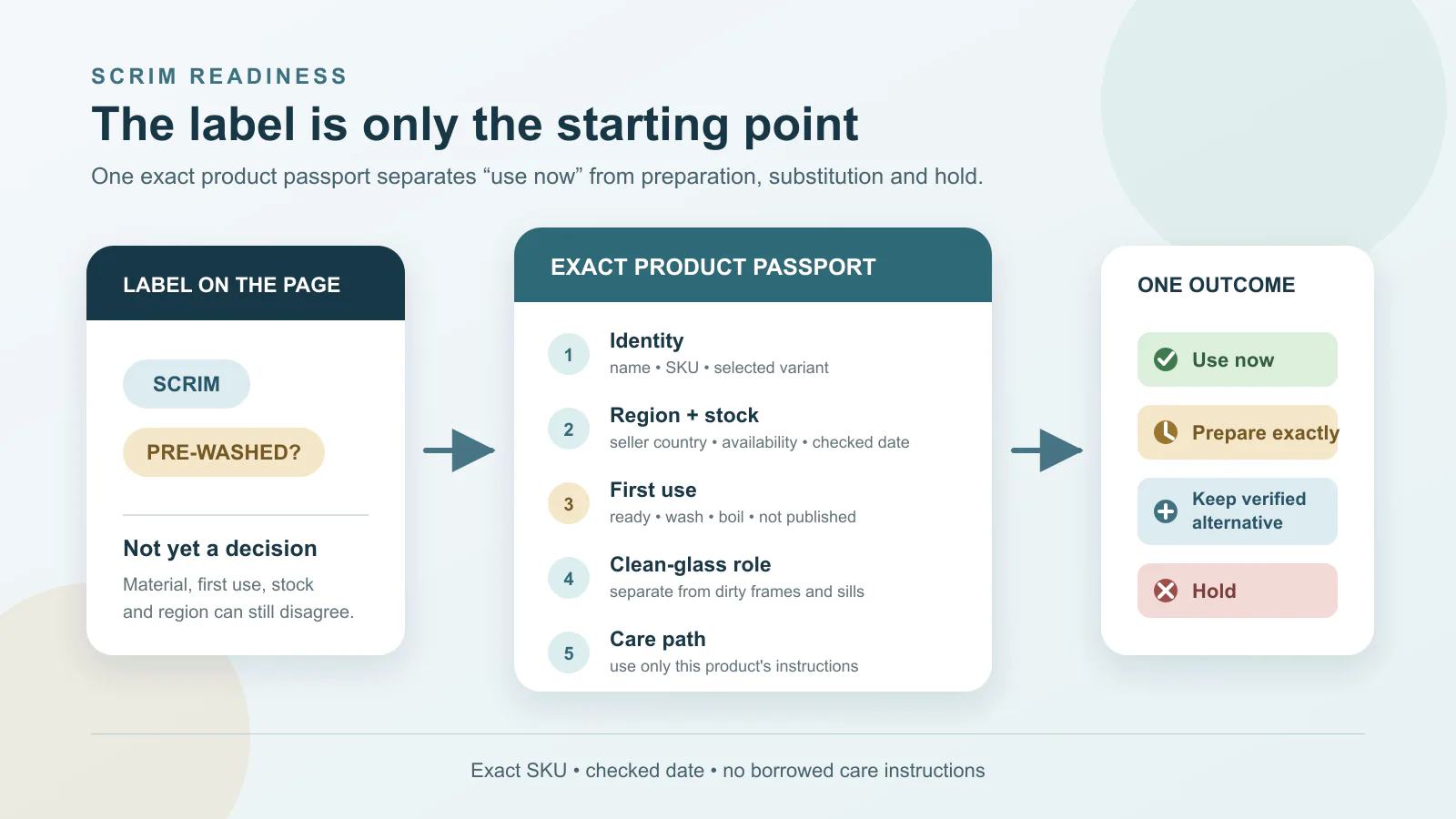
Give the exact cloth a product passport
Use one row for the product currently on screen. If the page offers standard and pre-washed variants, the chosen variant gets its own row; do not combine the best fields from both.
| Passport field | What to copy | Why it changes the decision |
|---|---|---|
| Exact identity | Product name, SKU and selected variant | Prevents care, dimensions or washed state from drifting across products. |
| Seller and region | Store, country and shipping destination | A ready UK listing is not automatically a ready US purchase. |
| Availability | In stock, sold out, back order or not verified, with the check date | Stock can overturn an otherwise suitable choice. Reopen it at checkout. |
| Material and grade | Only the fiber and grade explicitly published for that SKU | These identify the cloth; they do not create a universal performance score. |
| Dimensions and hem | Published size and edge construction | Size affects handling. Hem and post-wash dimensions remain unknown when the page is silent. |
| Published washed state | Standard, pre-washed or not published | This is a product field, not a category property. |
| First-use instruction | The exact boil, wash, dry or ready wording | Any required step keeps the product out of the use-now outcome until completed. |
| Declared task | Glass detailing/polishing versus frames, sills or general wiping | Clean-glass stock needs a deliberate assignment rather than every task listed on a sales page. |
| Care path | Product-specific washing, drying and surface warnings | A cloth needs a documented route back to clean stock after use. |
Not published is a valid passport entry. If an L176 page does not publish grade or hem, keep that wording; the missing field is not permission to copy Grade 1 or four-sided hem from another listing. If the product name or variant changes in the cart, start a new passport.
The result is use now only when an exact product is purchasable in the buyer’s region, the seller declares it ready, the clean-glass task is closed and the care path is usable. A published boil or wash step changes the result to prepare exactly. Region, stock or essential instruction gaps route to an existing verified alternative or a hold.
Current listings lead to different outcomes
The comparison below records what the pages published on August 9, 2026. It is not a performance ranking, and stock must be reopened before purchase.
| Exact page | Identity fields the page closes | First-use and current availability | Supported decision for a US buyer |
|---|---|---|---|
| Windows101 Scrim Polishing Cloth, SKU L176 | 27.5 × 27.5 inches (70 × 70 cm); seller assigns it to cleaning and polishing glass. Grade, hem and explicit fiber composition are not published fields on the observed page. | Need to be Boiled in water before use; sold out on the observed US page. | Hold this product now. If the same SKU returns, the page supports buy and boil exactly as directed, not use straight from the package. |
| NICE Scrim, SKU 345-15-01 | Seller lists genuine linen, 32 × 32 inches and detailing/polishing plus frame/sill uses. Grade and hem are not published. | Seller recommends washing before use and says the first wash should be separate; page showed sold out. | Hold this product now. If restocked, it remains a prepare-first item under its own instructions. |
| Unger SCRMW Grade 1 pre-washed scrim | UK seller lists 100% linen, Grade 1, 36 × 36 inches / 92 × 92 cm and four hemmed sides. | Seller listed it in stock, pre-washed and ready from the pack; the same page gives low-temperature wash, small-detergent, air-dry and rough-surface guidance. | Technically closed by this seller, but not a default US cart. Verify international shipping, landed cost and the exact current listing before treating it as available. |
| Impact Professional Window Scrim, code WINCLO0 | Seller offers a standard 91 × 91 cm variant and a pre-washed 75 × 80 cm variant. | Variant names are published, but material, grade, hem, first-use care and a ready claim are not. | Hold the readiness claim. The variant selector alone does not close enough fields for use now. |
Notice what the word pre-washed did not settle. The Impact variants even publish different dimensions. The UK SCRMW page closes material, grade, hem and care; the other pre-washed option does not. A label can reduce first-use uncertainty for one SKU without making the products interchangeable.
Price is intentionally absent from the decision above. It changes quickly and cannot rescue sold-out stock, missing preparation evidence or a region mismatch. Check price only after the passport reaches a usable outcome.
Keep dirty work out of the clean-detailing decision
A seller may describe one cloth for polishing glass, wiping frames and soaking water from sills. That describes possible uses for the model. It does not keep one physical cloth clean while it moves through all of them.
For this decision, give the scrim one declared job: clean-glass detailing or polishing after the main wash-and-squeegee pass. If it enters a dirty frame, track or sill task, move that physical cloth out of clean-detailing stock until it has completed the exact product’s care cycle. Do not call it ready because unused sections still look dry.
This boundary also changes what you buy. An operator who already owns a verified cloth for dirty pickup does not need the scrim to cover that role. Someone whose only towel will rotate between muddy sills and final glass has an inventory-state problem that a premium material label cannot solve.
The UK SCRMW seller warns that dry rough surfaces such as concrete sills can snag that exact cloth. That warning belongs to SCRMW, but it illustrates the value of preserving the clean-glass assignment: dirty or rough work can create a different care and replacement problem from detailing. Do not extend the warning to products whose pages do not publish it.
A US cart can be blocked by stock before cloth type
On the observation date, both US exact scrim pages in this research were sold out. The most fully closed ready listing was from a UK retailer. That does not prove scrim is unavailable everywhere in the United States; it proves these pages cannot authorize a ready US purchase today.
Do not solve the gap by buying a product with a similar photo or by assuming an unwashed listing will accept another brand’s preparation routine. There are two safer branches.
If the route already has a clean detailing cloth with verified product-specific care, keep it in service. The site’s window-cleaning microfiber cloth guide explains how to choose by assigned job and care rather than pack size. A verified huck cloth can also remain the temporary owner when its exact product and care path are already known. This is continuity, not a claim that microfiber or huck always outperforms scrim.
If the cloth role itself is missing, keep the row open in the starter-kit audit instead of turning an unavailable scrim into an emergency purchase. The broader professional tool setup still needs a clean detailing owner, but it does not require that owner to be scrim before the exact evidence closes.
Recheck only the earliest fact that can change the result: stock for a known product, shipping for a region mismatch, or first-use instructions for a newly found SKU. A stock change on L176 would move it from hold to prepare exactly; it would not erase the published boiling step.
Save one sentence that can survive a product-page change
Finish the decision in one line:
For [exact product and SKU] sold by [seller/region], availability is [current state checked on date], the page says [washed state and exact first-use instruction], and I will assign it to [clean-glass task]; therefore I will [use now / prepare exactly / keep my verified alternative / hold].
For the observed Windows101 page, that becomes: “For Scrim Polishing Cloth L176 sold by Windows101 in the US, availability was sold out on August 9, 2026, and the page says to boil it before use; I would assign it to clean-glass polishing, so I will keep my verified alternative and recheck this SKU rather than buy a substitute by label.”
A genuine use-now sentence needs no missing clause. If the seller cannot confirm the exact SKU, availability or first-use state, save the question instead of inventing the answer. If the page changes, update that single sentence and the passport row; the rest of the cloth category does not need to be rewritten.